

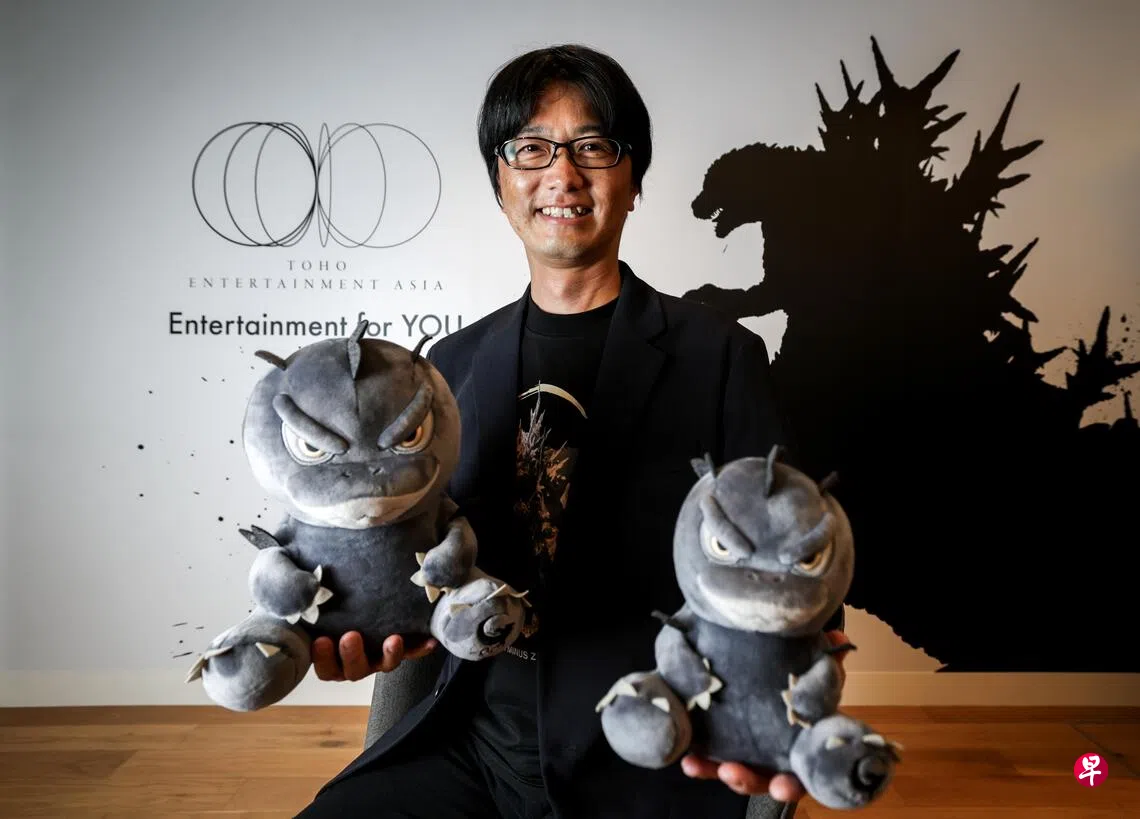
Compared with the deafening roar of its star monster Godzilla, TOHO Entertainment Asia has made a quiet entrance into Singapore, steadily building its business with little fanfare. Part of Japan’s long-established film company Toho Group, it was set up in Singapore in November 2024. Its business spans intellectual property and screen content licensing, merchandise and marketing. Besides managing the flagship Godzilla brand, it is developing business opportunities in Asia for Toho’s anime titles. Godzilla Minus Zero, which opened in Singapore in early November, is being distributed directly by TOHO Entertainment Asia.
In an exclusive interview with Lianhe Zaobao (LHZB), TOHO Entertainment Asia Managing Director Fabio Takamichi Murayama, 48, shared his journey from childhood Godzilla fan to Toho executive. He also explained how the team uses Singapore as a base to listen to audiences across the region and tailor its expansion to local markets.
Speaking about his connection with Godzilla, Murayama recalled an episode from his childhood. After watching a Godzilla film with his family, he spotted a Godzilla plush toy in a Japanese department store that made the monster’s familiar roar. Still caught up in the excitement of the film, he could not put it down. He begged his parents to buy it and got his wish, taking it home.
“Before I knew it, Godzilla had become a constant presence in my life. What I remember is not just the film, but everything around it: going out with my family, choosing a toy and taking that excitement home. The fun continued after we left the cinema.”
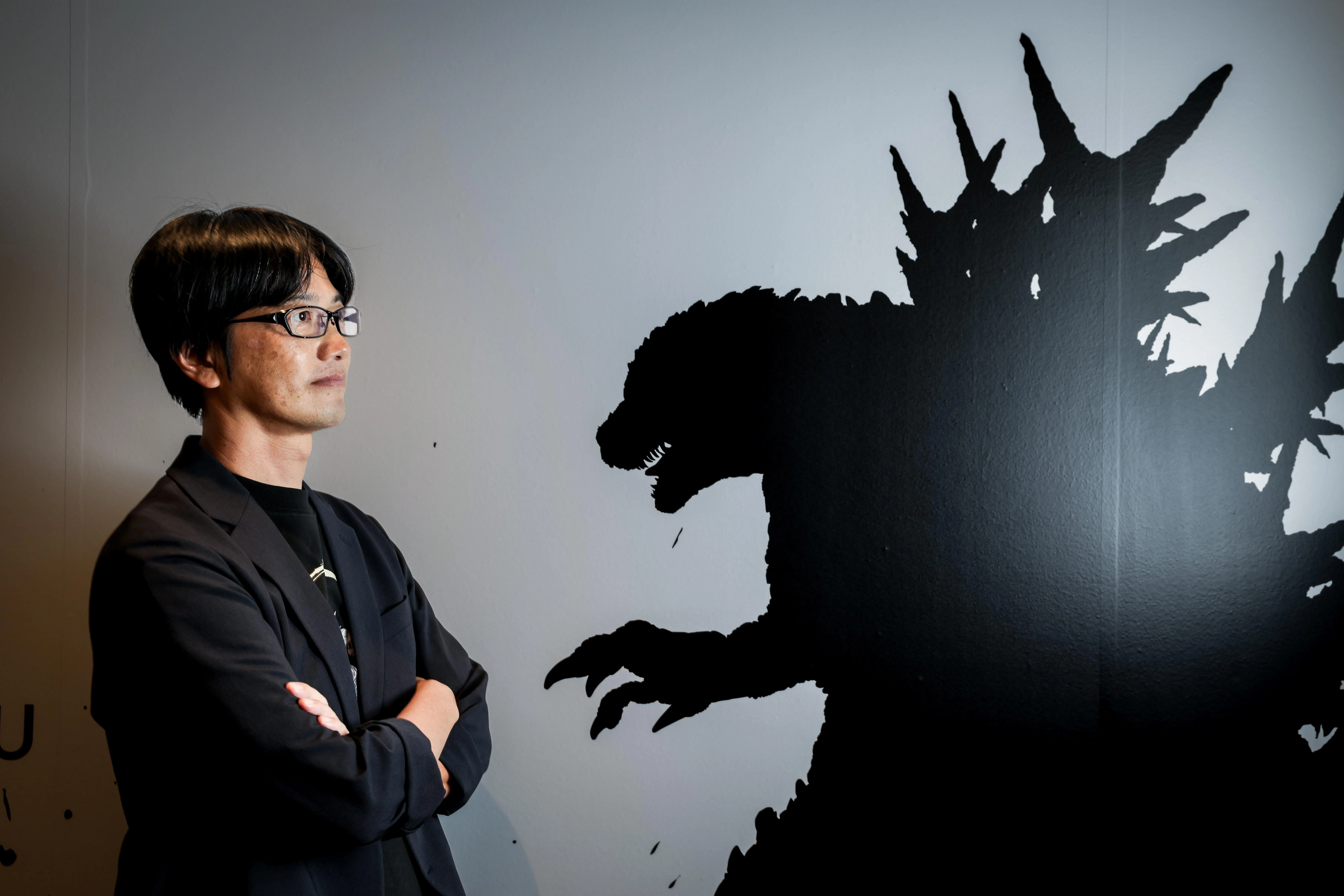
Years later, that childhood fan became managing director of TOHO Entertainment Asia, helping to bring Godzilla and other Toho titles to audiences across Asia. Back then, a film and a toy had carried his joy from the screen into everyday life. Now, he hopes to bring more audiences closer to these works through films, merchandise and a range of experiences.
For Murayama, introducing classic works to a new generation involves thinking beyond the films themselves.
“I am grateful that Godzilla is still loved across generations and around the world. Each generation connects with Godzilla through films, merchandise and many other experiences. At TOHO Entertainment Asia, we now have the joy and privilege of building those connections with fans directly and with great care.”
As he moved from being a fan to working behind the scenes on the business, his understanding of Toho deepened. Before joining the company, he worked in licensing and merchandise planning and development, and had already had dealings with Toho. Only after becoming part of the company did he gain a fuller understanding of what underpins its longstanding reputation: the care it gives each work, its commitment to the creative vision of every project and its long-term approach to business decisions.
Working for a company whose films he had known since childhood, and helping shape its next phase of growth in Asia, holds particular meaning for him.
Expanding in Asia starts with listening
In its two years of operations in Singapore, TOHO Entertainment Asia has grown from three people to more than 20 and gradually established a regional distribution network.
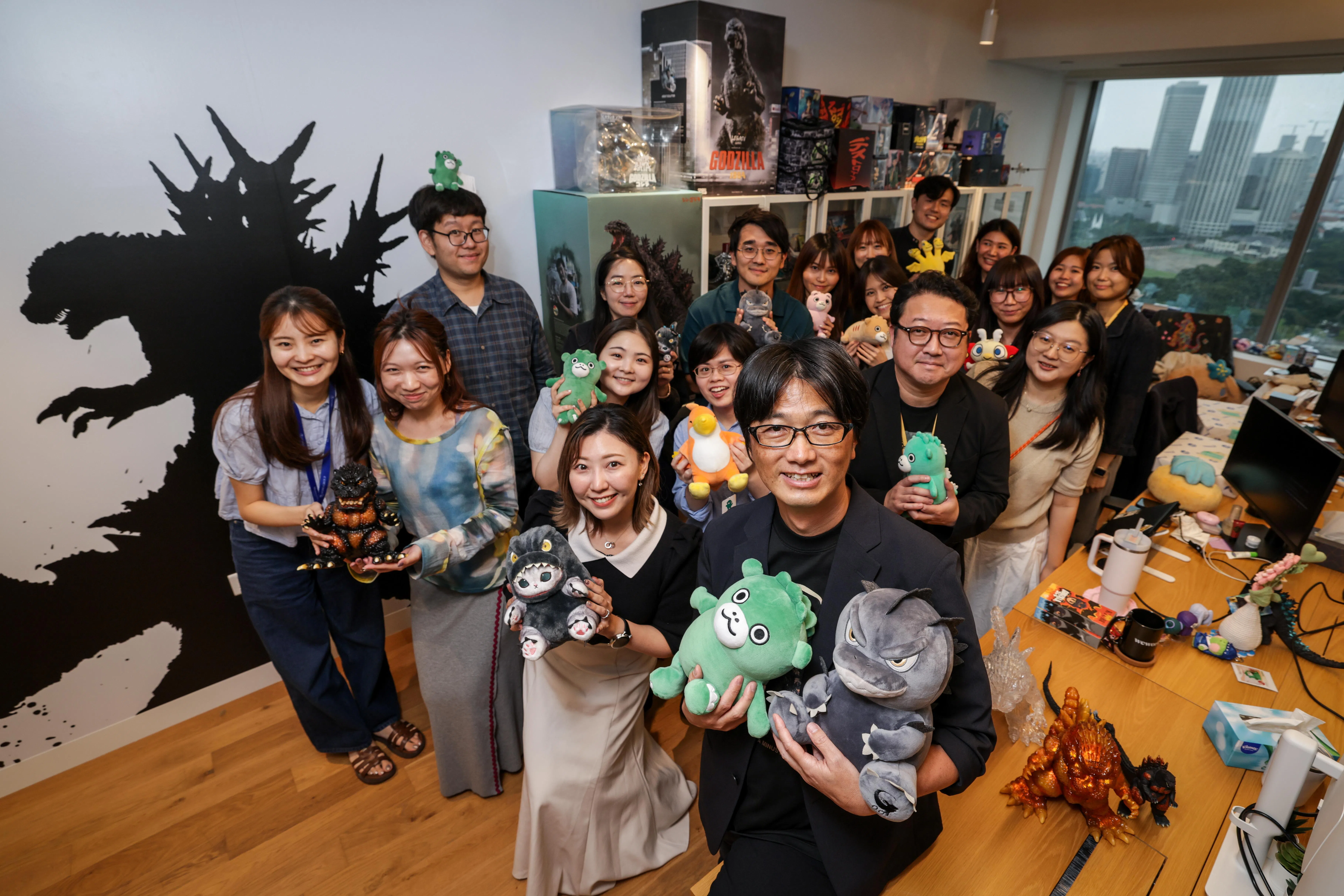
Asked which achievement he is proudest of, Murayama said: “The company now has the capability to distribute films directly in Singapore, the Philippines and Taiwan.”
For a young company, he explained, every step — from assembling a team to earning the trust of local partners — requires considerable effort. Being able to bring films directly to audiences through this network is the result of the team’s collective work.
Building a distribution network is only one step, however. Putting a regional growth vision into practice across different markets has proved harder than he expected. “An approach that works in one place will not necessarily work in another.”
Everything from marketing campaigns to the way the company works with partners must therefore be tailored to local conditions. In his view, the essential first step is to respect local cultures, customs and the things that matter to people. “That is why the knowledge of our local team and partners matters so much. My role is to make sure we listen to that knowledge and turn it into decisions and action.”
Fans decide a work’s value
That is the real voice of fans, and it is what I value most. It is not us who decide the true value of a work. It is the fans. — Fabio Takamichi Murayama
Living in multicultural Singapore gives Murayama more opportunities to hear directly from audiences of different backgrounds. Through face-to-face conversations with partners, colleagues and fans, he learns not only which films, characters or events they like, but also what draws them to them. These subtle, specific reasons are often hard to grasp from a report alone.
“That is the real voice of fans, which is hard to pick up from a report alone, and it is what I value most. It is not us who decide the true value of a work. It is the fans.”
These conversations have also shown him that people discover Japanese entertainment in different ways. Some start with films, others with anime, while others are first drawn to merchandise.
A fan he met at an event told him that even someone unfamiliar with the original work might be drawn to a cute plush toy, then go on to discover the story behind it. And fans of the same work may not share the same expectations. These are all differences the team must consider when introducing a title to audiences.
He stressed, however, that insights gained in Singapore cannot represent all of Asia. To understand audiences elsewhere, the team still has to visit different markets and stay in close contact with local partners.
An award alone will not fill cinemas
Returning to Godzilla, the attention surrounding Godzilla Minus Zero owes much to the foundation laid by 2023’s Godzilla Minus One. Its predecessor beat several Hollywood blockbusters to win Best Visual Effects at the 96th Academy Awards. For the sequel’s release, is that recognition an advantage or a source of pressure?
Murayama said he could not speak for the filmmakers about pressure. From a regional distributor’s perspective, however, an Oscar recognition is undoubtedly an advantage, helping attract audiences who have never seen a Godzilla film. Still, turning interest into action takes work.
“Our job is to turn that interest into a reason to go to the cinema. We cannot rely on the award alone to do that.”
Audiences’ familiarity with Godzilla varies across markets. The team has to work with local cinemas and marketing partners to show audiences why the new film is worth seeing in a cinema. He takes the heightened expectations seriously and sees them as motivation.
“Ultimately, Godzilla Minus Zero has to earn its own place with audiences, and our responsibility is to give it the best possible introduction.”
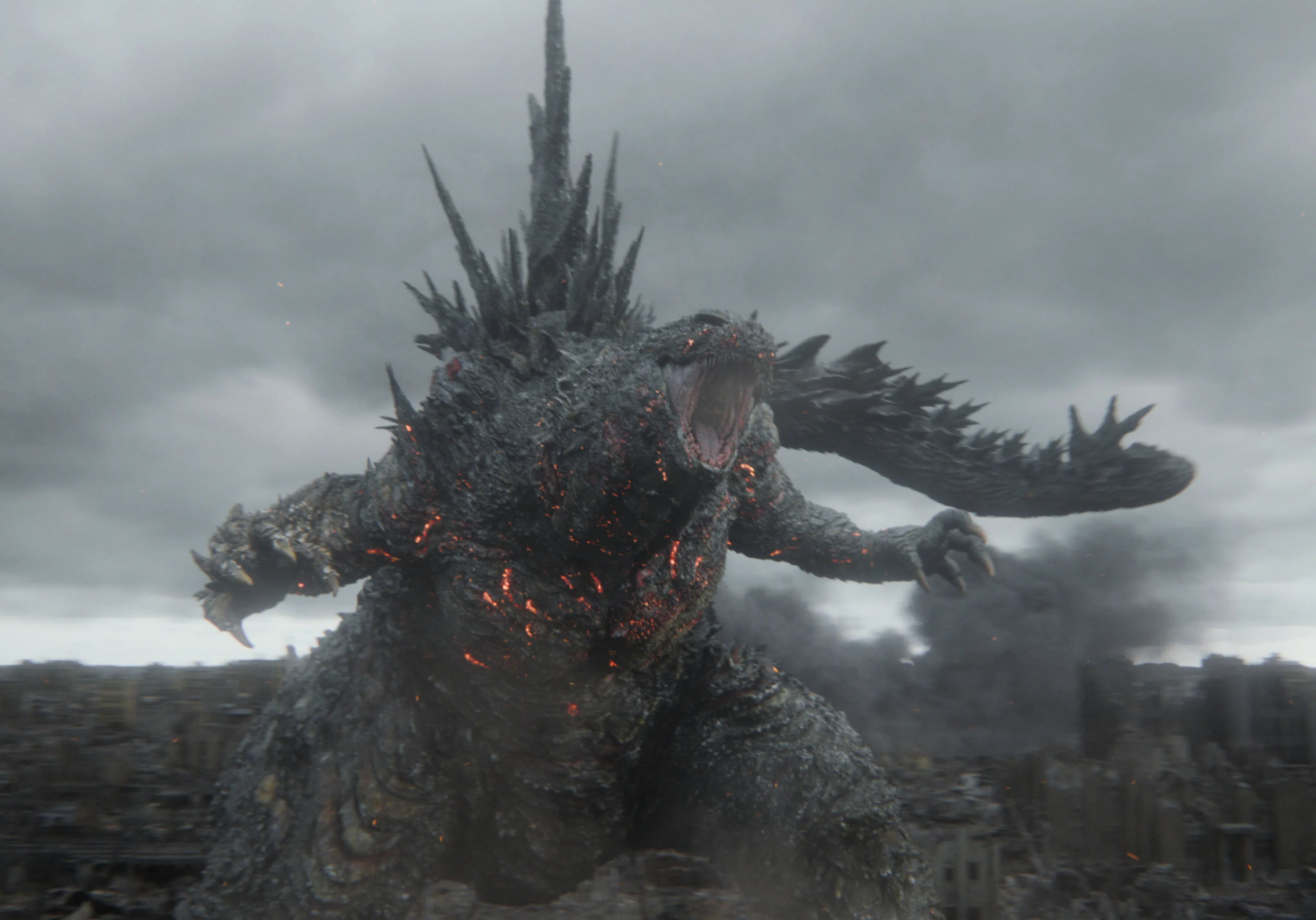
What, then, moved Murayama most about the new film? On his first viewing, its visual impact struck him immediately. As the first Japanese film made to “Filmed for IMAX” specifications, it combines visual effects with a powerful big-screen spectacle.
Yet what stayed with him most afterwards was the story of its characters. “When you care about the characters, the danger on screen feels much more immediate. I found myself thinking about what I would do in their position and what I would want to protect.”
He believes grand spectacle draws audiences into a story, but it is the characters and emotions that linger long after they leave. Even when a story is set far from viewers’ own lives, those emotions can cross cultural boundaries and resonate.
Holding your breath alongside strangers
With striking images now available at the tap of a phone, what makes the cinema irreplaceable?
Murayama believes the care and detail that go into filmmaking deserve to be appreciated on the big screen. “The details and the texture of an image may not be something you consciously notice, but together they help you believe in the world you are watching.”
In his view, each format has its value. Streaming platforms let people discover and revisit stories whenever they like, while merchandise brings characters into everyday life. Cinemas, meanwhile, allow people to step away from daily life and immerse themselves in the story before them.
“You set aside time for a film and give it your attention. The image fills your view, the sound surrounds you, and you hold your breath at the same moment as people you have never met. You cannot get that experience alone.”
The previous film did not get a theatrical release in Singapore, leaving some local fans understandably disappointed. He said: “I understand why fans wanted the chance to see Godzilla Minus One in Singapore cinemas. For people who love Godzilla, being able to experience a Godzilla film on the big screen means a great deal.”
Murayama believes Godzilla films are best seen in a cinema. The monster’s intimidating presence, powerful sound effects and tense atmosphere create an impact that is felt physically, while the reactions of fellow audience members become part of the experience.
The whole team is delighted to bring the sequel to Singapore cinemas. He hopes longtime fans will enjoy it to the full, and that those encountering Godzilla for the first time will also come to see it. He wants everyone to leave with something to reflect on and feelings they want to share.
With its slogan “Moments for Life”, Toho Group hopes to create moments that move people and enrich their lives. Murayama said: “A moment that moves you stays with you long after you leave the cinema. For me, that was the Godzilla I watched with my family as a child. I hope this film will be that kind of moment for audiences here.”
Director Takashi Yamazaki gives his imagination free rein
Godzilla Minus Zero opened in Japan on 3 November, taking more than 910 million yen (about S$7.37 million) on its first day and surpassing 2.5 billion yen (about S$20.24 million) in six days. It opened in North America on 6 November, earning US$31.6 million (about S$40.45 million) over its first weekend to top the box office there.
With Godzilla Minus One having won the Oscar for Best Visual Effects, how would the sequel rise to the challenge?
Director Takashi Yamazaki said: “I went in believing that if I became conscious of the award, I would lose.”
As writer, director and visual effects supervisor of Godzilla Minus Zero, he acknowledged that audiences’ love for the previous film made him feel a strong obligation to meet their expectations. During the creative process, however, he had to put awards aside and focus on making the visual effects serve the film. “When we were making Godzilla Minus One, we weren’t thinking about awards at all. Focusing on that would cloud our perception.”
A larger production budget gave him more room to indulge his ideas. This time, he went ahead with scenes he would previously have felt unable to pursue. For the sequences set in Japan’s Ginza alone, many sets were built for just one scene or even a single shot. Creating the aircraft and cabin interiors also gave him scope to explore his ideas fully. Yamazaki said with a laugh, “Though during the CG process, it all came back to bite me and I had a tough time.”
For the first Japanese film made to “Filmed For IMAX” specifications, Yamazaki felt that every detail would be magnified on the big screen. The computer-generated models, sets and actors’ expressions all had to stand up to scrutiny.
To make outdoor scenes built inside a studio look more realistic, the crew ran giant fans at low speed, making the actors’ clothes flutter gently. As the noise of the fans was also recorded, the actors had to re-record their dialogue in post-production. Yamazaki said it was hard work for both cast and crew, but seeing the sense of air moving outdoors in the finished scenes made it worthwhile.
The weather was harder to control. The monster arrives with dark clouds, so the images needed to remain gloomy, but location shoots often met with sunshine. The crew therefore moved into a studio. In a space just 20 metres long and eight metres wide, they repeatedly changed the set dressing and moved rubble around to give the same set different appearances, creating scenes of crowds fleeing across vast stretches of ruins.
Beyond delivering visual spectacle, he hopes the film will prompt audiences to reflect on war and weapons. He said, “I believe that if the audience feels through the work that ‘we must not cause war’, then a societal significance is born. Regarding scenes where we pushed further, there were opinions that ‘maybe it’s better to remove this’, but I didn’t yield and depicted it to the end with strong commitment.”
Why does Godzilla still resonate after more than 70 years? Yamazaki believes the monster can be playful, yet also carry weighty, serious stories. For audiences who grew up watching it, Godzilla is “a familiar acquaintance, yet a global superstar”. That combination of familiarity and star power may be the source of its appeal.
