

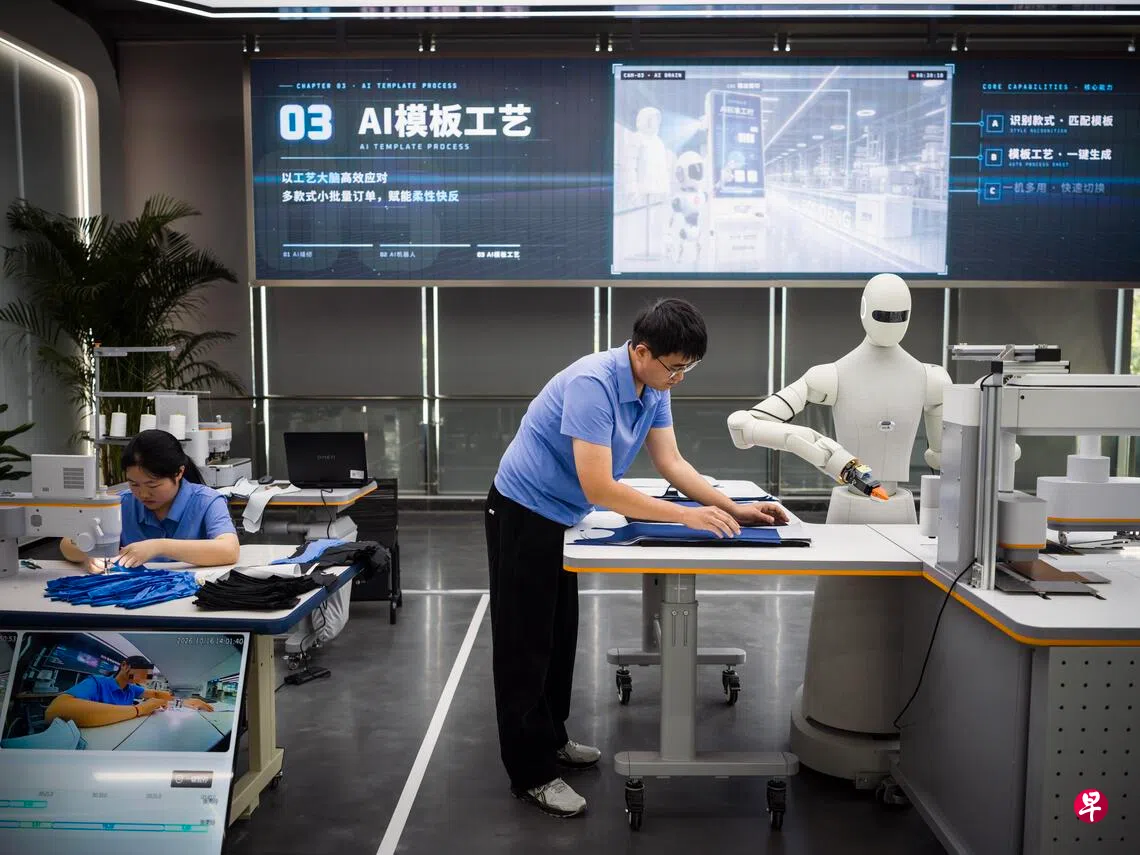
As China continues to promote its “AI Plus” initiative, officials say they will closely monitor the impact of artificial intelligence (AI) on employment. They will strengthen monitoring and early warnings of AI-related job displacement risks, and better align the social security system with changes in employment structures and ways of working.
Scholars interviewed said technological revolutions typically create a time lag between the displacement of workers and the emergence of new business activities. The immediate task is to contain the negative impact of this gap.
Speaking about AI’s impact on employment at a press conference on Tuesday (3 November), Wang Ruomeng, deputy director-general of the Department of Innovation and High-Tech Development at China’s National Development and Reform Commission (NDRC), said the authorities would closely monitor AI’s impact on employment. They would fully harness its potential to create jobs and spur innovation and entrepreneurship, and work to include new occupations such as model trainers and data annotators in the national occupational classification system.
He added that AI-related job displacement risks required stronger monitoring and early warnings, better alignment of the social security system with changes in employment patterns and ways of working, and social security provision that offers both a safety net and broad coverage.
In recent years, as AI adoption has accelerated, Chinese officials have paid increasing attention to job displacement risks even as they stress the technology’s role in supporting employment.
In its guidelines last year on further implementing the “AI Plus” initiative, China’s State Council called for actively harnessing AI’s role in creating new jobs and enhancing traditional jobs. It also called for stronger assessments of employment risks arising from AI applications and for innovation resources to be directed towards areas with strong job creation potential, to reduce the impact on employment.
In draft guidelines issued on the 23rd of last month on adapting to advances in AI technology and helping to foster employment-friendly development, the State Council proposed expanding AI-related employment opportunities in emerging sectors and accelerating the development of new occupations in AI.
Meanwhile, amid growing global concerns about AI safety, China has placed further emphasis on safety governance and regulation of the technology’s development. An NDRC spokesperson told the press conference that China would accelerate foundational, comprehensive AI legislation. It would also move faster to improve legislation safeguarding common elements such as data, computing power and algorithms, and regulating key applications, while establishing safety standards and ethical guidelines covering AI’s entire life cycle.
On the same day, Xiao Yuanqi, Vice Minister of China’s National Financial Regulatory Administration, said the excessive concentration of investment in AI was pushing up borrowing costs for other industries. His remarks also drew public attention to whether the AI investment boom was crowding out traditional industries.
Xu Tianchen, senior economist at the Economist Intelligence Unit, told Lianhe Zaobao that productivity gains from technological revolutions have two effects: displacing labour and expanding the scale of activity. In addition, if all companies aggressively adopt AI to cut costs and improve efficiency, this could ultimately reduce aggregate demand, creating a “paradox of thrift”.
He said whether labour displacement and the paradox of thrift materialise depends on whether the AI revolution can generate more new demand. “The era in which cars replaced horse-drawn carriages gave rise to demand for long-distance travel. It is not yet clear what new demand the AI era will create.”
Chen Bo, a senior research fellow at the East Asian Institute of the National University of Singapore, cited the Industrial Revolution as an example, saying technological revolutions often rapidly displace existing workers. “But new business activities created by technologies such as AI do not emerge instantly. There is a time lag between the two.”
He said it was difficult to predict what new industries AI might create to absorb workers. For now, more could be done to slow the pace at which AI replaces labour.
Xu said one approach was to increase the new opportunities generated by AI by promoting its use in specific sectors, in line with the authorities’ proposal to “prioritise its use in roles facing labour shortages or involving hazardous conditions”; at the same time, job losses should be kept in check. “We cannot rule out policy guidance on corporate layoffs in future.” Finally, the social welfare system should be strengthened to provide a safety net.
Both Xu and Chen rejected the suggestion that overheated AI investment was squeezing traditional industries in China, pointing instead to weak investment demand. Chen said the key issue was a lack of “investment opportunities offering sufficiently good returns... A shortage of suitable assets is the real problem”.
