

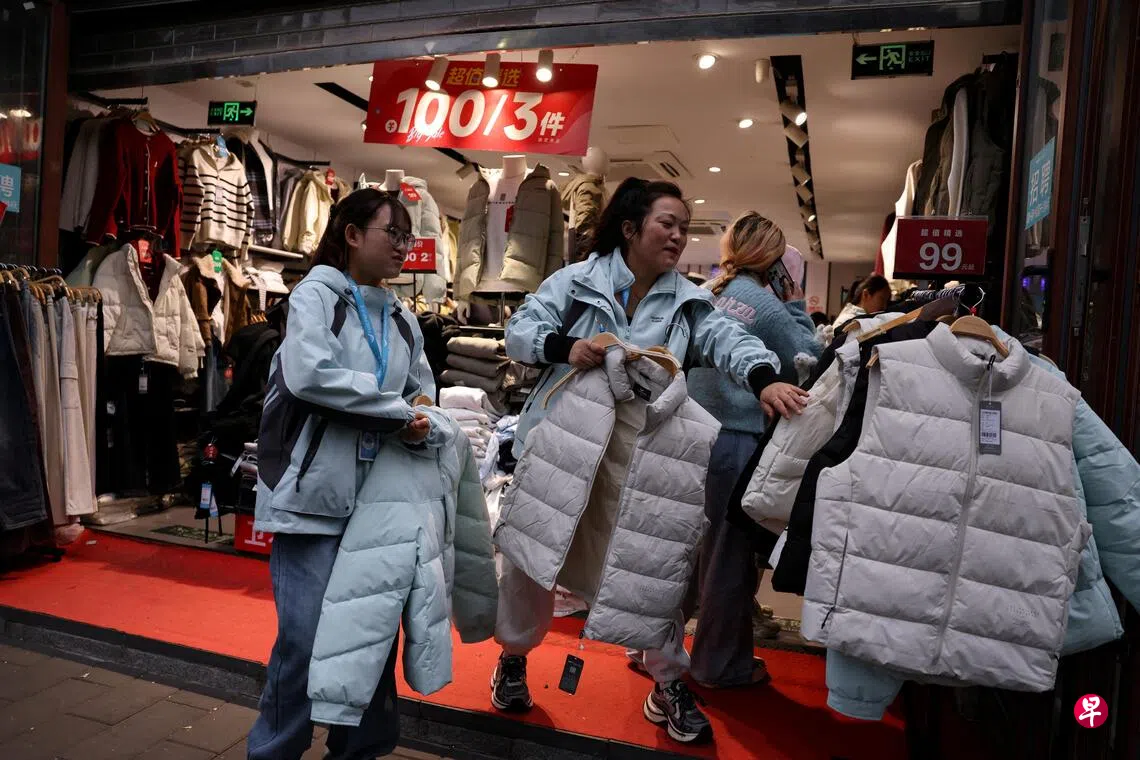
(Beijing) Down jackets priced below 500 yuan (S$96.80) are selling briskly in China this winter, while brands charging upwards of 1,000 yuan face a lukewarm reception. Chinese state media says the sell-out of 399-yuan down jackets is not a sign of consumer downgrading, but shows that consumers are willing to spend — just not on inflated premiums or products lacking transparent information.
As cold weather set in, a 399-yuan jacket with 90% goose down content from Peking University’s cultural merchandise shop went viral on Chinese social media. It sold out for a time in mid-November, with many internet users seeking proxy buyers. Meanwhile, women’s down jackets by US brand Rokka&Rolla sold at Sam’s Club have also proved popular with consumers, thanks to their price of 499.9 yuan and 80% down cluster content. They have sold out at several outlets.
The trend highlights Chinese consumers’ growing focus on value for money. A report by market research firm iiMedia Research showed that the average selling price of down jackets, a major winter purchase, more than doubled over the past decade, exceeding 1,000 yuan last year. The average selling price of core products from Bosideng, China’s largest down jacket manufacturer, has risen to around 1,500 to 2,500 yuan. But this year, 43.66% of Chinese consumers considered 401 to 600 yuan an acceptable price range for a down jacket, while only about 7% were willing to pay more than 1,000 yuan.
Reuters reported that China’s prolonged property market downturn, weak wage growth and concerns over job security have made many middle-class consumers more cautious about discretionary spending. This has also raised questions about how much of a premium they are willing to pay for high-end outerwear.
Some see the popularity of affordable down jackets as further evidence of “consumer downgrading” in China. However, in an article published on Saturday (28 November) titled “Do sell-out 399-yuan down jackets signal consumer downgrading?” (《“399元羽绒服卖断货”是消费降级吗》), the state-run Economic Daily (《经济日报》) argued that the two should not simply be equated.
The article said that while consumers were once willing to pay a brand premium for down jackets, they increasingly recognise that “expensive” does not mean “good”. Affordable down jackets owe their prices to lower supply chain costs, more efficient sales channels and brands accepting smaller margins, rather than compromises on quality.
Citing market research data from the Singles’ Day shopping festival, the article said sales of down jackets priced below 1,000 yuan rose about 21% year on year, while those of high-end technical jackets costing more than 3,000 yuan also grew by 18%. The market displayed “both consumer segmentation and a divergence in product mix”, rather than an overall contraction in spending.
The article acknowledged that slower household income growth and continued pressure on the job market have indeed made consumers more restrained in discretionary spending and more careful with essential purchases. The sell-out of 399-yuan down jackets is not an isolated case, but consumers are not unwilling to spend; rather, they refuse to pay inflated premiums or buy products lacking transparent information.
The article also said that addressing gaps in supply and developing new consumption opportunities were among the key measures to expand domestic demand. It called for a range of high-quality products at different price points to meet varying consumer needs.
Reuters, meanwhile, pointed to a broader divergence in China’s consumer market. Many consumers are seeking value for money, while affluent shoppers remain willing to pay for products that convey quality or status. Chinese consumers are also becoming more discerning, rather than simply seeking low prices.
Mark Tanner, founder of Shanghai-based consultancy China Skinny, said Sam’s Club’s affordable down jackets tapped precisely into Chinese consumers’ current desire to “get a similar design, functionality or enjoyment” without paying a hefty brand premium.
Lü Jiaming, a 27-year-old factory worker in Shanghai whose name was transliterated, told Reuters that he would definitely not buy another down jacket costing more than 1,000 yuan. “There isn’t much difference between a down jacket costing 500 or 600 yuan and one costing more than 1,000 yuan. Unless the quality is exceptionally good, you really can’t tell the difference.”
