

Disappointing earnings from several major technology companies have accelerated a shift in funds out of artificial intelligence (AI) investments and into safe-haven assets.
The global technology sector has come under pressure, with Japanese and South Korean stock markets hit by sell-offs on Friday (30 October) and Singapore tech stocks tumbling across the board.
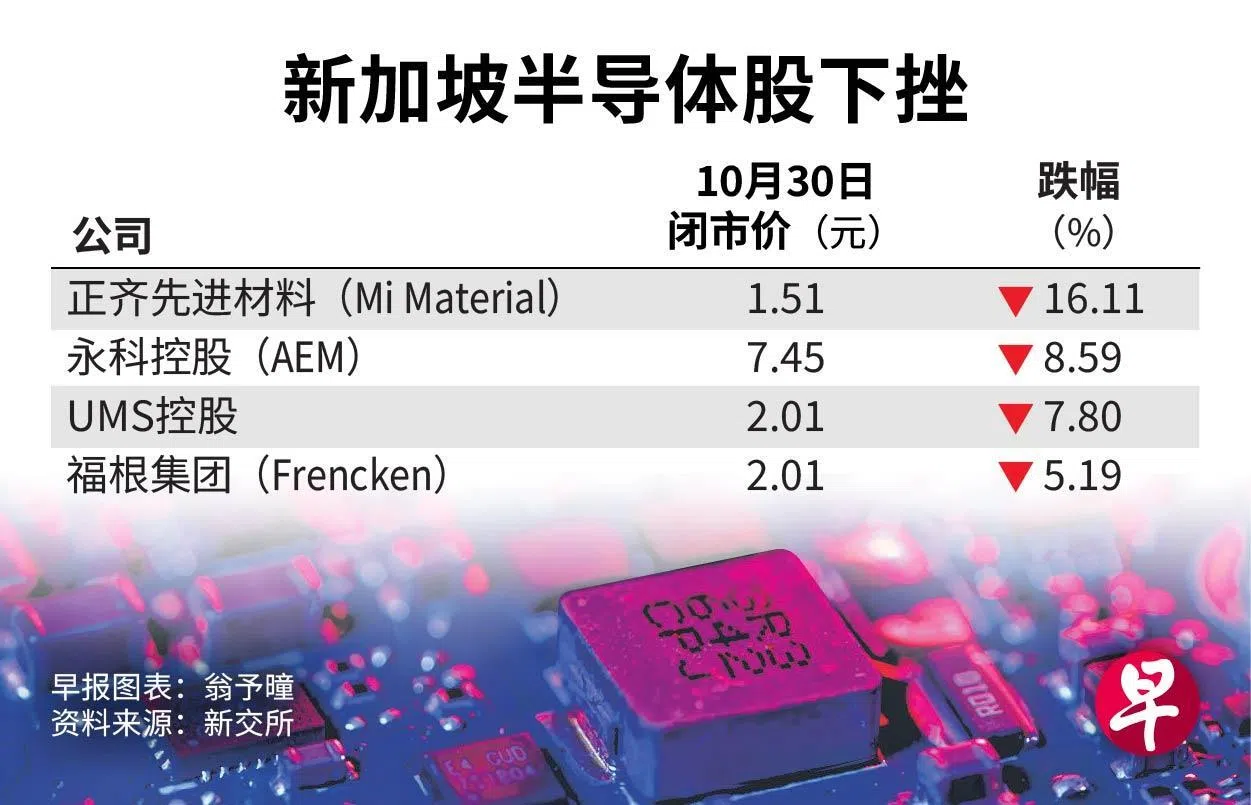
Most Singapore semiconductor stocks closed lower on Friday.
Advanced semiconductor packaging materials manufacturer Mi Material, which listed earlier this week, fell 16.11%. Semiconductor equipment makers AEM Holdings and UMS Holdings closed down 8.59% and 7.8% respectively, while Frencken Group fell 5.19%.
The latest tech stock rout follows in the wake of recent earnings from several major US technology companies falling short of market expectations, deepening investors’ doubts about the sustainability of massive AI investments and their potential returns.
Pan Zhechuan, a research analyst in FSM Global’s research and portfolio management department, said in an interview that Singapore semiconductor stocks could fall further in the short term.
US chipmaker Advanced Micro Devices (AMD) is due to report earnings next Tuesday (3 November), providing another potential trigger for declines.
Pan said: “If AMD reports disappointing earnings or weaker-than-expected guidance, particularly in its data centre and AI businesses, this could reignite concerns over semiconductor demand and trigger another round of selling across Asian semiconductor supply chain stocks.”
Several US tech companies fall short of market expectations
This week, Google parent Alphabet reported third-quarter revenue below analysts’ expectations, while revenue growth in its search-related business also slowed sharply. Its shares recorded their largest-ever single-day decline on Thursday (29 October).
Amazon’s latest quarterly net profit fell short of expectations, while free cash flow declined sharply because of AI capital expenditure, sending its shares tumbling.
Intel disappointed investors with a relatively weak business outlook amid a sluggish personal computer market. Together with the impact of an explosion at its factory in Kiryat Gat, Israel, this sent its shares down more than 25% in pre-market trading.
Pan said Intel was one of AEM’s major customers, and investors were concerned about its future investment plans and equipment demand. “This could also affect AEM’s order visibility,” he said.
However, Pan added that UMS Holdings and Mi Material had no publicly disclosed direct business dealings with Intel, but “both counters were also caught up in the broader weakness across semiconductor and technology stocks”.
Notably, China Galaxy International Securities, the stabilising manager for Mi Material’s listing, announced that it had ceased price stabilisation operations on 30 October, having purchased a total of 5 million shares. This may also have contributed to the stock’s steeper decline.
Saxo’s chief investment strategist Charu Chanana said strong earnings no longer guaranteed investor favour for technology companies. Rising capital expenditure, uncertainty over profit margins and high valuations had made the market more discerning. “But the investment story is becoming more complicated.”
Chanana also said earnings at advanced semiconductor and memory chip companies remained strong, driven by demand for AI infrastructure.
However, as companies continued to expand capacity and shortages eventually eased, outsized profits might not be sustainable over the long term, leading to more uneven stock market responses.
Pan noted that earnings at Singapore semiconductor companies remained encouraging, supported by demand for semiconductor equipment and AI investment. AEM and UMS posted revenue growth of 29.9% and 25.2% respectively in the first half of this year, while Frencken Group’s second-quarter net profit rose 40.5% from the previous quarter.
Mi Material’s third-quarter adjusted net profit reached US$11.4 million (about S$14.6 million), while revenue rose 15.6% from the previous quarter.
