

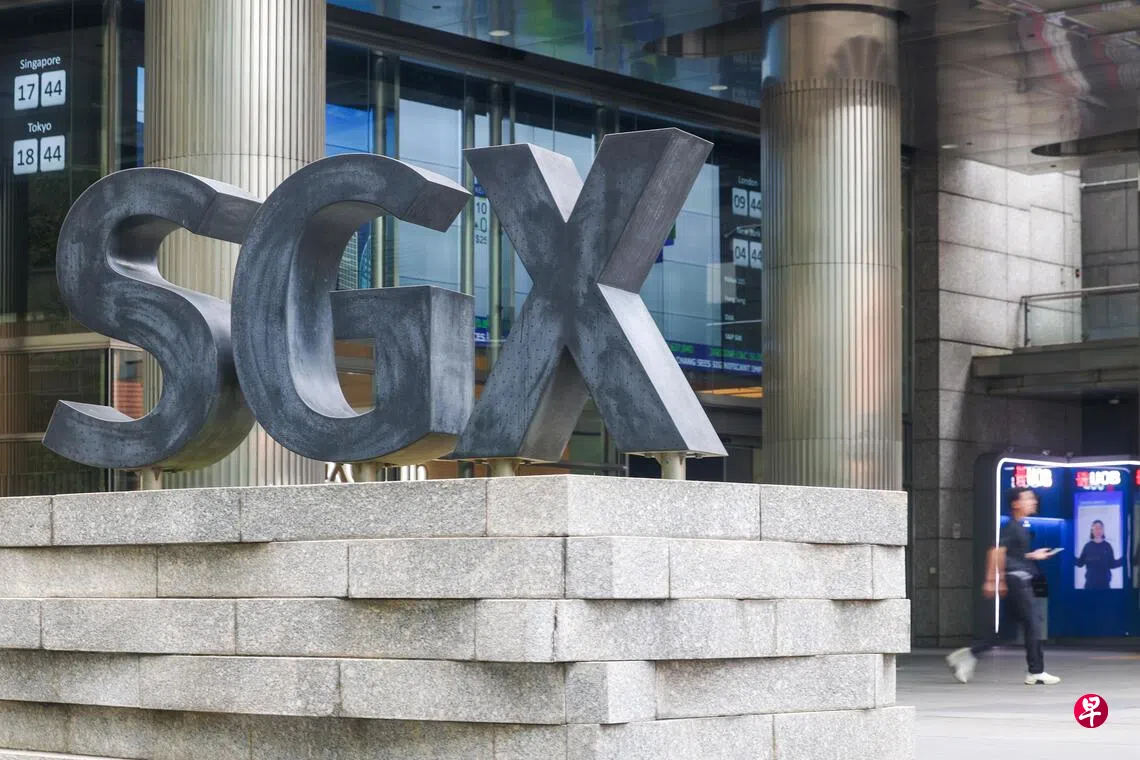
Better-than-expected earnings from artificial intelligence (AI) chip giant Nvidia gave global technology stocks a modest confidence boost, but failed to fully reverse the broader downturn in AI trades. Asia-Pacific markets ended mixed, while Singapore stocks remained under pressure amid expectations of interest rate increases by the US Federal Reserve.
Singapore’s Straits Times Index (STI) closed at 5,054.89 on Wednesday (18 November), down 54.24 points or 1.06%, marking its fifth consecutive trading day of losses.
Phillip Securities chief stockbroker Liu Weixiong told Lianhe Zaobao that foreign investors had been net sellers of Singapore stocks for several consecutive weeks. It was difficult for local funds alone to absorb the selling.
“Singapore stocks have been under sustained pressure since September this year. Even banking stocks, which had supported the STI, have failed to hold up and have entered a correction since October.”
He added that while the pullback in US stocks had been a major influence, the underlying factor was the prospect of higher interest rates. The US Federal Reserve’s recent stance remained hawkish, and expectations of a rate-hike cycle could keep local stocks under pressure, particularly in the banking and property sectors.
Elsewhere in the Asia-Pacific region, Tokyo closed 0.28% higher. Seoul and Taiwan gained 1.99% and 0.26% respectively, buoyed by more upbeat sentiment towards semiconductor stocks, while Shanghai rose 0.09%.
Hong Kong and Shenzhen fell 0.91% and 0.33% respectively, while Sydney declined 0.72%.
Ryotaro Sawada, a senior analyst at Tokai Tokyo Intelligence Laboratory, said investors remained largely pessimistic about AI and chips. Nvidia’s strong earnings would probably struggle to offset the prevailing negative sentiment surrounding AI investment.
Meanwhile, AI company Anthropic is set to list this week. MLive strategist Mark Cranfield said the giant’s stock market performance after its debut would be a key factor shaping market sentiment ahead.
He added: “Reports that SpaceX is planning a large-scale debt fundraising will also provide another test of market sentiment towards the AI sector.”
Trading volume on the Singapore market totalled 1.12 billion shares on Wednesday, with a turnover of about S$2.29 billion. At the close, 229 stocks had risen and 355 had fallen.
Of the STI’s 30 constituents, just five rose while 25 declined.
Jardine Matheson Holdings (JMH) was the top gainer, rising 2.43% to close at US$60.59 (about S$78.14). It was followed by Yangzijiang Shipbuilding, which gained 1.62% to S$4.39.
Frasers Logistics & Commercial Trust (Frasers L&C Trust) was the biggest decliner, tumbling 5.06% to close at S$0.845. Mapletree Industrial Trust and Mapletree Logistics Trust also ended lower, falling 4.05% and 3.6% to S$1.66 and S$1.07 respectively.
Asked whether the STI could rebound before the year-end, Liu said it still had a chance to recover once the Fed’s December interest rate decision became clearer and market uncertainty eased. “But property and construction stocks, as well as real estate investment trusts, will remain under considerable pressure from high interest rates. I would avoid them for now.”
In corporate news, Frencken Group released its latest results after the market closed, reporting a 31.3% year-on-year rise in third-quarter net profit for 2026 to S$13 million. Revenue rose 12.8% to S$238.5 million, mainly driven by higher revenue from its mechatronics business on strong demand from the semiconductor and medical sectors.
Based on current business visibility and the positive business outlook for its key customers, Frencken Group maintained its expectation that full-year revenue and net profit for the 2026 financial year would exceed those for 2025. However, it will closely monitor changes in the operating environment, given geopolitical conflicts and increased uncertainty following the US midterm elections.
Frencken Group shares closed 0.59% higher at S$1.71 on Wednesday.
Geo Energy Resources, whose share price had fallen sharply following Indonesia’s new coal mining policy, said in a statement on Wednesday evening that three senior executives had bought shares in the company on the open market.
The executives were the group’s chief operating officer, chief financial officer and business development director. Each bought 100,000 shares at about S$0.42 apiece, for a combined value of about S$126,000.
Following the transactions, the three executives’ combined holdings in Geo Energy Resources rose from 2.31 million shares to 2.61 million shares.
Geo Energy Resources shares closed at S$0.42 on Wednesday, up 10.53%.
For more information on the Singapore stock market, click here.
