

When a listed company announces its results and its CEO promptly sells shares, does it signal a lack of confidence in the company’s prospects, or is it simply a chance to manage personal shareholdings while the trading window is open?
Singtel group CEO Yuen Kuan Moon sold 2 million shares on 13 November, the day the company announced its results, raising about S$8.15 million. At the time, the news drew more attention than any other Singapore financial story apart from those related to Nvidia.
On the following Monday (16 November), Singtel took the step of explaining to the media that Yuen had sold the shares to pay taxes arising from his share-based remuneration, and as part of his personal financial planning.
Such transactions are not uncommon. Former DBS Group CEO Piyush Gupta sold 300,000 shares for S$12.6 million within a day or two of its third-quarter results announcement in 2024, also drawing market attention at the time.
Why do CEOs often sell shares after results announcements?
One important reason is the restrictions on trading windows at listed companies.
Under Singapore Exchange (SGX) listing rules, listed companies and their senior executives must not trade in the companies’ securities during specified blackout periods before results announcements. Once results are released and material information has been publicly disclosed, companies may reopen their trading windows. The same applies in other stock markets.
The trading window after a results announcement is therefore one of the few periods when they can legally buy or sell shares.
Mak Yuen Teen, an associate professor at the National University of Singapore (NUS) Business School, told Lianhe Zaobao that there was generally nothing wrong with selling shares after a results announcement, provided company insiders traded within an authorised window and did not possess material non-public information.
However, he said that, for the sake of market perceptions, executives would do better not to sell shares as soon as the market opens after a results announcement.
He suggested that companies consider requiring executives to wait at least 24 or 48 hours after releasing results before trading, to ease market concerns.
Professor Lawrence Loh, director of the Centre for Governance and Sustainability at NUS Business School, believes the issue is not entirely about timing, but also the context of the transaction and whether disclosure is adequate.
He noted that the information gap between the market and management narrows after results are released, making this potentially a more reasonable time to trade. Even if a transaction appears inappropriate, rational investors should still be able to understand its rationale.
However, he also said management might still possess undisclosed information about future developments. The release of results alone therefore does not mean that all information asymmetries have been eliminated.
CEOs may need substantial cash to pay taxes
Listed companies typically include restricted shares, performance shares or other equity awards in executive remuneration to align management’s interests with those of shareholders and encourage a focus on long-term performance.
When share awards vest, executives may have to pay tax on them. If their cash remuneration is insufficient to cover the bill, they may need to sell some shares to raise the money.
Suppose a CEO’s total remuneration in 2025 was S$8 million and was fully taxable. Excluding any tax reliefs or deductions, the personal income tax bill would be as high as S$1.88 million. Even a CEO may not have that much spare cash to pay taxes.
Mak said using shares as a long-term incentive was a reasonable remuneration arrangement. If markets were overly critical of executives selling shares, prompting companies to switch to cash-settled long-term awards, that might not be an ideal outcome.
He cited City Developments Limited (CDL) CEO Sherman Kwek, whose long-term incentives are cash-settled, meaning he does not face the need to sell company shares to raise cash.
Should investors be wary?
Terence Wong, CEO of fund manager Azure Capital, said in an interview that institutional investors understood why management sold shares. The likelihood of improper trading was low, particularly at blue-chip companies.
He suggested that investors watch changes in the holdings of funds, often referred to as “smart money”, in listed companies. A fund reducing its stake in a company could reflect a bearish view of its prospects.
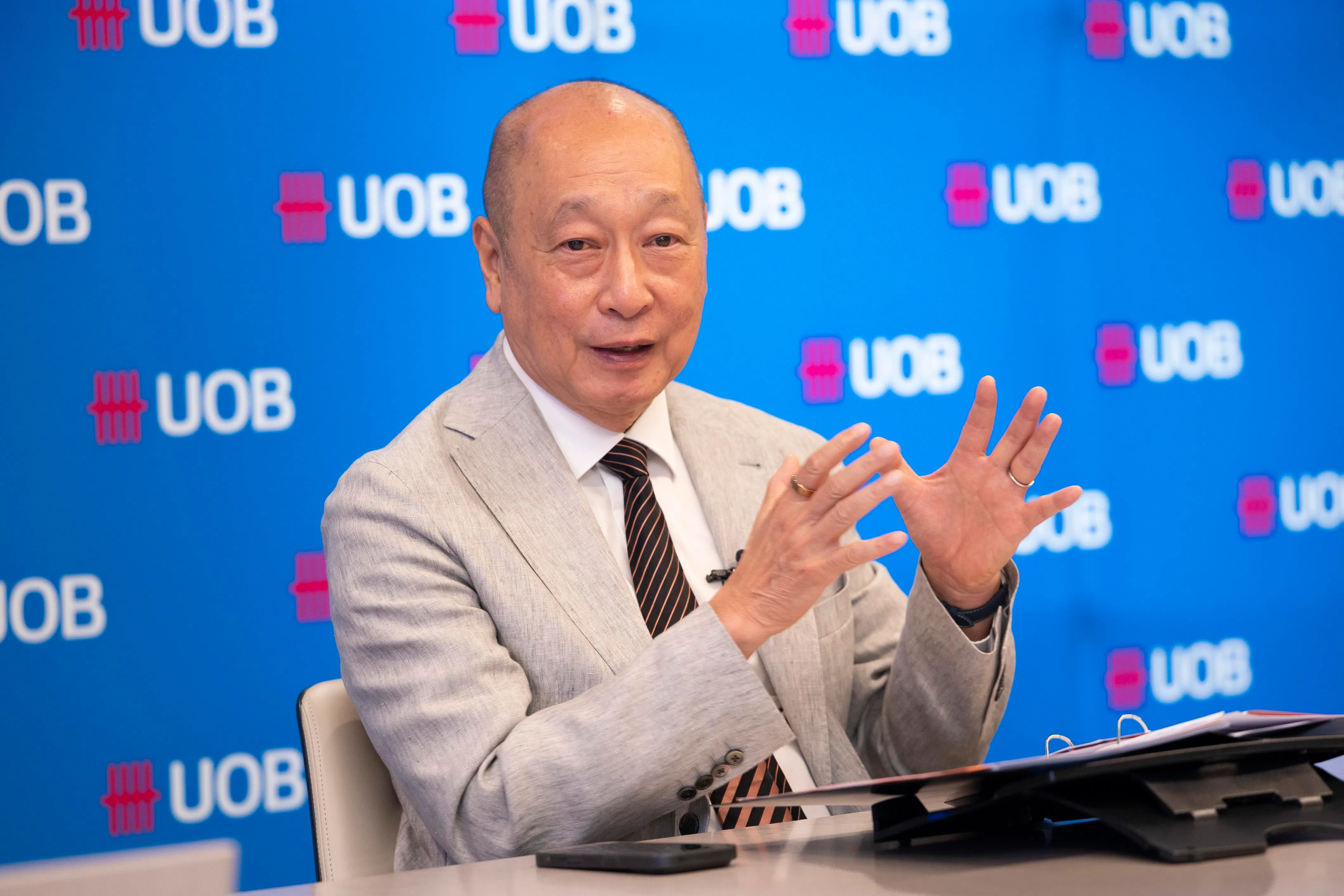
Executives also buy shares after results announcements. For example, UOB deputy chairman and CEO Wee Ee Cheong bought 200,000 UOB shares on the open market on Wednesday (18 November) at about S$36.14 each. The purchase, worth about S$7.23 million, brought his stake to 10.93%. UOB announced its results on 4 November.
Wing Tai Holdings chairman Cheng Wai Keung and his wife also bought shares in the days after the group announced its full-year results on 25 August.
Unlike share sales by executives, their purchases are generally seen by the market as a positive signal, suggesting that they believe the shares are undervalued or are optimistic about the business outlook.
Are there similar examples overseas?
Executives overseas also frequently sell shares around major company announcements. Some of these transactions attract public attention even when they have been arranged in advance.
One prominent example involves Albert Bourla, CEO of US pharmaceutical company Pfizer.
On 9 November 2020, Pfizer announced that a preliminary analysis of its Phase 3 clinical trial showed that the Covid-19 vaccine it was developing with German biotechnology company BioNTech was more than 90% effective. Pfizer shares rose nearly 15% at one point following the announcement.
On the same day, Bourla sold 132,508 Pfizer shares for about US$5.56 million (about S$7.17 million).
Pfizer later explained that the sale was part of a stock trading plan Bourla had put in place on 19 August 2020, rather than a decision made after learning the vaccine trial results. The plan stipulated that the transaction would be executed only if the share price reached a preset level.
The sale attracted attention mainly because it took place on the same day as the major positive announcement. Nevertheless, the prearranged trading plan gave the company a basis for explaining that the transaction was not a last-minute decision.
Rule 10b5-1 under the US Securities Exchange Act allows company insiders who do not possess material non-public information to set up written trading plans in advance, specifying conditions such as the number of shares to be sold, the price or the timing of future trades.
Provided the relevant requirements are met, prearranged trades may qualify for a defence against insider trading allegations even if they are executed during a blackout period.
Sanjay Mehrotra, CEO of US chipmaker Micron Technology, offers another instructive example.
Mehrotra sold 40,000 Micron shares on 29 May 2026 for about US$38.45 million. At the time, Micron’s share price had surged as artificial intelligence drove demand for memory and storage, and the company was due to announce its quarterly results on 24 June.
Regulatory filings showed that the sale was made under a prearranged Rule 10b5-1 trading plan. The plan had been established on 30 January 2026, about four months before the sale.
After the sale, Mehrotra still held 384,503 Micron shares directly and another 607,075 shares indirectly through a family trust.
