

As global trade becomes increasingly fragmented, geopolitical uncertainty rises and financial market volatility intensifies, multinational companies are becoming more receptive to tokenised money, which could go mainstream faster than expected.
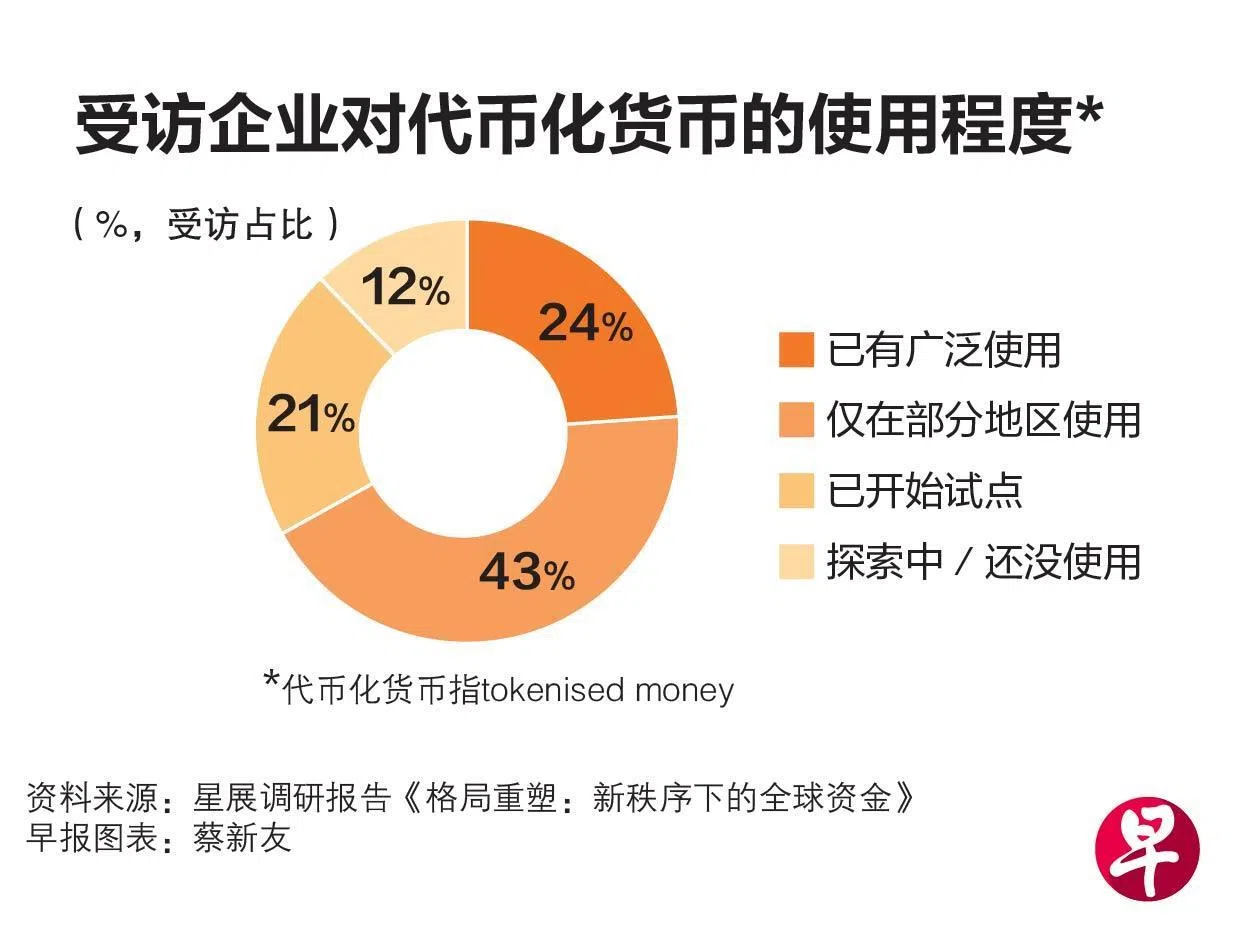
DBS Group’s research report, The Great Rewiring: Money in a New Order, released on Wednesday (28 October), found that tokenised money is fully deployed and operational at scale at 24% of companies surveyed, while 21% said they were at the pilot or proof-of-concept stage and 43% said they used it only in certain locations.
Overall, as many as 88% of companies surveyed have begun trying tokenised money, with just 12% still at the exploratory stage.
DBS Group surveyed 422 business leaders, chief financial officers and other senior executives between mid-June and mid-July this year. Their companies all had annual revenues exceeding US$500 million (about S$640 million) and came from 11 markets, spanning sectors including technology, energy, automotive, consumer goods, advanced manufacturing and finance. Multinational companies accounted for 64% of the companies surveyed.
DBS Group Head of Global Transaction Services Lim Soon Chong said the it was somewhat unexpected to find that nearly nine in ten companies surveyed were already using tokenisation for payments, collections or deposits. “We know that its tokenisation is increasing, and it's going mainstream. But the pace whereby it is going mainstream is much faster than we expected.”
Stablecoins and tokenised deposits were the most widely adopted forms, at 63% and 53% respectively. These were followed by tokenised money market funds (52%), central bank digital currencies (51%) and cryptocurrencies (35%).
Most executives surveyed expect the use of tokenised money to deliver tangible benefits for their companies within the next one to two years. These include enhanced traceability and auditability of transactions, real-time settlement of cross-border payments, and greater transparency and efficiency in payment processes.
The report noted that this trend is driven by several factors, including continued shifts in global trade and shipping routes, rising sanctions risks, and increasing volatility in foreign exchange markets and energy prices. These changes create numerous treasury management challenges for companies operating across borders.
As companies accelerate digitalisation, their cash, payment and liquidity management arrangements are also becoming increasingly complex. This places greater demands on their ability to coordinate multiple ecosystems in future while maintaining transparency, control and liquidity.
Compliance and regulation still evolving, with uneven rules across markets
However, the compliance and regulatory environment for corporate use of tokenised money is still evolving. Uneven regulation across markets also poses challenges.
Responding to a question from Lianhe Zaobao (LHZB), Lim said that most legal and regulatory frameworks were still evolving, whether for tokenised money payments, securities tokenisation or the tokenisation of so-called “real-world assets”. These frameworks would have to keep pace with technological developments.
He said that we might be moving towards convergence, but the current landscape is still somewhat uneven. While certain regions may be more liberal, others lean towards having innovation happening in a much more controlled fashion. “Many markets do feel that it is indeed a challenge.”
The report also found that 78% of companies surveyed had increased their exposure to multiple currencies and reduced their reliance on a single traditional settlement currency to support more trade corridors.
Demand for the renminbi among companies surveyed also continues to rise as their trade ties with China deepen. Interest was particularly strong among respondents in markets such as Australia and the UK, where more than half said they would consider using the currency within the next one to two years.
