

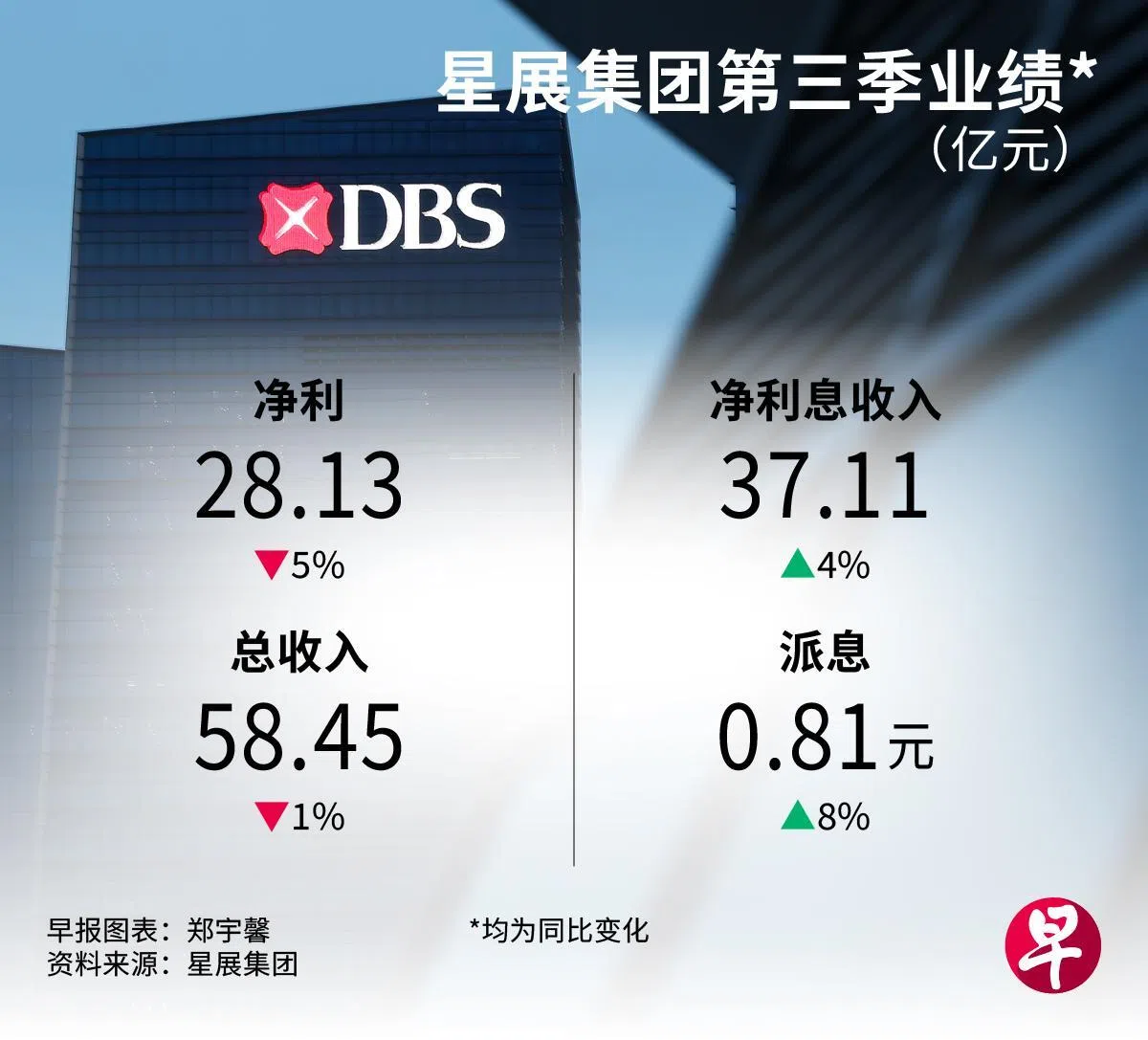
DBS Group’s net profit fell 5% year on year to S$2.813 billion in the third quarter of 2026, dragged down by a sharp decline in financial markets trading income. Group chief executive Tan Su Shan said the bank was considering establishing a prime brokerage business to tap growth opportunities in Asia’s financial markets.
DBS Group released its third-quarter business update before the market opened on Thursday (5 November). Net profit fell short of the S$2.95 billion forecast by analysts polled by Bloomberg.
The group’s third-quarter net profit fell 9% from the previous quarter. Total income fell 1% year on year to S$5.845 billion, and was down 4% from the previous quarter.
The group will pay a dividend of S$0.81 per share for the third quarter, comprising an ordinary dividend of S$0.66 and a capital return dividend of S$0.15. This is higher than the S$0.75 paid for the same period last year, which comprised an ordinary dividend of S$0.60 and a capital return dividend of S$0.15.
The group’s net profit for the first nine months rose 2% year on year to a record S$8.822 billion.
DBS’s core business continued to grow. Net interest income rose 4% to S$3.711 billion, as hedging and strong balance sheet growth offset the negative impact of a lower Singapore Overnight Rate Average (SORA).
However, markets trading income plunged 65% to S$152 million, largely amid unfavourable market conditions. Tan noted at the results briefing that trading accounted for only 6% of the bank’s total income.
She also said: “We will take that as a market player. But the overarching message we want to share is that the structural growth momentum that we are building for our franchise, be it number of clients, be it volumes, be it the momentum around fee, that underlying growth is still good.”
Tan also said some US peers had posted strong trading income, largely because they had sizeable prime brokerage businesses. Although DBS has yet to enter this business, it already has the key building blocks, including stock custody, market access and trading capabilities.
Tan: DBS will drive continued growth in institutional client business
“So I think in Asia we have all the building blocks and we may put it together. But right now we’re still considering what the options are,” she said.
Prime brokerage services typically cater to hedge funds, asset management companies and investment institutions. Beyond executing clients’ brokerage orders, they offer comprehensive solutions including margin financing, securities lending, custody services and trade clearing.
DBS remains focused on the “financialisation” of Asian markets and the continued growth of its foreign institutional investor (FII) and financial institutions group (FIG) franchises, Tan said.
DBS Group’s third-quarter net interest margin was 1.87%, down nine basis points from a year earlier. Tan believes the bank’s interest income has passed its trough. She expects net interest margin to continue rising into 2027, with total income growth in the mid-single-digit range.
The bank expects two more US interest rate increases by the end of 2027, with the Singapore Overnight Rate Average holding at around 1.6% and the Singapore dollar strengthening further. Deposit growth will likely normalise to the mid-single digits next year, although Tan said she remains watchful on whether higher Treasury bill rates will absorb some deposit growth.
DBS also expects continued expansion in wealth management, as well as prudent growth in its coverage of companies in the financial institutions group, and technology, media and telecommunications sectors.
Tan said the lender has taken a conservative and structured approach to data centre investments, despite strong growth in the sector, and will not finance speculative assets.
MAS lowers DBS’s additional capital requirement as service quality improves
DBS focuses on high-quality investment-grade hyperscalers, with around S$14.6 billion in exposures to data centres and outstanding loans of around S$8.98 billion.
The Monetary Authority of Singapore also announced on Wednesday (4) that the additional capital requirement imposed on DBS Group following past digital banking service disruptions would be reduced, with the multiplier applied to its operational risk-weighted assets lowered from 1.8 times to 1.5 times.
The authority said DBS had made significant progress in strengthening its technology and operational risk controls and improving service reliability.
DBS Group shares closed at S$71.20, up 0.59%.
