

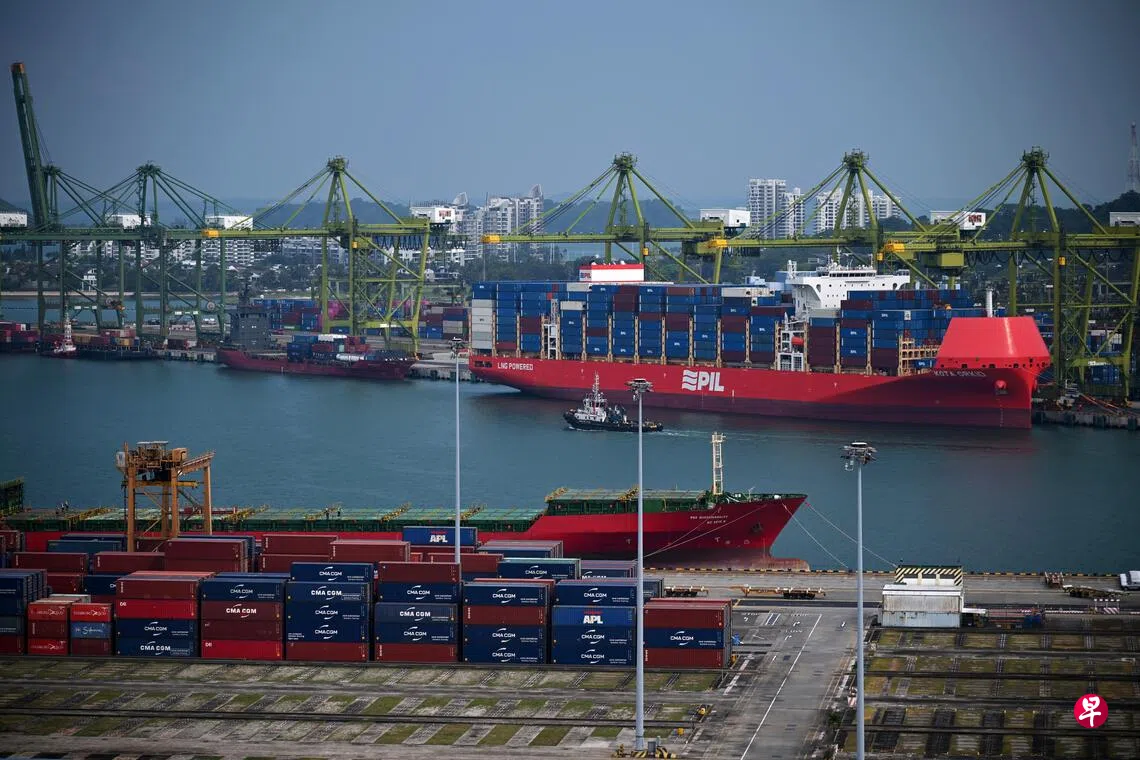
The US is proposing Section 301 tariffs of up to 20% on Singapore goods to address structural excess capacity in manufacturing. But economists interviewed expect the new tariffs will not be stacked on top of existing duties, while semiconductors and pharmaceuticals will remain exempt. They are therefore maintaining their forecasts for Singapore’s gross domestic product and non-oil domestic export growth in 2027.
The Office of the United States Trade Representative released the findings of its Section 301 investigations into 14 economies and announced the proposed tariffs in Washington on Wednesday (25 November). Economists at OCBC, Maybank, UOB and DBS offered their responses and analysis on Thursday (26 November).
Under the proposal, the 12.5% Section 301 tariff that Singapore currently faces over forced labour would be deducted from the new tariff. This “non-stacking” approach would apply the higher of the two rates, meaning the maximum tariff would be 20%, rather than a combined 32.5%.
The proposal also leaves Singapore room to negotiate. The tariff could be reduced to 10% if Singapore and the US reach a reciprocal trade agreement or another relevant agreement. The deadline for written public comments is 5 January 2027, with hearings beginning on 25 January.
OCBC chief economist Selena Ling noted that the proposed measures have yet to be finalised, while about 68% of Singapore’s exports to the US are exempt under the existing framework, leaving an effective tariff rate of only about 6.1%. She is therefore maintaining her baseline forecasts of 2.5% to 4.5% GDP growth and 5% to 10% growth in non-oil domestic exports for Singapore in 2027.
Discussing the motivations behind the US move and the prospects for negotiations, Ling said: “The driving concern is no longer just bilateral trade deficits, but increasingly industrial policies, subsidies and what the US sees as structural excess capacity.”
She added: “I would not put a probability on it at this stage. But the fact that the US has explicitly provided a pathway to a 10% tariff if an agreement is reached suggests there is genuine room for negotiation.”
Ling also cautioned that the greater long-term concern is that higher trade barriers could become a structural feature of the global economy. If broader tariff measures weaken global demand, disrupt regional supply chains or coincide with a downturn in the artificial intelligence capital expenditure cycle, they would pose second-round downside risks to Singapore’s highly open economy.
Maybank economist Brian Lee is also maintaining his forecasts for Singapore’s GDP and non-oil domestic exports in 2027. He noted that the proposed 20% ceiling is 7.5 percentage points above the current 12.5%, meaning goods that are not exempt do face the risk of higher tariffs.
He expects the impact on Singapore’s overall exports to remain limited because key products such as electronics remain on the exemption list. There is also still time before the new tariffs could take effect, in February next year at the earliest. Singapore is actively engaging the US to seek a reduction to 10%, below the current rate.
At the regional level, UOB head of global economics and markets research Kin Suan Teck and fellow economists noted in a report that the investigations cover six Southeast Asian countries — Singapore, Malaysia, Thailand, Indonesia, Cambodia and Vietnam — challenging the established perception of Southeast Asia as a “tariff haven” for supply chain relocation.
The report showed that Vietnam faces a proposed maximum tariff of 35%, which could fall to 20% if an agreement is reached. India faces 25%, or 17% under an agreement, while Indonesia, Malaysia and Thailand face 18%, potentially rising to 25%. Japan, South Korea and Taiwan remain subject to an agreed ceiling of 15%. Meanwhile, US Section 232 national security tariffs on semiconductors and chips remain a major concern hanging over Asia’s export economies.
In a separate report, DBS Group senior economist Chua Han Teng and colleagues said continued exemptions for semiconductors and pharmaceuticals, along with active bilateral communication and mutual trust between Singapore and the US, would help keep the downside impact on Singapore’s non-oil domestic exports manageable.
The report also noted that the proposed tariff on China would rise from 12.5% to 20%, potentially doubling to as much as 40% if talks break down. This is expected to shave 0.1 to 0.2 percentage points off China’s economic growth in 2027. However, with Asia as a whole supported by AI-related investment and digital infrastructure spending, the near-term drag on the region’s economy is expected to be similar to that seen in the second half of 2025.
