

As artificial intelligence (AI) technology spreads globally, countries can use it to identify vulnerabilities in other nations’ critical systems, but must also continually strengthen their own defences. This contest between attack and defence will keep evolving, and no system can be perfectly secure.
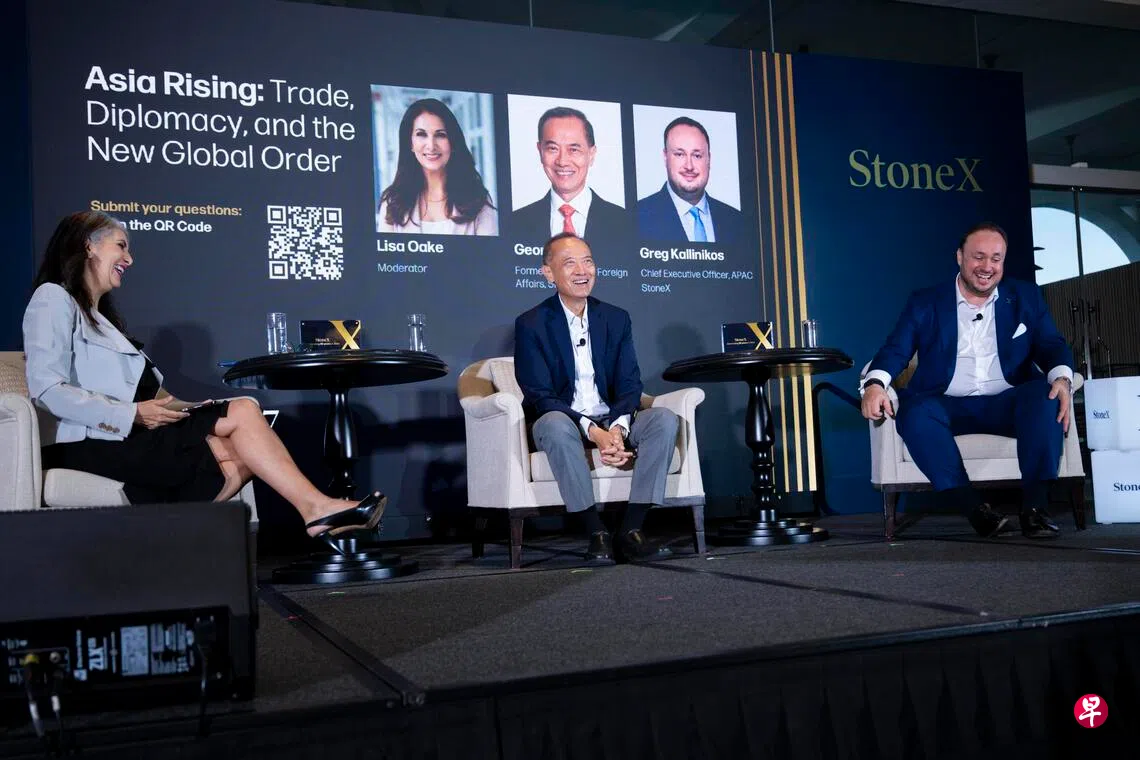
George Yeo, Singapore’s former Foreign Minister, made these observations when asked how AI competition between China and the US would develop, at StoneX’s Asia-Pacific market outlook event on Wednesday (19 November) evening.
He said AI technology would eventually become as widespread as fire and electricity. “The US may be ahead tomorrow. Somebody else may be ahead. But it's okay.”
“I mean, who is ahead in making fire? Who is ahead in making electricity? Who's ahead in science? This is part of human civilization." Small countries such as Singapore would also benefit as open-source technology spreads.
Yeo said that when people acquire new technology, their instinct is to use it to gain power and influence, keeping it secret so that others will do their bidding. But once the “secret” gets out, the other side will fight back, setting off a contest between attack and defence, much like a sword pitted against a shield.
He likened the shifting dynamics of global competition to the checks and balances within an ecosystem.
In nature, certain species may multiply rapidly and threaten an entire ecosystem. But as counterbalancing forces emerge, the system eventually finds its own equilibrium. AI development will see a similar evolution of attack and defence.
Citing recent disruptions to systems at US airlines, banks and other organisations, Yeo discussed the security risks facing critical infrastructure in the AI era.
As the security of critical infrastructure becomes increasingly important, he said countries might not only patch and test their own systems for vulnerabilities, but also study other nations’ defences so they could disable their systems at a critical moment.
AI development tests countries’ ability to respond
On AI’s economic and social impact, Yeo said the constraints on its future development would not be technological, but political, and would depend on societies’ ability to respond.
For example, he said, residents in some parts of the US were unhappy because data centres had driven up electricity and water costs. China, meanwhile, was committing substantial energy resources to developing AI, but also faced difficulties finding jobs for large numbers of graduates.
He said Singapore was actively addressing these challenges, with government ministers frequently discussing AI and the changes it brings.
During the same dialogue, Greg Kallinikos, StoneX’s APAC CEO, drew on his career experience to stress that AI speeds up workflows in financial services but cannot replace personal relationships and trust. StoneX is a Nasdaq-listed financial services provider. The industry still requires an understanding of local markets and long-term relationships with clients.
US reduces reliance on Taiwan’s advanced chips
Turning to developments in Asia, Yeo said China-US relations had stabilised and the prospects for continued peace in the region were relatively favourable. He did not expect major problems in Southeast Asia.
He also said the US-Iran and Russia-Ukraine wars had demonstrated the limits of using force to resolve problems. Even if the US entered a conflict with mainland China over Taiwan, it would struggle to subdue China through military force.
Yeo added that the two major powers would not come into conflict over Taiwan for now, as the island remained an important source of advanced chips for the US.
At the same time, the US was investing heavily in semiconductor industries in Arizona, Japan and elsewhere to reduce its reliance on Taiwanese chips. But he did not believe Taiwan’s semiconductor companies would be “naive” enough to make themselves dispensable.
Yeo said that if, in 15 years’ time, the US no longer depended on Taiwan’s advanced chips, the political calculations surrounding the Taiwan issue could also change.
