

As geopolitical risks rise worldwide and traditional safe-haven assets lose their lustre, global investors are turning to stable, reliable jurisdictions to shield their wealth from risk. Singapore and Hong Kong are expected to be the main beneficiaries in Asia.
A new research report by Swiss private bank Julius Baer notes that Asia’s advanced economies have robust governance systems. As a key engine of global economic growth, Asia also has growing wealth and an expanding population of high-net-worth individuals. These factors are shifting the focus towards safe-haven jurisdictions in the East and enhancing the appeal of Singapore and Hong Kong as wealth havens.
Safe-haven assets are assets or investments that retain or gain value during periods of market volatility. Common examples include US Treasuries, gold, the Swiss franc and the Japanese yen.
Amid inflationary pressures and the prospect of interest rate rises, prices of 10-year US Treasuries have fallen, with yields at one point exceeding 5%. Spot gold has fallen 10% so far this year, while the Swiss franc and the yen have declined against the US dollar by 3.6% and 0.6% respectively.
Jen-Ai Chua, equity research analyst for Asia at Julius Baer, wrote the report and noted that traditional safe-haven assets have had a mixed record in protecting investment returns this year. Alongside rising geopolitical tensions and eroding trust in US institutions, this has broadened the discussion of safe havens, with its definition increasingly shifting towards jurisdictions.
She said Singapore and Hong Kong are Asia’s leading safe havens. Both have extensive financial and legal services ecosystems, as well as stable monetary foundations. Their roles differ, however: Singapore’s strength lies in its neutrality, allowing it to serve as a wealth hub connecting mainland China, ASEAN, India and other regions. Hong Kong primarily serves as a gateway for mainland Chinese wealth to enter international markets.
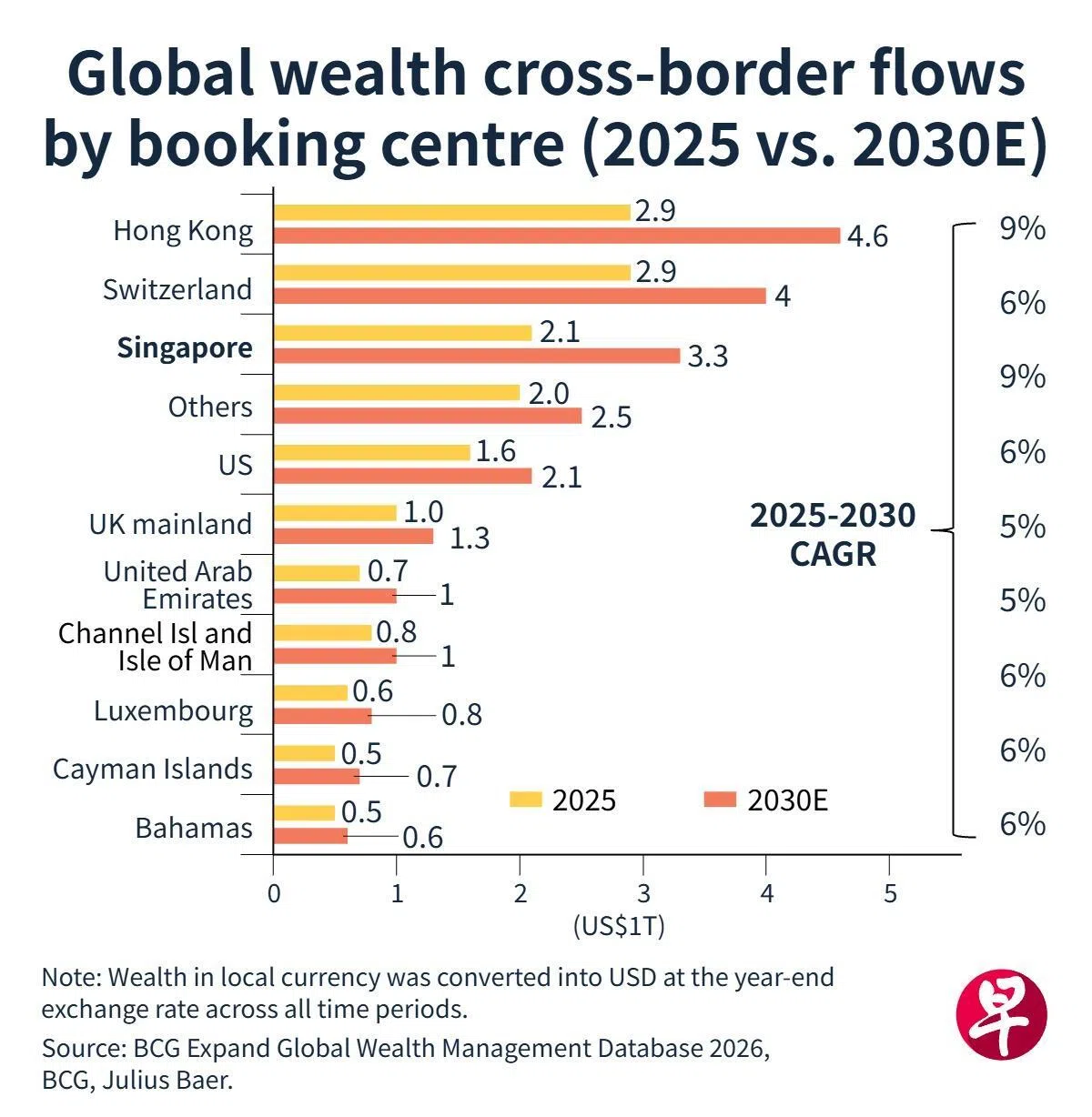
Data from Boston Consulting Group (BCG) shows that Hong Kong and Singapore ranked first and third respectively among global cross-border wealth booking centres in 2025. Hong Kong held about US$2.9 trillion (S$3.7 trillion) in cross-border wealth, compared with Singapore’s US$2.1 trillion. By 2030, these figures are projected to rise to US$4.6 trillion and US$3.3 trillion respectively, both representing compound annual growth rates of 9%.
Chua said that although Asia’s share of global capital markets still falls short of its economic weight, its advanced economies generally pursue prudent fiscal policies, have clear strengths in governance and enjoy strong credit ratings. These give developed Asia the key foundations to serve as a long-term store of wealth.
Asia is home to the world’s largest engines of economic growth, with three of the five largest economies located in the region. Both the wealth and number of high-net-worth individuals in Asia are also growing rapidly. According to consultancy Capgemini, the wealth of high-net-worth individuals in the Asia-Pacific region rose by 10.5% in 2025, while their numbers grew by 9.4%, outpacing all other regions on both measures.
“This irreplaceable convenience and natural home market bias make regimes in developed Asia intuitive choices for Asian based investors looking for dependable places to park their assets. They also offer credible alternatives for global investors from markets in the West looking to establish satellite offices through which they can diversify.”
Nevertheless, she believes Asian wealth centres will not displace Switzerland as the world’s leading wealth haven in the near term. Two parallel wealth networks could emerge: a Western axis centred on Switzerland, the US and the UK, and an Asian axis centred on Hong Kong and Singapore.
In its investment strategy, Julius Baer has an “overweight” rating on equities in Japan, China and Singapore, expecting these markets to outperform regional or global benchmark indices over the next nine to 12 months.
