

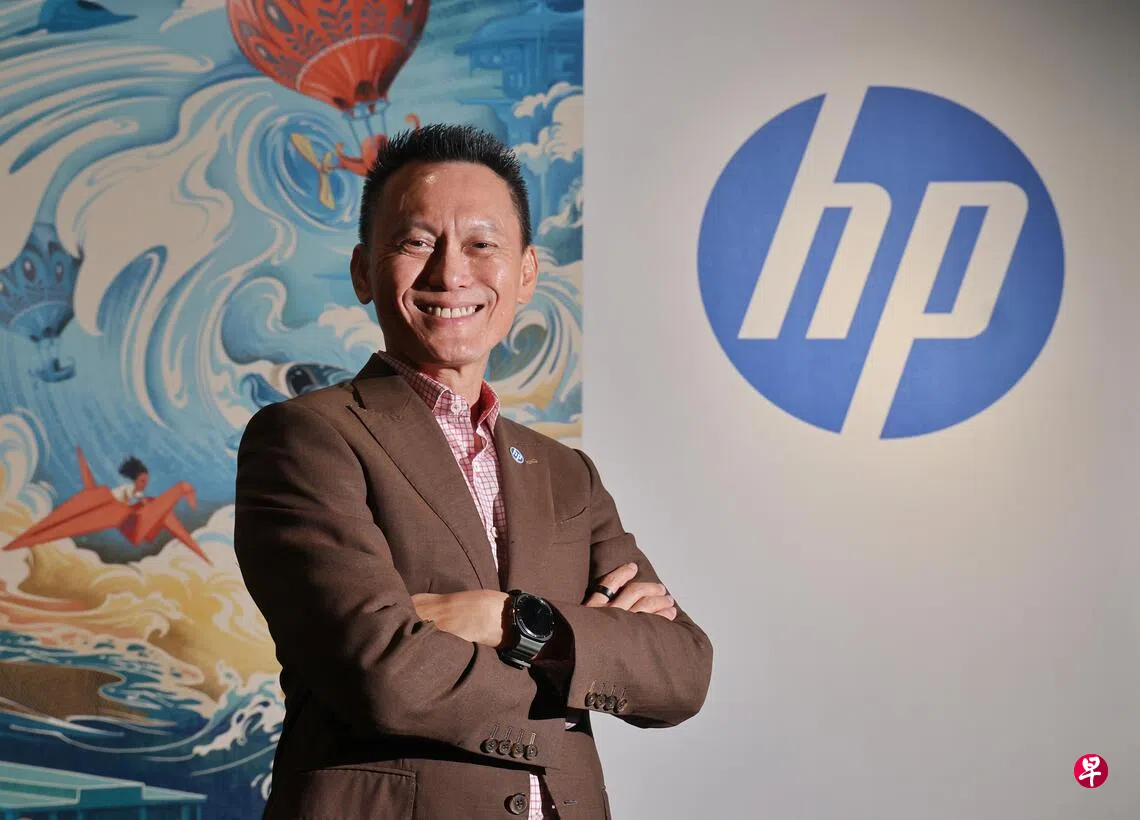
The interview fell on the last day of the financial year, and the first thing Koh Kong Meng, managing director of HP Southeast Asia and Singapore, recalled was the “unease” at the start of the year.
Chip shortages and soaring component prices had left the computer market facing challenges on both supply and costs.
Those headwinds have yet to ease. Intel recently released its results, forecasting that the personal computer (PC) market would remain weak until at least the first half of 2027. Its shares plunged 20% in response.
HP executives also said in September that they expected industry-wide PC shipments to fall by a mid-single-digit percentage next year.
In an exclusive interview with Lianhe Zaobao (LHZB), Koh acknowledged that rising prices were shrinking Southeast Asia’s computer market. In markets such as Indonesia and the Philippines in particular, some consumers could no longer afford entry-level computers.
He found that business customers were concerned about shortages and wanted relatively stable prices to plan their procurement budgets. “The key thing that customers wanted from us was supply... beside supply availability, the pricing stability, not assurance of pricing.”
To address this, HP and its dealers built up stocks in advance, using lower-cost inventory to cushion the impact and keep supplies and prices as stable as possible.
Koh Kong Meng stressed that HP had no intention of competing for market share by offering the lowest prices. “We have never been a price leader, and I don't think we want to be a price leader in that sense.”
But building up inventory ahead of time is only a stopgap. The industry as a whole still faces pressure on profit margins.
Revenue at HP’s Personal Systems business rose 18% year on year to US$11.8 billion in its third financial quarter, even as computer shipments fell 16% and its operating margin declined to 4.6%.
The group had previously said that the benefits of lower-cost inventory had largely faded, and that it was responding through adjustments to its product mix, cost management and pricing.
Despite the near-term pressures, Koh remains optimistic about the growth prospects for artificial intelligence (AI) PCs. These are a new generation of computers with built-in AI hardware that can run AI locally.
Looking back at the evolution of computers, he said the PC was conceived to bring computing power out of vast computer rooms and into ordinary homes.
That mission has never changed. Today, AI PCs are putting some of the computing power that migrated to the cloud back into users’ hands.
AI need not always run in the cloud: PCs remain the best entry point
Koh noted that demand for PCs had not diminished. Even as smartphones and tablets become increasingly widespread, they cannot replace PCs for work, learning and content creation. HP still has 500 million active devices worldwide.
As AI becomes more widespread and processors more powerful, PCs will take on more computing tasks that previously relied on the cloud, further raising users’ requirements for their devices’ computing power.
“The best device to act as the point of entry for AI, we believe, is still the PC.”
One major driver of this shift is the rising cost of cloud-based AI, which is typically charged by token usage.
Koh explained that developing and training large AI models requires vast amounts of data, computing power and memory, so data centres remain essential. Once trained, however, models can be scaled down to run on PCs.
Tasks such as summarising emails and drafting documents need not all be processed in the cloud — smaller AI models on a computer can handle them too. This is not only “almost free” but also works without an internet connection and helps keep data secure.
This does not mean the cloud will be replaced. Koh sees promise in a hybrid AI model that lets users choose whether to run AI locally, in the cloud or through a combination of both, depending on their needs.
He also noted that Singapore’s limited land and power resources make it difficult to meet growing demand for computing power simply by building more data centres. There is therefore considerable scope for personal devices to take on some of the work now handled by the cloud.
Research firm IDC forecasts that by 2030, as much as half of enterprise AI inference workloads in the Asia-Pacific region will run on endpoint devices such as PCs, or on edge computing nodes — devices located near users and data sources.
However, AI PCs generally cost 10% to 20% more than conventional PCs, one reason consumers and businesses may be reluctant to replace their computers.
Koh did not shy away from the price premium. He believes users are willing to pay it because AI can improve productivity and allow more applications to run locally on their computers, reducing reliance on paid cloud services.
AI PCs already accounted for 46% of HP’s computer shipments in its third financial quarter. The group expects that proportion to rise to between 60% and 70% in financial year 2027, and exceed 70% in financial year 2028.
Beyond selling PCs: connecting software and hardware for smarter workplaces
Beyond computer hardware, HP also hopes to use AI to connect software and office equipment, allowing previously separate cloud and desktop environments to work closely together.
This year, the group launched HP IQ, a local AI software platform that includes a large language model. It helps employees analyse documents and prepare meeting summaries directly on their computers.
It can also identify and connect to meeting-room equipment and seamlessly share information with colleagues, without uploading sensitive data to the cloud.
Koh cited background blurring in video conferences as an example.
Previously, this function relied mainly on the central processing unit (CPU), consuming computing resources, slowing the computer and using more power. An AI PC can now assign the same work to a neural processing unit (NPU), which is designed specifically for AI tasks, easing the burden on the CPU.
Users may not notice what has changed inside their computers, but they can experience smoother video conferences and longer battery life.
Koh said HP wanted to make digital devices easier to use. The best AI integrates technology naturally, without requiring users to understand the complex computing processes behind it.
HP is also experimenting with alternatives to the traditional computer form. One example is the EliteBoard G1a AI PC, which integrates the computer, speakers and microphone into a slim, lightweight keyboard, offering a new option for office spaces.
Using AI to connect PCs, software and office equipment is becoming a new area of growth on which HP is betting. Software, peripherals, collaboration solutions and related services now contribute about a third of the total gross profit of HP’s Personal Systems business.
Singapore is a microcosm of global operations
Besides traditional rivals such as Lenovo and Dell, chipmakers including Nvidia are stepping up their investments in AI PCs. What gives HP a distinctive competitive edge?
“I think one of the key things, to be honest, not so much the hardware. It is our people.”
Koh pointed to the trust that generations of HP employees have built with customers over the years — an advantage that hardware or software would struggle to replace. After years of working together, many customers have become true partners rather than simply buyers.
The group has more than 2,000 retail outlets across Southeast Asia, serving customers ranging from individual consumers to small and medium-sized enterprises and other organisations.
Koh said HP currently ranks second by market share, but would not pursue market rankings for their own sake. As long as it continues to meet customers’ needs, market share will follow.
Regarding Singapore’s role in HP’s regional operations, he described the country as almost a microcosm of the group’s global business.
Having been based here for 56 years, the group has a local presence for all its major functions. Besides regional management, these include research and development for PCs and printing, advanced manufacturing, supply chain operations, finance and human resources.
Singapore is also an important base for HP to explore new technologies and foster innovation partnerships. Last year, HP launched its first innovation platform, Garage 2.0, which has brought together about 20 start-ups.
After more than 30 years in the industry, keep learning to go further
Despite spending more than 30 years in the technology industry, Koh does not believe that greater seniority necessarily brings an advantage. “Thirty years of experience could simply mean repeating the same year’s work 30 times.”
In an era of rapid technological change, he stays curious and is willing to listen to different views. He particularly enjoys talking to younger employees and, through HP’s Spark management trainee programme, learning from their knowledge, fresh thinking and enthusiasm.
Looking back on his career, his most memorable experience was the market downturn following the September 11 terrorist attacks in 2001.
He had just taken charge of IBM’s PC business in Singapore and was leading a team for the first time. Overcoming weak market demand and inventory pressures to revive the business taught him the importance of staying positive and resilient.
Looking ahead to next year, he acknowledged that the market was hard to predict. But as an optimist by nature, he believes there is no harm in setting higher goals.
Where does that confidence come from? With a smile, Koh offered an analogy: if you were always worried about being hit by a car when you went out, would you simply never leave home?
That easy-going streak was also evident in the cup beside him: despite his sharp suit, he had chosen a cute cup with a pink straw.
HP names former GSK chief as CEO
On 5 November, HP appointed Emma Walmsley, the former head of pharmaceutical company GSK, as its chief executive, effective next January.
Walmsley will lead HP in seizing a crucial opportunity to transition towards AI devices amid a weak PC market.
Although she lacks direct experience in the hardware industry, her strong track record of leading major companies through significant change has fuelled market expectations. HP’s shares rose more than 6% in after-hours trading following the news.
Walmsley led GSK for nearly nine years, overseeing the spin-off of its consumer healthcare business, substantially improving its operating performance and strengthening its balance sheet.
Before that, she spent 17 years at L’Oréal. Her closest connection to the technology industry was her seven years as a Microsoft director.
Market analysts see Walmsley as a “portfolio” rather than a “product” chief executive, who could bring a fresh perspective to HP’s strategic and financial direction.
