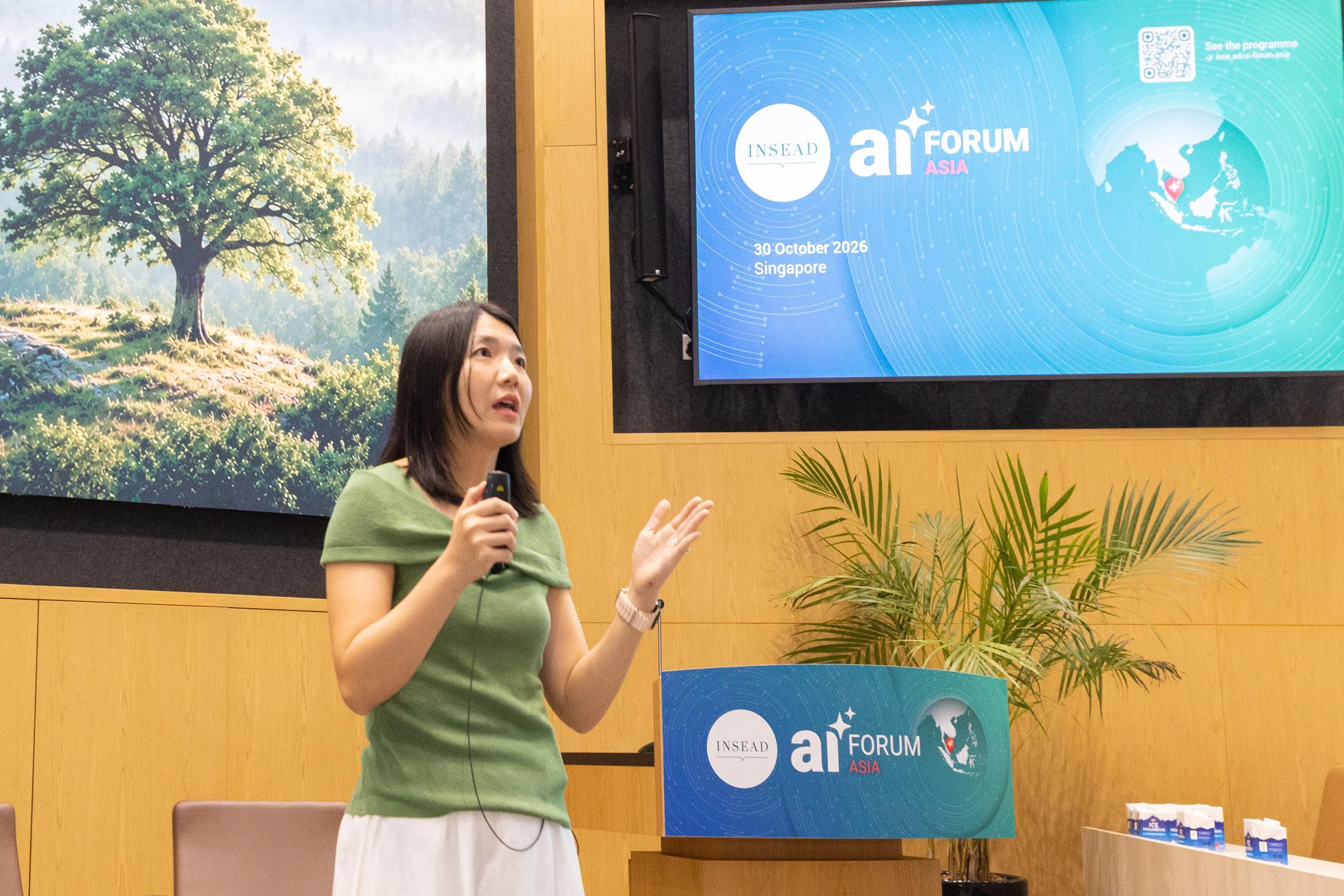
INSEAD’s Singapore campus has received US$3 million (about S$3.84 million) in funding from Google to study how people and businesses can benefit from technological transformation.
The school announced the funding on Friday (30 October) at the INSEAD AI Forum Asia.
The new INSEAD Thrive Lab has received US$3 million from Google’s philanthropic arm, Google.org, and its artificial intelligence research and development unit, Google DeepMind.
The lab will focus on two main questions: how people can strengthen their personal, social and psychological capital amid continual technological change, and how learning ecosystems spanning education, communities and workplaces must evolve to build these forms of capital.
Winnie Jiang, an associate professor of organisational behaviour at INSEAD who is leading the research, told Lianhe Zaobao: “Many employees worry about whether artificial intelligence will replace their jobs. We want to study how people can maintain their ability to learn and their drive to develop, and continue to create work that we find meaningful and economically valuable.”
The lab will use its findings to design courses and training materials to help people and businesses better address the challenges posed by rapid technological change.
She hopes the lab’s findings will have a tangible social impact and offer actionable insights to help individuals and organisations not only adapt to a rapidly changing world, but thrive in it.
Countries should work together to address cybersecurity risks
Meanwhile, speaking at a fireside chat at the INSEAD AI Forum Asia, He Ruimin, the government’s chief artificial intelligence officer at the Ministry of Digital Development and Information, said AI technology can bring people many conveniences but also carries potential risks. He said Singapore actively promotes good governance and called on countries to work together to address cybersecurity risks.
He said that when a cybersecurity incident occurs — for instance, when an AI agent breaches another system — someone must take responsibility for reporting it.
“This certainly should not fall solely on the victims, because they may not know that their systems have been breached. I think the parties involved should bear some responsibility for proactively disclosing the actions of their AI agents. This could be voluntary at the outset.”
He also said there would be no point in a code of conduct implemented by just one country. It must be a framework involving multiple countries, major technology companies and other relevant stakeholders.
On how Singaporeans should approach emerging AI technology, he said people should actively use it while remaining vigilant and taking its risks seriously.
Kenny Tan, Deputy Secretary at the Ministry of Manpower, also stressed at the forum that the purpose of using AI is to enable people to do more valuable things.
“I think this is the key to enabling businesses to thrive. Secondly, for employees, it can fundamentally change the way we work… It gives people time to do more meaningful work, such as building relationships.
“It can also give us more time and space to rest, learn and spend time with our families.”