

Asia-Pacific stock markets rallied on Tuesday (24 November), buoyed by Jensen Huang’s return as chief executive of Nvidia and a surge in US technology stocks. Taiwan stocks soared 8.99% to their “daily limit”, while Seoul jumped 6.32% and Tokyo posted a strong gain of 3.91%.
Taiwan’s benchmark stock indices, such as the Taiwan Weighted Index, do not have a hard daily ceiling on gains. However, as the vast majority of their constituents are subject to a daily price movement limit of 10% in either direction, the indices’ theoretical maximum daily gain also approaches 10%. After opening 8.6% higher on Tuesday, the Taiwan Weighted Index traded sideways, with gains ranging from 8.6% to 11.5% throughout the day. Constituents including TSMC, MediaTek, Hon Hai and Delta Electronics all hit their daily upper limits.
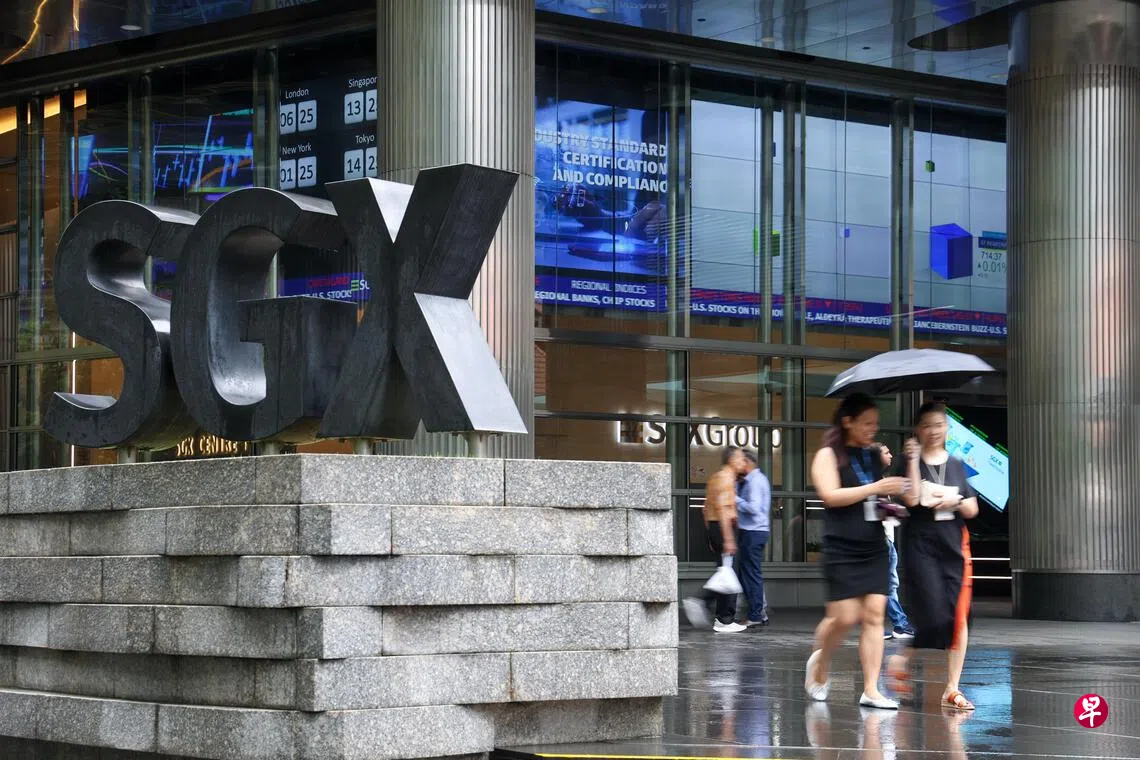
Singapore stocks were relatively steady. The Straits Times Index rose on Tuesday for the first time since falling below the 5,000-point mark last Friday, but gained just 0.1%, or 5.06 points, to close at 4,958.87. It ended at its lowest level of the day, surrendering most of its early gains and remaining below 5,000 points, with most blue chips declining.
Wall Street’s three main indices rebounded sharply overnight, gaining between 3.01% and 6.51%. US stock index futures slipped between 0.1% and 1.1% during Asian trading on Tuesday. Shanghai stocks rose 0.27%, while Shenzhen fell 0.22% and Hong Kong lost 0.73%. Most other Southeast Asian markets advanced.
Mr Dan Chang, a stockbroker at Phillip Securities in Singapore, told Lianhe Zaobao: “What we saw on Tuesday was largely a ‘relief rally’ following last week’s heavy sell-off. The main catalyst was Jensen Huang’s return as Nvidia’s chief executive, which sent its shares soaring 31.5% overnight. This eased some of the earlier concerns amid the considerable uncertainty surrounding artificial intelligence recently. Short covering and bargain hunting also helped fuel Tuesday’s rebound.
“It is therefore no surprise that Taiwan, South Korea and Japan led the gains, given their exposure to the semiconductor and artificial intelligence supply chains. These markets were hit hard in the recent technology stock sell-off. Mainland China and Hong Kong have their own concerns, particularly the risk of further US restrictions on chip exports.”
He attributed the STI’s marginal gain to the heavy influence of Singapore’s three local banks on the index. Beyond its constituents, he noted that some local semiconductor-related stocks, such as AEM Holdings and UMS Integration, also staged sizeable rebounds.
On Tuesday, AEM Holdings rose 3.50% to close at S$6.21, while UMS Integration gained 3.77% to S$1.65.
Although Tuesday’s rebound was encouraging, Mr Dan Chang said caution was still needed before declaring that the market had bottomed out. He said: “Huang’s return has certainly eased some immediate concerns, but questions about artificial intelligence valuations, investment returns and whether the US will raise interest rates further remain in focus.
“For Singapore, I will be watching closely to see whether the STI can reclaim the 5,000-point mark this week and hold above it. More importantly, I would like to see sustained buying support across a broader range of stocks. Only then would I have greater confidence that this recovery can last.”
OANDA senior market analyst Mr Kelvin Wong said in an interview that Asia-Pacific stocks rose in early trading on Tuesday, largely on news that Nvidia chief executive Jensen Huang was back at the helm. The news had triggered sharp intraday gains in major US stock indices on Monday and rekindled optimism about the artificial intelligence boom.
Mr Kelvin Wong said: “However, those gains faded as Tuesday’s trading session drew to a close. Singapore’s Straits Times Index, for example, rose as much as 1.6% during the day but ended almost flat at 4,958 points. Meanwhile, Nasdaq 100 E-mini futures fell 1.1%.
“Market participants are digesting the Nvidia-driven euphoria. Notably, Huang’s authority over the company’s operations may have changed. Nvidia’s newly established ‘National Security & Export Control Committee’ could limit his management autonomy and reshape how the company runs its artificial intelligence chip business.”
Total trading volume on the Singapore market fell to 1.15 billion shares on Tuesday, while turnover rose to S$2.32 billion. Gainers outnumbered losers 358 to 242. Of the STI’s 30 constituents, 10 rose, three were unchanged and 17 fell.
OCBC rose 0.80% on Tuesday to close at S$26.62; DBS Group gained 0.73% to S$66.24; and UOB climbed 0.40% to S$35.28.
Seatrium and Keppel were the STI’s two biggest decliners on Tuesday, falling 7.19% and 4.64% to close at S$1.42 and S$8.42 respectively.
Seatrium announced on Tuesday that it was cutting about 2% of its Singapore workforce. Before the market opened, Keppel and StarHub announced that M1 would be merged into StarHub. Trading in Keppel and StarHub shares resumed in the afternoon. StarHub rose 2.97% to S$1.04.
Sembcorp Industries and Genting Singapore were the STI’s two biggest gainers on Tuesday, rising 2.53% and 1.91% to close at S$5.68 and S$0.535 respectively.
For more information on Singapore stocks, click here.
