

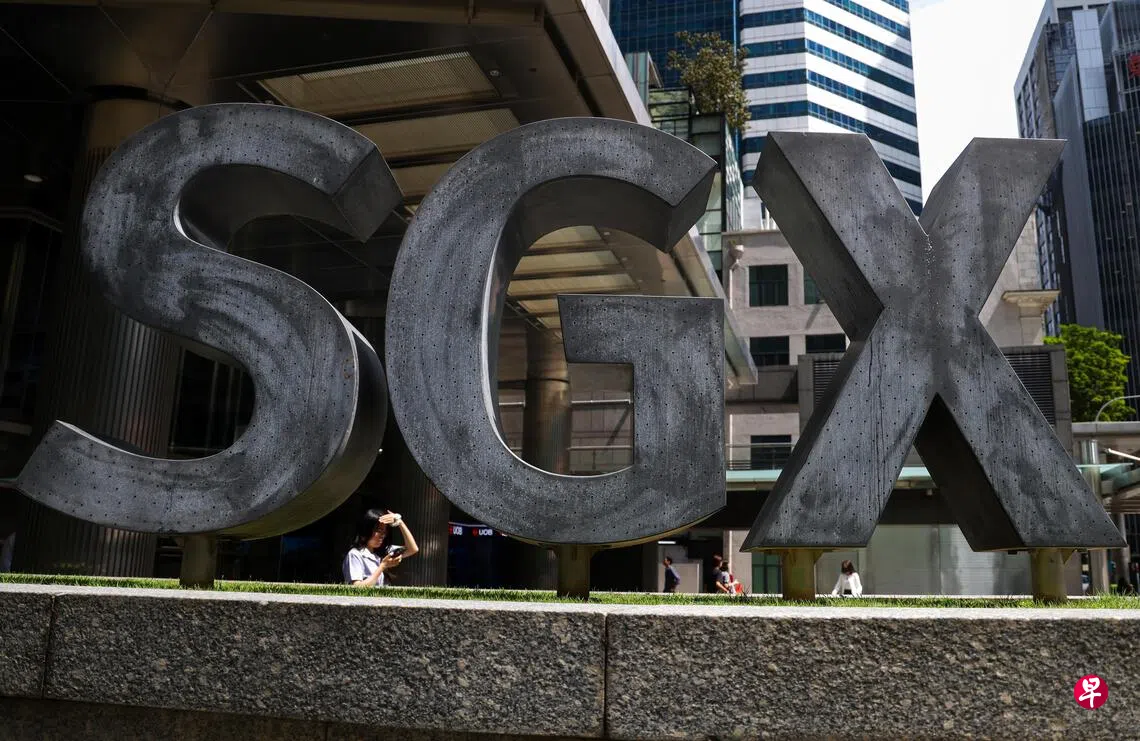
Despite last week's market turmoil, retail investors were the biggest buyers in the Singapore stock market, with net purchases of S$257.4 million. This brought their net inflows for the year to date to S$6.83 billion. Institutional investors recorded net purchases of S$38 million last week.
Retail and institutional investors took opposing positions last week, the Singapore Exchange said in a market report released on Monday (23 November). Of the 69 stocks with average daily turnover (ADT) of more than S$3 million this year, the two groups took opposite sides in 55.
Retail investors net bought S$133 million of the 15 stocks that fell more than 10%, while institutional investors net sold S$137 million. In 12 of these stocks, retail investors were net buyers and institutional investors were net sellers. Across the other 54 stocks, which either fell by no more than 10% or rose, both groups were net buyers.
Retail investors' largest net purchases were in DBS Group, at S$51.7 million, followed by UOB (S$48.2 million), ST Engineering (S$40.8 million), Seatrium (S$38.8 million), AEM Holdings (S$28.3 million) and Keppel Ltd (S$16.4 million).
These six stocks accounted for 87% of retail investors' net purchases, or about S$224 million. Institutional investors, meanwhile, net sold S$158 million of these stocks. The six stocks fell between 5.4% and 19.9% last week.
Institutional investors' five largest net purchases were in CapitaLand Ascendas REIT (S$84.8 million), Singtel (S$63.9 million), OCBC (S$63.1 million), Yangzijiang Shipbuilding (S$34.4 million) and CapitaLand Integrated Commercial Trust (S$18.7 million), totalling about S$265 million.
The SGX report noted that institutional investors were net sellers of companies focused on artificial intelligence-driven productivity, and net buyers of infrastructure-related companies, including energy and connectivity stocks such as Singtel and Sembcorp Industries.
Meanwhile, the Philadelphia Semiconductor Index (SOX) fell 17% last week, reducing its total return for the first 47 weeks of the year to 19%. Its price-to-earnings (PE) ratio returned to 29 times, close to the 28 times recorded in early April last year.
