

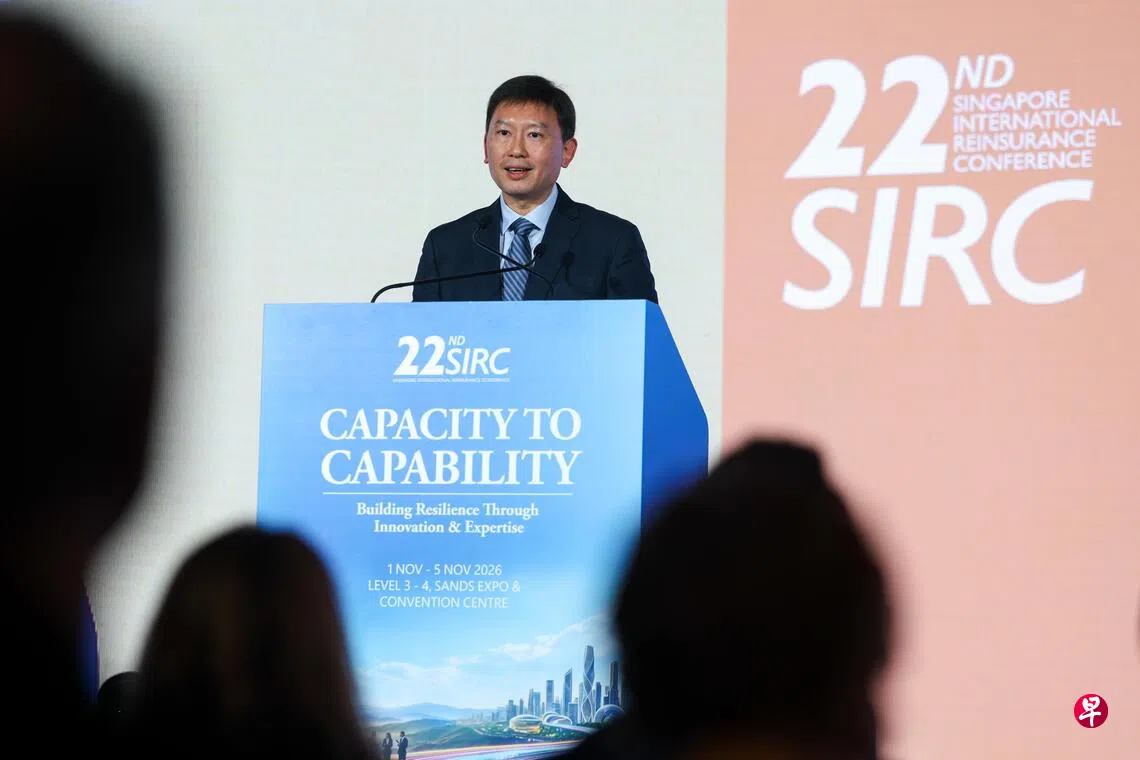
The Monetary Authority of Singapore (MAS) will introduce a series of measures, including a S$30 million grant scheme and a public consultation on refinements to the insurance capital framework, to strengthen insurers’ infrastructure investment capabilities and help them deploy long-term capital in infrastructure and asset securitisation.
Minister for National Development and MAS Deputy Chairman Chee Hong Tat announced the support for insurers’ investments in infrastructure in a speech at the 22nd Singapore International Reinsurance Conference (SIRC) on Monday (2 November).
Chee said that as large-scale investment in energy networks, submarine cables and data centres across Asia continues to grow, insurers can go beyond their traditional role of sharing risks. As long-term institutional investors, they can also mobilise “patient capital” to support regional development and financing needs.
The insurance industry in the Asia-Pacific currently manages more than US$10 trillion (about S$13 trillion) in investable assets, but infrastructure accounts for only about 1% to 2% of investments, leaving significant room for growth.
To help insurers build investment capabilities, MAS is allocating S$30 million under the Financial Sector Development Fund (FSDF) for an Infrastructure Capability Development Grant for insurers, effective immediately.
The grant will help fund insurers’ efforts to build specialist investment teams locally, upskill existing staff and engage professional advisory services to expand their infrastructure investment business, anchoring key investment decisions and management expertise in Singapore.
Dedicated data centre insurance platform to launch with US$200 million in underwriting capacity
To address increasingly complex digital infrastructure risks in the region, Chee also revealed that industry representatives, including MSIG, Gallagher Re, SCOR, Samsung Re and the Cyber Security Association of Singapore, are working together to establish a dedicated data centre insurance underwriting platform in Singapore.
The platform will have an initial underwriting capacity of US$200 million (just over S$225.6 million), covering construction, operations, supply chain and cyber risks. A memorandum of understanding on the collaboration will be signed this week.
On the regulatory front, MAS launched a public consultation on the same day on refinements to its second-generation Risk-based Capital Framework (RBC2), with a focus on ensuring that regulatory capital requirements accurately reflect the risks of underlying assets.
Chee said: "Our guiding principle is that regulatory capital requirements should reflect underlying risk. Where infrastructure and other long-term assets demonstrate different risk characteristics, our insurance capital framework should recognise this, while maintaining sound prudential standards and protecting policyholders."
Meanwhile, MAS is working with the industry to improve the accuracy of information used in investment assessments. It is developing standardised disclosure templates, clearer assessment guidance and fund-manager declarations to help insurers assess more efficiently and consistently whether infrastructure projects qualify for preferential capital treatment, while maintaining appropriate due diligence. This will help speed up the deployment of long-term capital.
At the 22nd Singapore International Reinsurance Conference, the Singapore Reinsurers’ Association (SRA) officially launched the Reinsurers’ Artificial Intelligence Handbook. The online handbook aims to provide a practical reference for underwriting, claims and risk management professionals, helping the industry assess artificial intelligence-related risks effectively and inform reinsurance decisions.
The handbook sets out a five-stage assessment cycle covering five core areas: the reliability of data, models and decisions; third-party dependency risks; underwriting processes; claims management; and portfolio concentration risks. It was developed by a dedicated working group comprising members of the association’s technical and legal and compliance subcommittees.
