

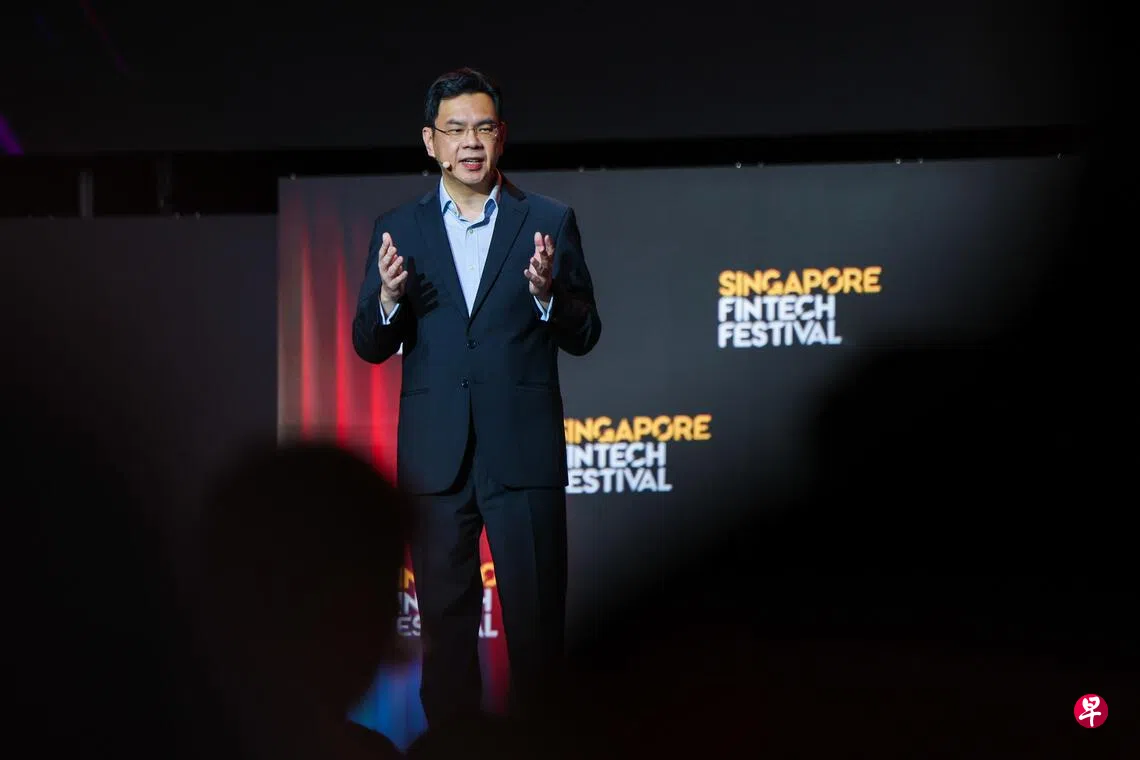
Artificial intelligence (AI) agents could move funds and allocate assets more quickly, prompting financial institutions to consider limits on transactions initiated by these agents to manage liquidity risks, said Chia Der Jiun, managing director of the Monetary Authority of Singapore (MAS).
Speaking at the Singapore FinTech Festival (SFF) on Thursday (19 November), Chia said: “Regulators will have to consider the implications for financial stability from agentic participation in financial markets and movement of deposits.”
He said AI agents were beginning to shop and make payments on behalf of consumers, and manage cash and liquidity for businesses. However, many financial institutions have yet to set terms for agents to use financial services or establish channels for them to do so.
Some users have already handed their financial account login credentials to AI agents, he noted. He advised against this, as adequate safeguards are not yet in place. Financial institutions face difficulties verifying whether agents have been authorised by customers and whether transactions go beyond their instructions.
He announced that MAS would develop a common “know your agent” protocol. This would allow financial institutions to establish an agent’s identity, whom it represents, what permissions it has, and what assurances there are about its provenance and reliability. Institutions could then determine which services the agent may access and under what conditions, and establish dedicated, secure access channels.
MAS will also set up a sandbox with the Future of Finance Institute to test the use of AI agents in corporate treasury management and payments.
For example, businesses could authorise agents to monitor liquidity and payments falling due, and transfer funds using tokenised deposits. For payments, agents could use tokenised deposits or stablecoins. Participating banks or payment service providers would have to verify agents’ identities and permissions, and apply risk controls before executing transactions.
Chia said the future would likely see a human economy coexist with an emerging agentic economy. Business models and practices would have to adapt to the speed and manner in which agents transact. Thinking ahead about the agentic economy would help shape policies to “harness the benefits of more efficient markets and expanded economic opportunity while minimising the potential risks”.
He said: “Importantly, consumers and businesses need to retain meaningful control over the objectives, mandate and actions of their agents. Autonomy has to be bounded. Actions and outcomes have to come with accountability.”
MAS advances collateral tokenisation, explores including foreign government securities
Chia also discussed how tokenisation was transforming the financial industry. He announced that MAS would turn SGD Testnet into a live settlement facility and rename it SG Digital Ledger. The network has already supported interbank settlement and the issuance of MAS bills. It will next support settlement across institutions and ledgers, covering different tokenised assets and digital currencies.
Although more financial assets have been tokenised, their value remains small relative to traditional markets, Chia said. Scaling up adoption requires commercially attractive use cases, trusted digital currencies and interoperable settlement infrastructure.
Citing collateral management as an example, he said tokenisation could speed up the transfer and posting of collateral while reducing costs. This month, MAS issued S$100 million in tokenised MAS bills, settled using Singapore-dollar central bank digital currency.
MAS will next work with the industry to explore tokenising other commonly used collateral, including widely used foreign government securities and money market funds.
