

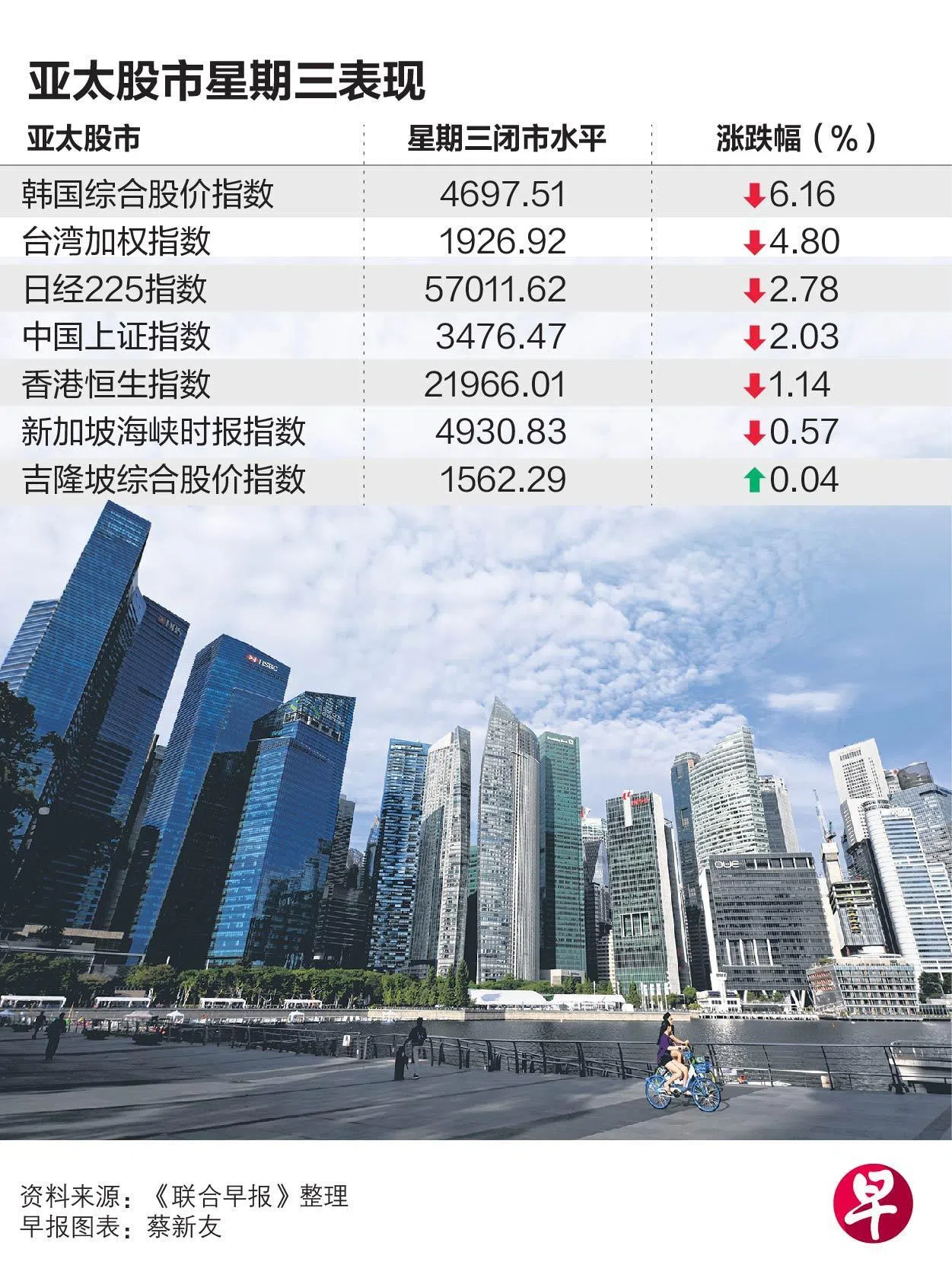
Facing the twin blows of a proposed new round of US tariff measures and a global pullback in semiconductor shares, Asia-Pacific stock markets came under broad pressure on Wednesday, with Seoul and Taiwan suffering particularly steep losses. Singapore was not spared, falling 0.57%.
Analysts interviewed said regional markets were likely to see sharp swings this week, while Singapore’s Straits Times Index could also remain weak. However, its relatively low weighting of technology stocks could cushion it against the pressure facing other regional markets. Singapore manufacturers have also been expanding into new markets and diversifying their businesses, which is expected to limit the impact of tariffs.
Asia-Pacific markets were broadly lower on Wednesday (25 November), with Seoul suffering the heaviest sell-off, tumbling 6.16%. South Korean chip giants SK Hynix and Samsung Electronics plunged more than 11% and 9% respectively.
Taiwan followed with a 4.80% decline, while leading chip foundry Taiwan Semiconductor Manufacturing Company (TSMC) fell 3.59% that day. Shanghai and Tokyo also came under pressure, both falling more than 2%.
Research Analyst, Research & Portfolio Management, FSM Global Adeline Gao Yuanhui told Lianhe Zaobao that two main factors had driven the decline in Asia-Pacific markets. A sell-off in US technology stocks had fuelled risk aversion, weighing on investor sentiment across the region, while US tariff measures had dealt a further blow to confidence.
On Tuesday, AMD and Intel both fell more than 8%, while Nvidia and Broadcom declined more than 5% and 3% respectively.
Gao said that as artificial intelligence (AI) company valuations and spending continued to rise, investors were increasingly concerned that actual earnings growth would fail to keep pace. They had therefore begun taking profits in stages.
Among Singapore technology stocks, AEM Holdings fell more than 6% on Wednesday, while UMS Integration and Nanofilm Technologies both lost more than 3%.
Analysts expect limited impact from new US tariffs
Reuters reported on Wednesday, citing US officials, that the US government had proposed new tariffs on 14 major trading partners, including Singapore, to address what it described as overcapacity.
Gao said higher tariffs would inevitably weaken the competitiveness of Singapore’s export sector, particularly electronics. However, the extent of the impact would depend on the final tariff rates and the range of products covered.
UOB Kay Hian trading representative Wang Hanhui said in an interview that the latest round of tariffs was expected to have a milder impact on Singapore’s stock market than previous increases, as many Singapore manufacturers had already diversified their production locations and markets. “I would therefore view tariffs not just as a risk, but also as a catalyst for supply-chain restructuring.”
Wang expected investors to become more cautious and the STI to remain weak this week. However, with its constituents spanning several sectors and its limited exposure to technology and semiconductors, the index was expected to prove more resilient than other regional markets.
Investors advised to focus on industrial and defensive stocks
Wang advised investors to focus on defensive stocks, particularly companies with low debt ratios, strong balance sheets and healthy cash flows. He said: “In this environment, financial resilience is just as important as growth potential.”
Gao said industrial stocks among the STI’s constituents remained worth watching, given their promising earnings growth prospects. Recent share price pullbacks had also created more attractive entry points for investors.
Meanwhile, Nvidia founder Jensen Huang will appear at a US congressional hearing next week to face questions over whether he helped China obtain advanced chips. Wang said the hearing would affect short-term investor sentiment towards the semiconductor and AI sectors. Shares of related Singapore companies could also be affected, even if they had no direct links to Nvidia.
However, he noted that investors were more focused on whether the semiconductor industry could sustain its long-term profitability beyond 2028, whether AI spending could deliver commensurate returns, and chip supply and demand trends.
