


OCBC reported a 3% year-on-year rise in third-quarter net profit to S$2.042 billion. The bank said the increase was mainly driven by strong growth in its wealth management and wholesale banking businesses, partly offset by weaker investment performance at its subsidiary Great Eastern Holdings.
The result was slightly above the S$2 billion consensus forecast in a Bloomberg survey of analysts. OCBC was also the only Singapore bank to beat market expectations for net profit this earnings season.
OCBC released its third-quarter results for 2026 before the market opened on Friday (6 November). Its net interest income rose 4% year on year to S$2.313 billion, mainly driven by loan growth and higher yields. Higher funding costs partly offset the increase.
The bank’s third-quarter net interest margin was 1.66%, down 18 basis points from 1.84% a year earlier. This was mainly because higher US interest rates put pressure on margins during the quarter, although the benefits could gradually materialise over the coming quarters.
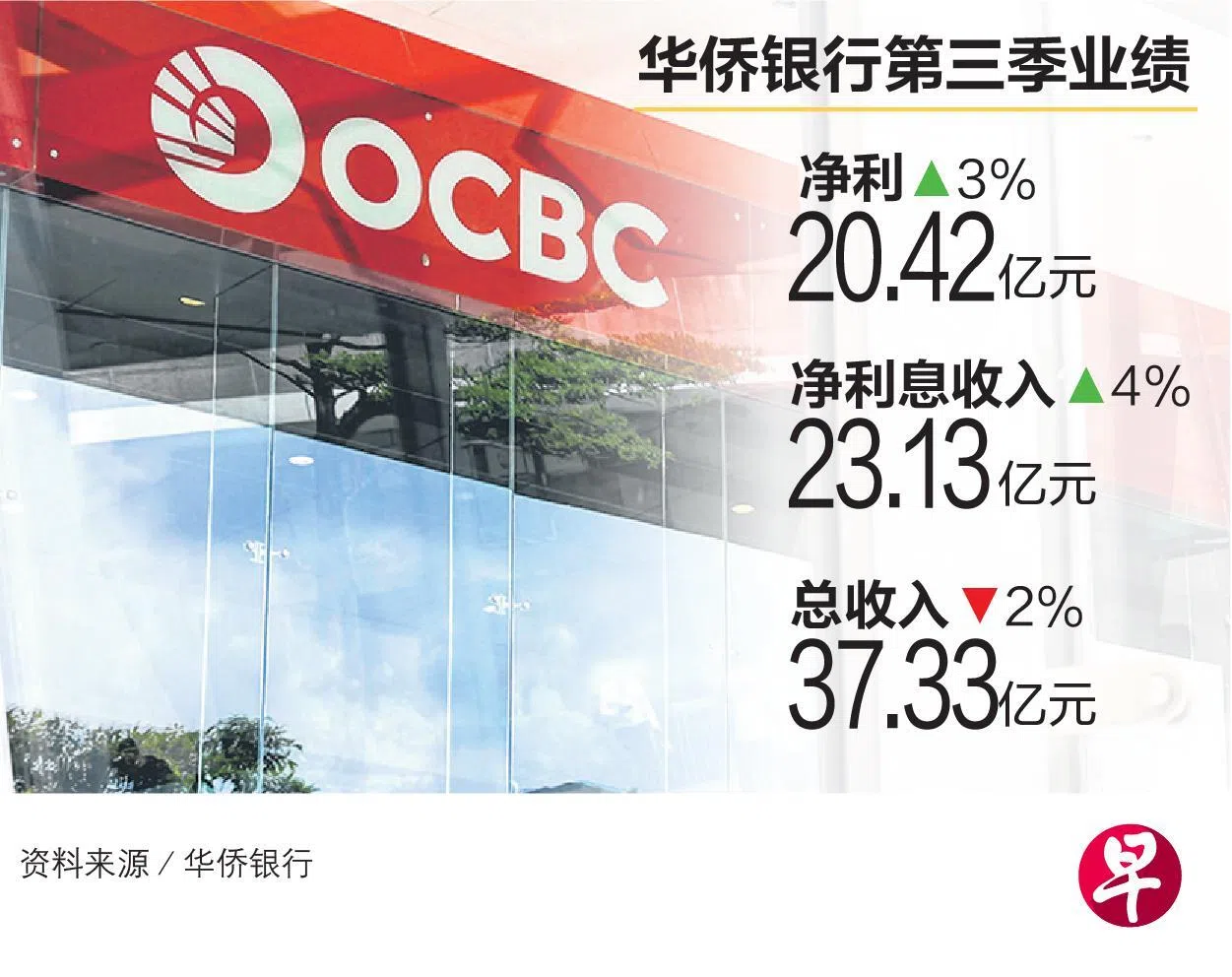
Non-interest income fell 10% year on year to S$1.42 billion, mainly weighed down by Great Eastern Holdings’ weaker investment performance. Wealth management income declined 25% quarter on quarter. Excluding the impact of Great Eastern Holdings’ performance, the bank’s wealth management income grew 2%.
The bank’s non-performing loan ratio fell to 0.8%, from 0.9% a year earlier.
For the full year, OCBC expects net interest income to be flat or decline slightly and total income to grow by a mid-single-digit percentage. It raised its loan growth forecast to a low-double-digit percentage.
OCBC chief executive Tan Teck Long said the global outlook remained uncertain amid geopolitical tensions and the risk of high inflation. The near-term outlook depended largely on whether the impact of the Middle East conflict on energy prices eased. “At the same time, we are also closely monitoring market developments in Indonesia.”
Global stock index provider MSCI had earlier planned to downgrade Indonesia to standalone market status, its lowest classification, triggering a sharp sell-off in Indonesian stocks.
Tan noted that the bank’s loan assets and assets under management had actually grown in local currency terms, or Indonesian rupiah. The impact came from currency translation when compiling financial results at group level. The rupiah has depreciated by at least 8% against the Singapore dollar since the start of the year.
OCBC focuses on project risks and debt-servicing capacity in AI and data centres
Meanwhile, the US midterm election results prompted investors to reassess the AI and data centre sectors, triggering a series of technology stock sell-offs. Asked by Lianhe Zaobao (LHZB) about a potential bubble in these sectors, Tan said the bank’s data centre loan exposure accounted for less than 3% of its overall loan portfolio, while artificial intelligence (AI)-related loans made up less than 1%.
He also said the bank was more concerned about the risks of individual lending transactions and whether projects had sufficient cash flow to service their debt than about the share prices of AI-related companies. “We prefer, for example, hyperscalers. We confirm takeout of the capacity, and we prefer hyperscaler with a portfolio of businesses.”
Greater China accounted for 23% of operating profit in the first nine months, up from 21% a year earlier. The bank has also recovered some of its lending to the region’s property sector.
On the group’s growth prospects in Greater China, Tan noted that although mainland China’s economy faced challenges such as consumers trading down and a weak property market, some industries remained strong, particularly strategic sectors receiving priority support from the Chinese government. The bank has made a series of prudent adjustments in underperforming sectors.
On the impact of Chinese offshore trusts on the wealth management business, Tan said the bank had been closely monitoring whether clients would liquidate assets to meet their tax obligations, but had not seen this happen. “The customers actually kept their existing liquidity and facilities to pay for it.”
Tan was also optimistic about the bank’s other two core markets, Hong Kong and Malaysia. He noted that Malaysia had benefited greatly from global industries: it was part of global supply chains in semiconductors and technology, and also hosted numerous data centres.
OCBC shares closed at S$27.73 on Friday, down slightly by 0.72%.
