

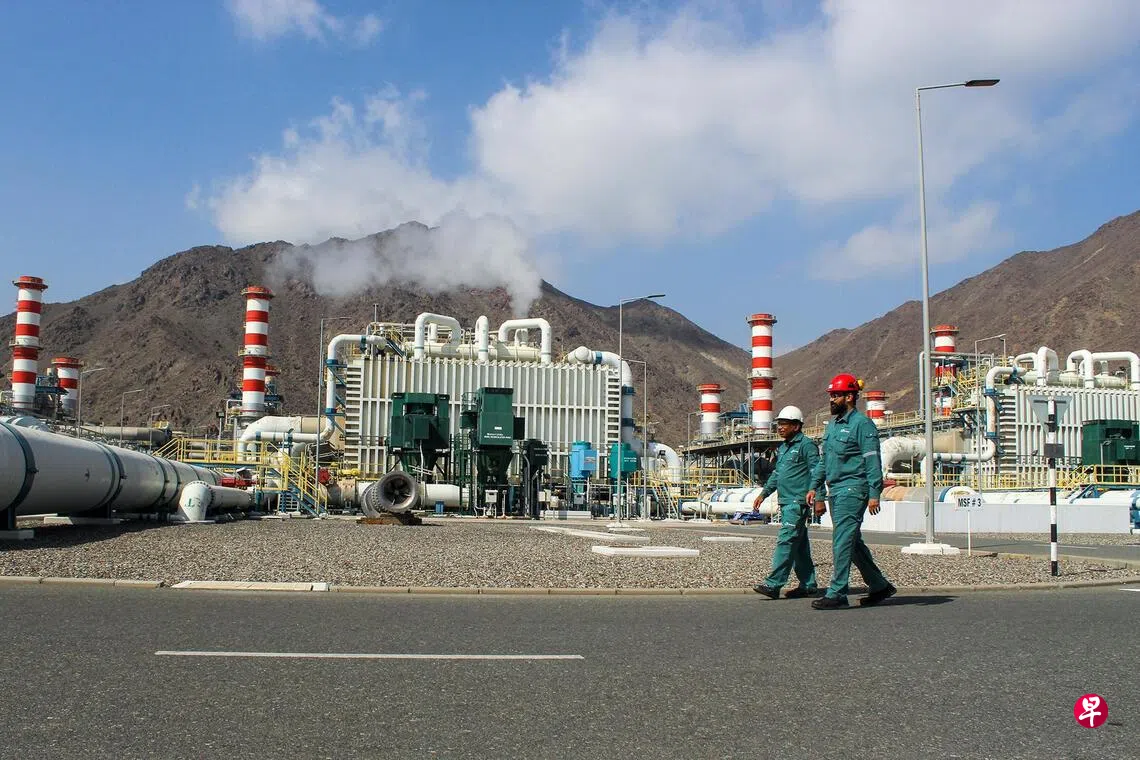
The Taweelah C independent power plant project, with a total investment of AED7.706 billion (about S$2.7 billion), has reached financial close.
Abu Dhabi National Energy Company (TAQA), Emirates Water and Electricity Company (EWEC), Saudi Arabia’s Al Jomaih Energy and Water Company (AEW) and Sembcorp Industries announced this in a joint statement on Monday (23 November).
China Energy Engineering Group (Energy China) has been awarded the project’s engineering, procurement and construction contract. The plant is expected to begin commercial operations in 2029.
Located in Abu Dhabi, the Taweelah C independent power plant is a highly efficient and flexible gas-fired facility with a designed installed capacity of 2.6 gigawatts (GW). It will also be equipped to accommodate carbon capture technology in future.
The statement said the project’s financing comes primarily from senior debt provided by Singapore and international banks. Participating institutions include HSBC, DBS, OCBC, Germany’s KfW, Industrial and Commercial Bank of China (ICBC) and First Abu Dhabi Bank (FAB).
These banks, together with Abu Dhabi Islamic Bank and Dubai Islamic Bank, also served as coordinators and arrangers for the transaction.
Under a previously signed power purchase agreement, EWEC will be the sole buyer of all net electricity generated by the plant.
TAQA, as the local shareholder, holds a 60% stake in the project company. The international consortium comprising AEW and Sembcorp Industries holds the remaining 40%.
TAQA holds a 40% stake in the operations and maintenance (O&M) company, while the international consortium holds 60%.
Electricity demand in the UAE continues to rise, driven by rapid urbanisation, population growth and a boom in data centre construction fuelled by the growing adoption of artificial intelligence (AI).
To fulfil the UAE’s long-term energy strategy for 2050, EWEC is significantly expanding its planned solar photovoltaic capacity. Installed capacity is expected to reach 15.5 GW by 2030 and exceed 35 GW by 2035.
Given the intermittent nature of large-scale renewable energy fed into the grid, the Taweelah C plant’s efficiency and operational flexibility will be crucial in maintaining grid stability and balancing electricity supply and demand.
