

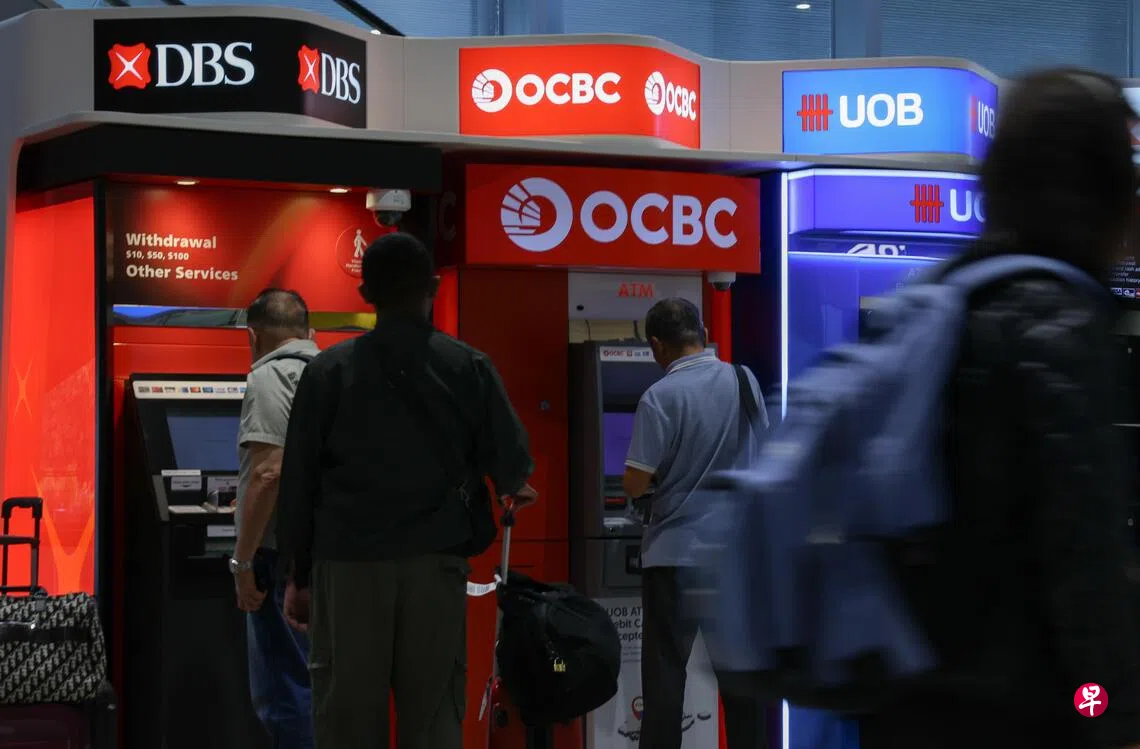
Singapore’s three major banks are due to report their third-quarter results. Higher interest rates will drive growth in net interest income, but analysts expect fee income to normalise from its peak. Earnings at the three local banks are therefore expected to fall quarter-on-quarter while still growing year-on-year.
UOB will be the first to report its results on 4 November, followed by DBS Group and OCBC on 5 and 6 November respectively.
Amid weak earnings expectations, the three bank stocks, which have performed strongly this year, were recently sold off by institutional investors, with their share prices falling for several consecutive days.
Jefferies analysts Joanna Cheah and Wei Han Ang told Lianhe Zaobao (LHZB) that higher interest rates should support net interest margins and drive earnings growth. However, investors are focused on the strength of wealth management inflows and recurring fee income, credit costs remaining moderate, and sustainable capital returns.
They said: "These would reinforce confidence that banks can sustain current ROEs (Return on Equity) and valuations."
Loan growth provides impetus
Looking ahead to the third-quarter results, Bloomberg Intelligence's Rena Kwok said in an interview that expanding loan books and stabilising interest margins would drive growth in banks’ net interest income.
According to preliminary data released earlier by the Monetary Authority of Singapore, total bank lending in August rose 13.4% year-on-year.
Kwok added that banks’ wealth management fee income could ease from its peak in the first half of this year. However, net new money inflows are expected to support assets under management and provide a steady foundation for recurring fee income.
With interest rates staying higher for longer, she expects banks’ asset quality to remain stable and credit costs to stay within management’s forward guidance for 2026.
Earlier, JPMorgan analyst Harsh Wardhan Modi noted in a report that surging long-term bond yields would increase mark-to-market (MTM) losses in Southeast Asian banks’ trading books and hurt their capital markets activity.
Kwok sees rising bond yields as a manageable headwind for Singapore banks, as their capital positions will remain robust in the second half, providing sufficient buffers against macroeconomic shocks.
She said: "DBS is least exposed to MTM losses, whereas UOB is most exposed given a larger securities share of which with a higher fair-value allocation, and longer duration."
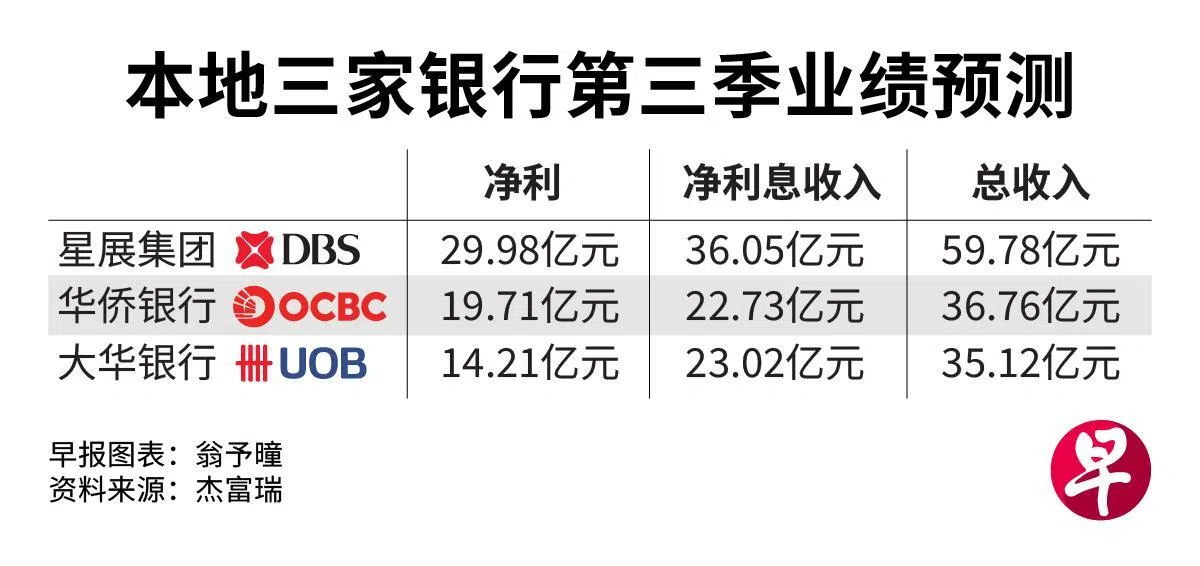
Cheah and Ang forecast that DBS Group’s third-quarter net profit will reach S$2.998 billion, up 1% year-on-year. OCBC’s net profit is expected to remain flat year-on-year at S$1.971 billion, while UOB’s is projected to exceed S$1.4 billion, a sharp increase of 221%.
The analysts explained that UOB’s substantial year-on-year net profit growth reflects a low base, as the bank set aside an additional S$600 million in provisions in the same period last year.
On fee income, Cheah and Ang said DBS and OCBC delivered particularly strong wealth management performances in the second quarter and would subsequently face more demanding year-on-year comparisons. Although inflows remain robust, weaker equity markets could put pressure on trading income.
By contrast, UOB’s wealth management fee income is expected to grow quarter-on-quarter, mainly due to a recovery in credit card fees from a low base and the recognition of loan-related fees deferred in the second quarter.
All three banks retain buy ratings despite share price declines
The three bank stocks have weakened recently, with OCBC’s share price even falling below S$30, but analysts remain positive about its prospects.
Maybank head of research Thilan Wickramasinghe and analyst Amirul Rusydy have a “buy” rating on OCBC, with a target price of S$37.23.
In their latest report, they said the group could draw on the strengths of OCBC, Bank of Singapore and Great Eastern to deepen cross-selling. This could unlock new revenue opportunities and lift return on equity.
OCBC’s increased investment in its Hong Kong wealth centres and relationship managers should also expand its business footprint. Wickramasinghe and Rusydy forecast that OCBC’s return on equity could approach 14% by the 2028 financial year.
The Jefferies analyst team has “buy” ratings on DBS and UOB, with target prices of S$91 and S$48 respectively.
Specifically, the analysts see strong growth momentum in DBS’s wealth management business, while UOB’s ASEAN network is driving stronger growth.
