


Some companies providing data centre and cloud services said they would study the details of the new policy and closely monitor developments after the US tightened controls on exports of advanced artificial intelligence chips to Singapore.
Singtel, which has three data centres in Singapore, expects the new US policy to have a negligible impact.
In response to queries from Lianhe Zaobao, the group said: “Our graphics processing unit (GPU) computing business is a standalone AI platform dedicated to serving customers in Singapore. Most of our customers are in the public sector or are research institutes, and do not re-export chips.”
Customers have signed contracts for 6 megawatts of capacity at Singtel’s AI data centre in Tuas. Of this, 4 megawatts are in use, while the remaining 2 megawatts have yet to be activated. The group said it would closely monitor whether the new policy affects its customers and carefully manage the use of its remaining capacity.
The group also said it would work with the Singapore government to obtain the necessary approvals and apply for licences to import advanced chips from the US.
The US announced on Monday (16 November) that any company seeking to export, re-export or transfer advanced semiconductors within Indonesia, Malaysia, Singapore, Thailand and Brazil must apply for a licence. However, shipments to companies headquartered in the US, or whose ultimate parent company is based in the US, may be exempt from the licensing requirement if they meet specific reporting requirements.
Singapore has strongly promoted the development of its data centre industry in recent years. It now has more than 70 cloud, enterprise and colocation data centres, with a combined capacity exceeding 1.6 gigawatts.
US data centre giant Equinix, which has six data centres in Singapore, said in response to queries that it was reviewing the policy. “As a colocation service provider, Equinix does not directly provide computing services, including those using high-end GPUs. The company will, as always, strictly comply with all laws and regulations in every market in which it operates.”
Digital Realty, one of the world’s largest data centre operators, expects the new rules to have a limited impact on its business and potentially even offer some advantages.
At a media briefing after the opening of the Digital Realty Innovation Lab in Singapore on Tuesday, Serene Nah, Managing Director and Head of Asia Pacific at Digital Realty, said the company was closely monitoring US regulatory developments and had contacted the relevant local agencies to better understand the potential impact of the new rules. Specific registration, reporting and licensing requirements have yet to be clarified, and the company will make adjustments once the final rules are known.
She said: “We have quite a few large customers headquartered in the US that are also very interested in deploying their operations here. We are a US operator ourselves and have focused on compliance in this area for many years. I think this could give us certain operational advantages.”
In the semiconductor industry, Singapore Semiconductor Industry Association (SSIA) executive director Ang Wee Seng said in an interview that the association would seek to understand its members’ concerns and the measures’ potential impact on operations. It is gathering feedback and working closely with the relevant government agencies to better understand the new policy.
The association will also help its members, particularly small and medium-sized enterprises, understand export control requirements and compliance procedures.
The tighter US rules on advanced semiconductor imports pose additional challenges for the companies concerned, but so far appear to have little impact on listed companies with AI-related businesses.
Singtel shares rose 2.5% to S$4.10 on Tuesday (17 November).
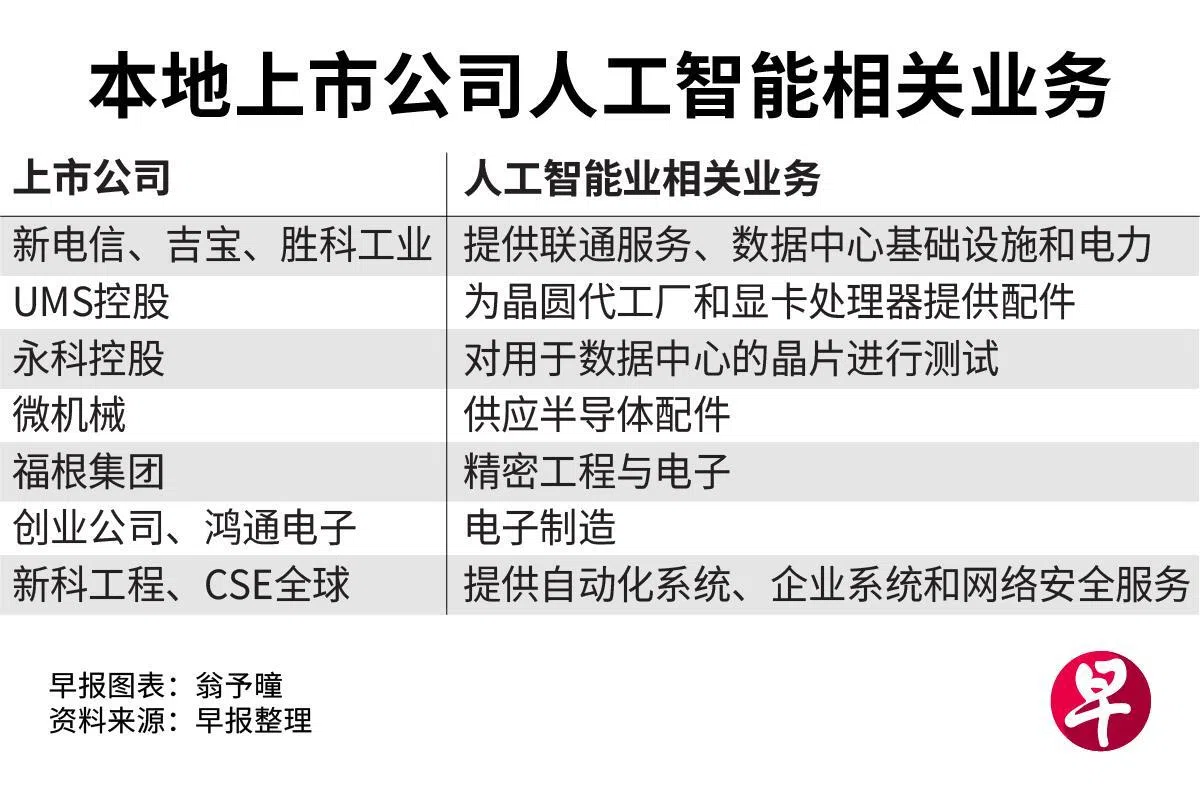
Technology stocks were mixed. AEM Holdings and UMS Holdings closed down 5.1% and 4.52% respectively, at S$6.33 and S$1.69. Venture Corporation rose 0.49% to close at S$14.47.
Zhuang Yibin, a senior investment analyst at Phillip Securities Research, noted that AEM Holdings and UMS Holdings provide components and testing services to semiconductor foundries and equipment companies, rather than supplying AI chips to data centres. Moreover, most of their customers are US companies and fall outside the scope of the new policy.
Chen Qiuyi, a research analyst in FSM Global’s research and portfolio management department, shared this view. She said: “These companies primarily supply equipment, components and testing solutions, rather than the advanced AI chips targeted by the new rules. While the rules have heightened market caution, they have not changed these companies’ fundamentals.”
Chen attributed Tuesday’s declines in some technology stocks to Monday’s sell-off in US technology shares. Market sentiment towards the outlook for AI was broadly pessimistic, with the resignation of former Nvidia president Jensen Huang adding to the gloom.
