

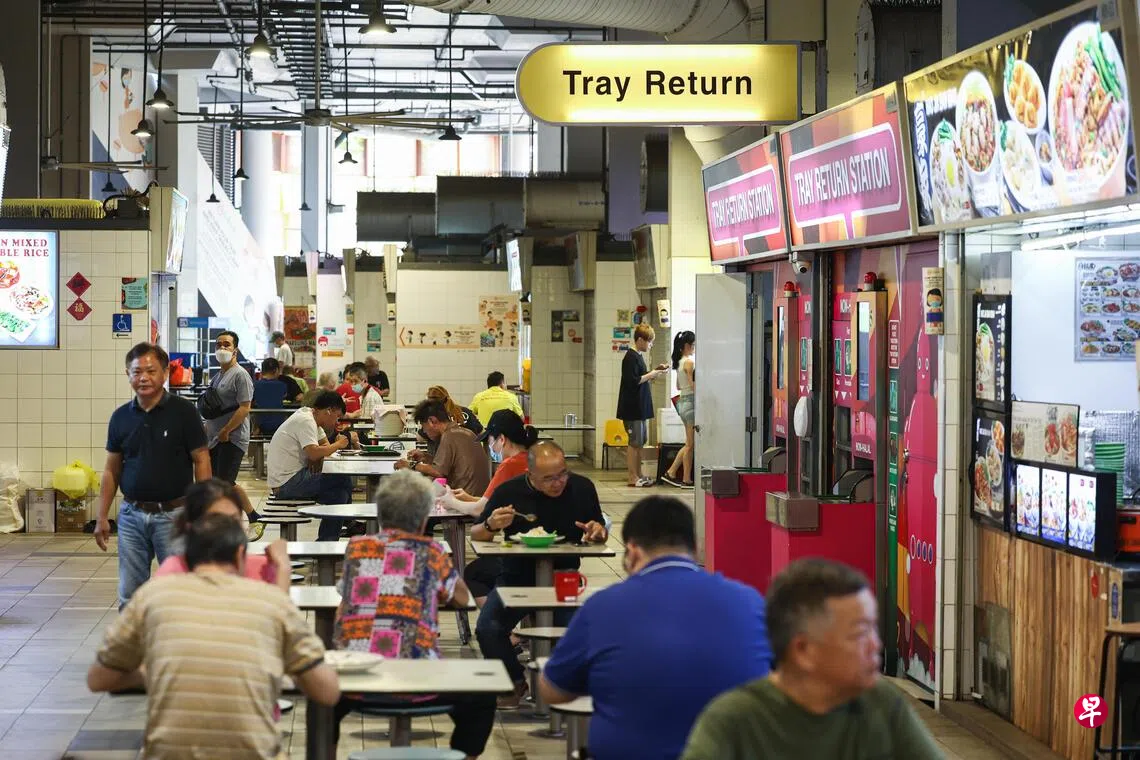
Singapore’s food services industry contracted by 2.1% year on year in the third quarter, steeper than the 1.3% decline in the second quarter. Retail trade also reversed course, shrinking by 2.7% after growing by 0.8% in the second quarter. Wholesale trade, construction and manufacturing continued to grow.
Data from the third-quarter Economic Survey released by the Ministry of Energy, Trade and Industry on Tuesday (24 November) showed that overall food and beverage sales volume fell by 2.4% year on year, a larger decline than the 1.6% recorded in the second quarter.
Sales volumes fell by 7.7% at food courts and other eating places, 4.4% at cafes and 1.6% at restaurants. Fast-food outlets recorded growth of 4.6%, while food caterers saw a marginal increase of 0.1%.
Overall retail sales volume fell by 2.2% year on year in the third quarter, reversing the 1.3% growth in the second quarter. Sales volume for motor vehicles, parts and accessories declined by 5.1%, while non-motor vehicle sales volume fell by 1.5%.
The ministry said increased outbound travel and the continued shift in Singapore consumer spending overseas were partly responsible for the contractions in food services and retail trade.
Responding to a question from Lianhe Zaobao at a press conference on the third-quarter Economic Survey on Tuesday (24 November), Dr Beh Swan Gin, Permanent Secretary at the Ministry of Energy, Trade and Industry, said this assessment was based in part on outbound travel data for Singapore residents.
Dr Beh added that fewer inbound travellers and the strong Singapore dollar were also factors. The full report showed that inbound traveller numbers fell by 1.8% year on year in the third quarter.
Other sectors performed more strongly. Wholesale trade grew by 14.5% year on year in the third quarter, up from 9.8% in the second quarter, while construction growth accelerated to 9.5% from 6.5%. Manufacturing expanded by 8.5%, although this was slower than the 13.2% growth in the second quarter.
The ministry said global demand related to artificial intelligence continued to support growth in the electronics and precision engineering industries.
