

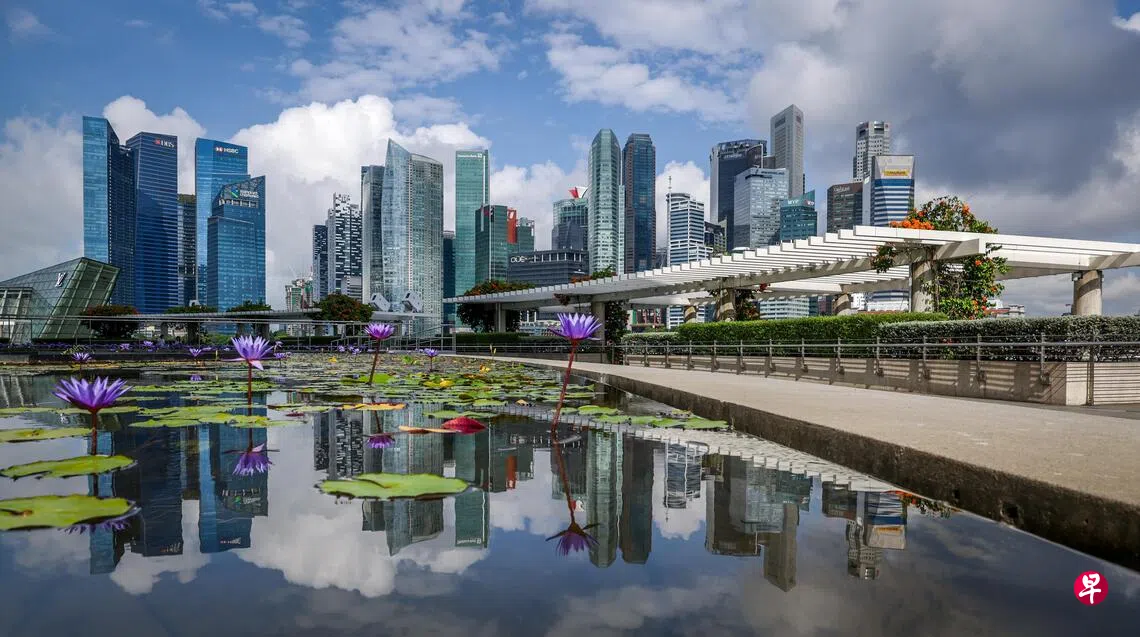
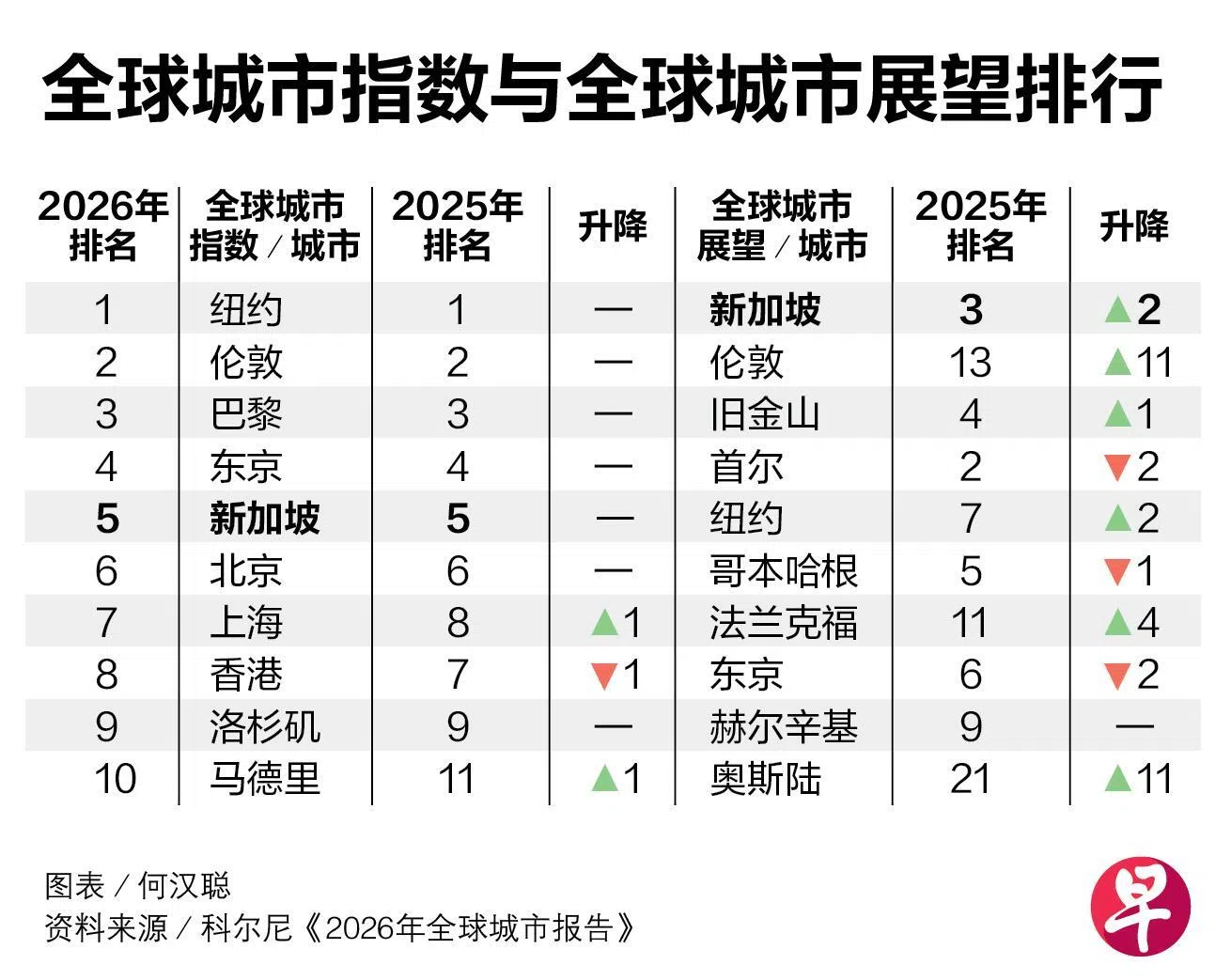
Singapore retained fifth place in the 2026 Global Cities Index, helped by a widening lead in internet speeds, greater ease of entry and an improved showing in cultural experience. Five Asia-Pacific cities made the global top 10: Tokyo, Singapore, Beijing, Shanghai and Hong Kong.
New York, London, Paris, Tokyo and Singapore continued to occupy the top five spots in the Global Cities Index, according to the Kearney 2026 Global Cities Report released by consultancy Kearney on Wednesday (25 November).
The Global Cities Index uses 31 indicators across five dimensions — business activity, human capital, information exchange, cultural experience and political engagement — to assess the ability of 158 cities worldwide to attract and retain talent, capital and ideas, and facilitate their global flow. The report reflects conditions as of the end of 2025.
Singapore further widened its lead in internet speeds, while greater ease of entry also lifted its human capital score. Of the five dimensions assessed, Singapore made its biggest improvement in cultural experience, rising from 36th to 14th.
Among other Asia-Pacific cities, Sydney rose four places to 16th. Bangkok climbed for the third consecutive year, moving up four places to 29th and entering the top 30.
The report noted that leading cities were pulling further ahead of others by drawing on advantages built up in areas such as capital markets, talent development and cultural investment. The average score increase among the top 30 cities was nearly 12 times the average increase across all cities in the index.
Shigeru Sekinada, Region Chair, Asia Pacific at Kearney, said: “Asia Pacific is where the global cities map is being redrawn. As national governments turn inward, the region’s leading cities are competing harder for capital and talent, and increasingly partnering with each other to do it.”
Singapore rises to first for future potential; climate change poses biggest risk
Singapore rose from third to first in the Global Cities Outlook, which measures future development potential. London, San Francisco, Seoul and New York placed second to fifth respectively. The ranking assesses cities’ potential across four dimensions: personal well-being, economics, innovation and governance.
Foreign direct investment in Singapore grew 36% year on year in 2025. Increased patent and start-up activity also helped lift its innovation ranking from 34th to ninth.
Of the 64 Asia-Pacific cities assessed, 58 improved their performance on economic indicators. South Korea’s Incheon and Busan rose 36 and 28 places respectively, recording the two largest gains in the global ranking.
The report identified climate change as the biggest risk to Singapore’s development prospects, with rising sea levels and extreme heat threatening infrastructure such as ports and airports on which the economy depends. In several months of 2025, Singapore’s rainfall or temperatures were among the highest on record.
The report said: “The city’s outlook will be influenced by the balance it strikes between compounding its capital and innovation gains and defending its economy’s physical foundation against nature.”
