

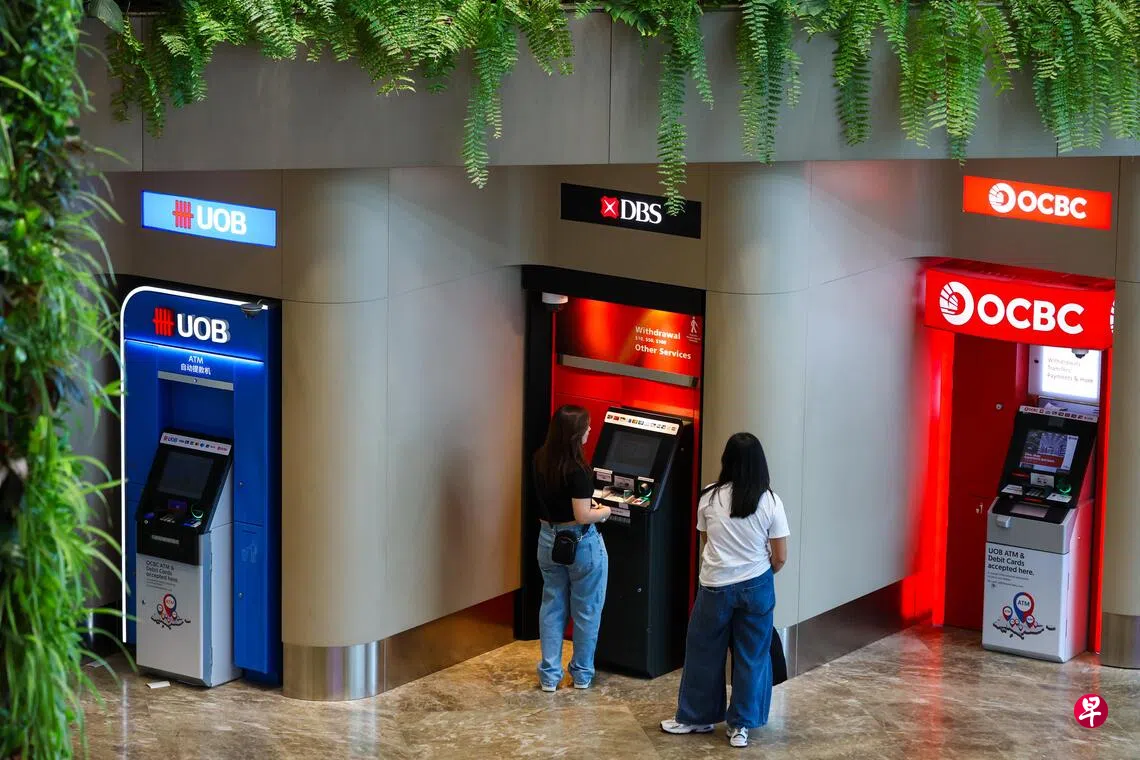
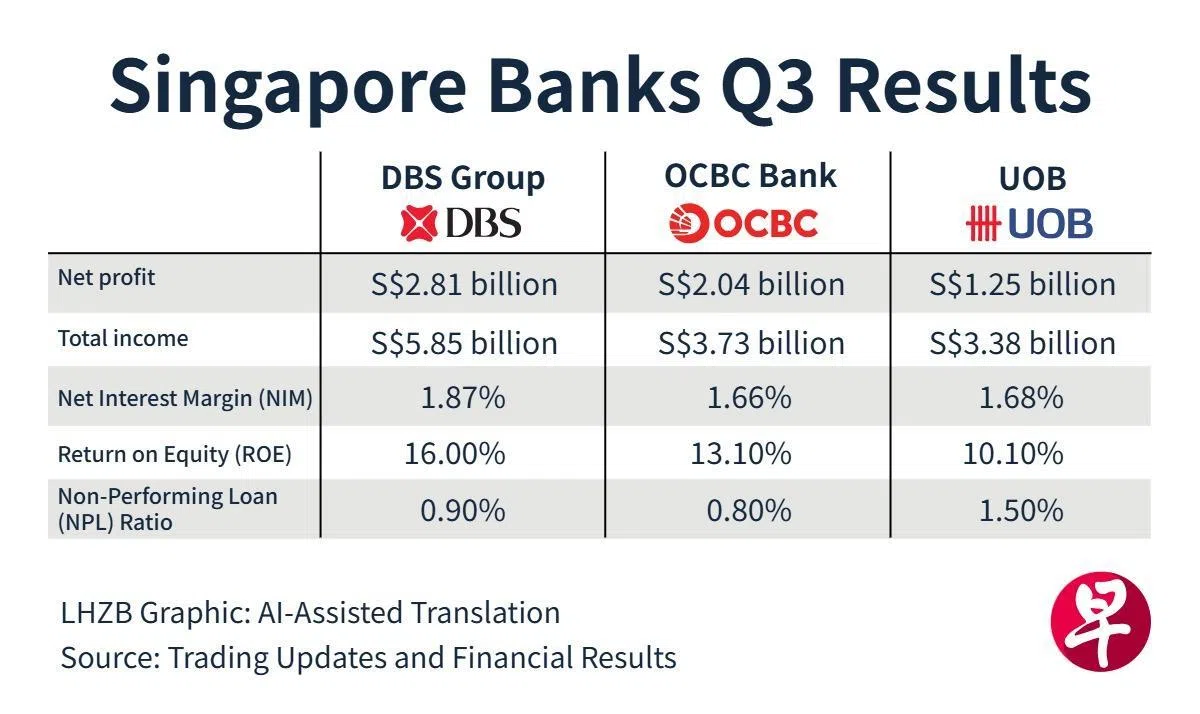
Singapore’s three major banks have completed their third-quarter earnings announcements, with mixed results. OCBC’s net profit came in slightly above analysts’ consensus forecast, while DBS and UOB both fell short of expectations.
Although wealth management continued to grow at all three banks and loan demand remained robust, pressure on net interest margins, volatile trading income and rising operating costs remained the main factors affecting earnings.
Several indicators showed UOB lagging its two peers, while its non-performing loan ratio was also the highest. Analysts are divided on whether now was a good time to buy the stock.
Jefferies analysts Joanna Cheah and Ang Wei Han noted that although UOB’s wealth management business was growing, its net interest margin remained under pressure.
Higher spending could weigh on UOB; credit risks remain a concern
Increased investment in technology and wealth management could also weigh on UOB’s near-term earnings. The analysts downgraded the bank from buy to hold and cut their target price from S$48 to S$42.
UOB’s credit exposure in Greater China also remained a concern. “With the earnings inflection back-end loaded and Greater China risks not fully resolved, execution risk has increased in our view.”
Maybank, however, upgraded UOB from hold to buy. Its research report noted that while UOB’s third-quarter earnings were slightly below market expectations, wealth management and loan growth had improved, as had asset quality. RHB maintained its buy rating.
As for DBS, although third-quarter earnings missed market expectations partly because of lower trading income, several analysts were positive about its core business and earnings growth prospects for next year.
Tay Wee Kuang, research analyst at CGS International Securities Singapore (CGSI), and other analysts noted signs that DBS’s net interest margin had bottomed out and was recovering, potentially driving net interest income growth in the 2027 financial year.
Local banks’ net interest margins have generally been under pressure this year, mainly because earlier interest rate declines lowered yields on loans and other interest-earning assets, squeezing lending margins.
DBS net interest income set to rise; analysts see management guidance as conservative
With markets expecting the US Federal Reserve to raise interest rates twice by the end of 2027, analysts forecast that DBS’s net interest margin will widen by five basis points in the 2027 financial year, potentially delivering mid-single-digit percentage growth in net interest income.
Cheah and Ang said the recent pullback in DBS’s share price offered a buying opportunity. The group’s proactive capital management, robust earnings and shareholder returns were sufficient to support a higher valuation.
Ada Lim of OCBC Group Research noted that DBS’s third-quarter results were slightly below market expectations, but its core business remained sound. She upgraded DBS from hold to buy while maintaining her fair value estimate of S$78.
On the outlook for next year, Jayden Vantarakis, Macquarie’s head of ASEAN equity research, considered DBS management’s guidance relatively conservative. He noted that DBS itself expected mid-single-digit growth in total income, compared with analysts’ forecast of 8% year-on-year growth.
He expected DBS’s final dividend for the fourth quarter to rise to S$0.87 a share, which could provide a catalyst for the share price.
OCBC was the only bank to meet expectations this earnings season. Cheah and Ang noted continued strong growth in lending, but a year-on-year decline in insurance income and overall income.
However, they said: “While headline insurance and trading income look weak, the drag was mark-to-market changes in Great Eastern Holdings’ bond losses on rising rates, and the non-repeat of second-quarter equity gains, rather than franchise deterioration.”
At Friday’s close, DBS was down 2.08% at S$69.72, OCBC fell 0.72% to S$27.73, and UOB slid 2.46% to S$36.88.
