


As Singapore steps up efforts to become a leading gold trading hub in the Asia-Pacific, banks in Singapore are expanding their gold storage capacity. Following a vault expansion by DBS, OCBC has also added a dedicated vault in Singapore, providing about 100 tonnes of additional capacity — enough to hold around 8,000 large gold bars weighing 12.4kg each.
OCBC did not disclose the location or operational details of its new vault, but told Lianhe Zaobao that its current capacity meets demand. It will continue to assess the need for further expansion.
Responding to queries, a DBS spokesperson said the bank had offered gold custody services in Singapore since 2013. Earlier this year, it expanded its dedicated vault capacity to safeguard the gold holdings of private wealth and institutional clients, as well as the bank’s own assets.
UOB has been in the physical gold business for decades and operates its own vaults. Kelvin Ng, Head, Group Global Markets, UOB, said the bank had substantially expanded its precious metals infrastructure, increasing its vault capacity severalfold between 2023 and 2025.
Neither DBS nor UOB disclosed its specific gold storage capacity. Deutsche Bank is reportedly also considering expanding its gold storage capacity in Singapore.
Lianhe Zaobao also sent queries to several other banks, including J.P. Morgan, that are clearing members of the over-the-counter gold clearing system operated in partnership with the Singapore Exchange. They had not responded by press time.
Singapore’s publicly disclosed gold storage capacity currently stands at at least 2,500 tonnes, across commercial vaults and the National Currency Vault.
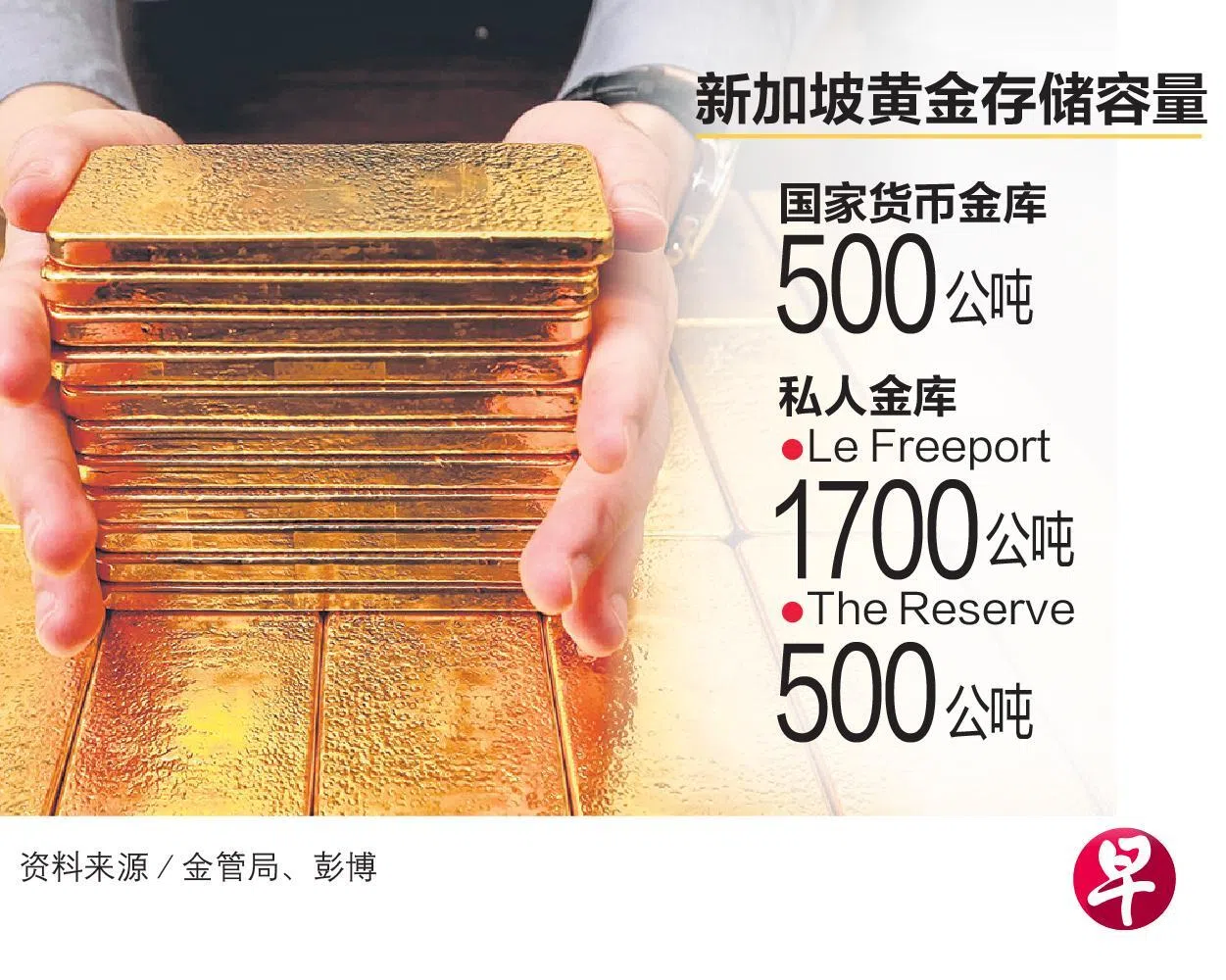
Earlier this month, the Monetary Authority of Singapore opened up gold storage services at the National Currency Vault to foreign central banks, international financial institutions and sovereign entities. The vault can hold 500 tonnes of gold, with scope to expand capacity according to demand.
Deputy Prime Minister and Minister for Energy, Trade and Industry (Trade) Gan Kim Yong said in June that major commercial providers offered more than 2,000 tonnes of secure storage capacity.
Singapore’s two major commercial vaults, Le Freeport and The Reserve, are understood to have capacity for 1,700 tonnes and 500 tonnes of gold respectively, or 2,200 tonnes in total.
Strong investment demand drives bank vault expansion
OCBC entered the physical gold business in June this year, offering physical gold trading and custody services to institutional clients and clients of its subsidiary Bank of Singapore. Over the past five months, client interest in secure, Singapore-based physical gold storage solutions has continued to grow.
OCBC said there was strong demand among Bank of Singapore clients for long-term physical gold storage. Institutional clients, including banks and private banks, were also showing growing interest in gold custody services.
Ng also said demand for physical gold custody services continued to grow steadily as investors increasingly sought to store gold outside traditional hubs such as London in the UK and the US.
“This trend reflects a growing emphasis on geographical diversification, greater awareness of supply chain risks and a stronger preference for direct ownership of physical assets. Singapore is well positioned to benefit from these developments, supported by its political stability, robust legal framework and well-established financial infrastructure.”
Meanwhile, wealthy investors from Europe, the US and the Middle East are also moving physical gold to Singapore to diversify the risks associated with where their assets are held, amid heightened geopolitical risks, government debt and political uncertainty.
Precious metals dealer J.Rotbart & Co. estimates that private gold holdings in Singapore exceeded 800 tonnes last year, about 16 times the level in 2014. A substantial share of the increase came from Europe.
The company said online enquiries from Western clients had tripled over the past year, with interest coming mainly from the US, Canada, the UK and Australia.
Analysis: Vault expansion must be matched by greater liquidity
Expanding gold storage capacity is an important prerequisite for establishing a gold hub, but whether it can stimulate gold trading also depends on market liquidity.
A white paper published by DBS this month found that financial institutions placed the greatest weight on market liquidity when choosing a gold hub. This was followed by regulatory transparency, reliable clearing and custody infrastructure, and cost-effectiveness. These factors outweighed time-zone alignment and geographical proximity.
However, Ramkishen Rajan, a professor at the National University of Singapore’s Lee Kuan Yew School of Public Policy, noted that storing gold securely did not mean it could be freely accessed or used.
In a recent article, he highlighted Singapore’s “custody paradox”: central banks still have to go through banks reliant on the US financial system to sell or pledge their gold. If they come under US sanctions, banks may refuse to handle the transactions. In other words, even gold stored in Singapore’s vaults cannot bypass the “gatekeeper” of the US financial system.
For Singapore, expanding gold storage capacity is only the first step. Building and maintaining clients’ trust is equally important. Rajan suggested that MAS should explain in advance how gold stored locally would be affected if Singapore were to impose sanctions on a country in future, so clients understand the risks before depositing their gold.
