

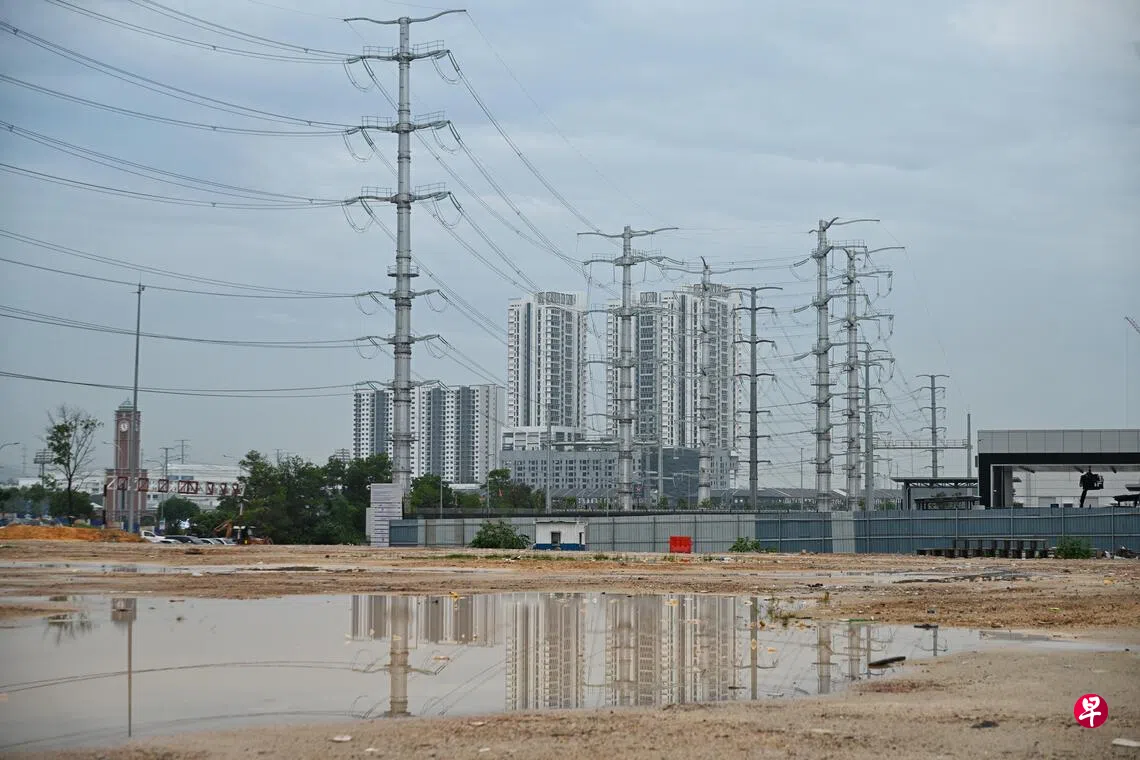
Tighter US restrictions on Chinese companies’ access to advanced chips and remote computing power could make it harder to develop new data centres in five Southeast Asian countries, including Singapore and Malaysia, with Malaysia’s Johor state potentially facing the greatest risk.
In a report released on Wednesday (25 November), S&P Global Ratings said data centres in the Asia-Pacific region were most vulnerable to the new US rules because of their significant exposure to Chinese customers and stricter licensing requirements.
According to datacenterHawk, a data centre research firm owned by S&P, major Chinese cloud service providers lease about 635 megawatts of hyperscale data centre capacity in Johor, equivalent to 65% of the state’s total capacity.
The analysis noted that some of this capacity may be used for commercial purposes, such as e-commerce or social media, that are not directly restricted by the new rules. Even so, data centre operators must conduct extensive due diligence to understand who their tenants’ end users are and how the computing power is used, increasing legal and compliance risks.
Meanwhile, more than half of the roughly 4.1 gigawatts (GW) of capacity under construction in Johor is intended for artificial intelligence training and inference. It remains unclear how many new projects involve neocloud providers and Chinese customers, but those that do could face tighter scrutiny, leading to delays or even cancellations.
Neocloud providers bear the brunt
In terms of business models, neocloud providers with Chinese customers face the greatest near-term credit risk.
These providers typically invest directly in graphics processing units (GPUs), then rent computing capacity to customers. Besides having to apply for licences to procure chips in certain Southeast Asian markets in future, they may also need to demonstrate that their Chinese customers’ use of computing power qualifies for exemptions, or find new customers to avoid leaving equipment idle.
Whether the new rules trigger immediate credit risks depends on the terms of service contracts. If customers can terminate contracts early without paying sufficient compensation, or if new customers generate less revenue than existing contracts, these cloud providers will face liquidity and refinancing pressures.
By contrast, powered-shell data centre operators, which mainly provide premises and power infrastructure, generally do not own GPUs or directly provide computing services. They therefore face less direct impact, but must also gain a deeper understanding of their tenants to meet compliance requirements.
Computing prices could fall before rising
S&P said redirecting the affected computing capacity to other customers could depress prices for computing services in the near term. Major US cloud providers and other non-Chinese customers could use this opportunity to negotiate better prices.
Over the longer term, however, regulatory uncertainty could slow data centre construction, while operators and lenders are also likely to step up scrutiny. Reduced new supply, coupled with sustained demand from major cloud providers, could support data centre rents and computing service prices once excess capacity is absorbed.
