Despite tighter technology controls and diverging technical standards, global technology supply chains remain closely interconnected. The bifurcation of countries’ technology sectors therefore does not mean a complete separation of supply chains. Asia can still seize growth opportunities arising from supply chain restructuring and the development of artificial intelligence (AI).
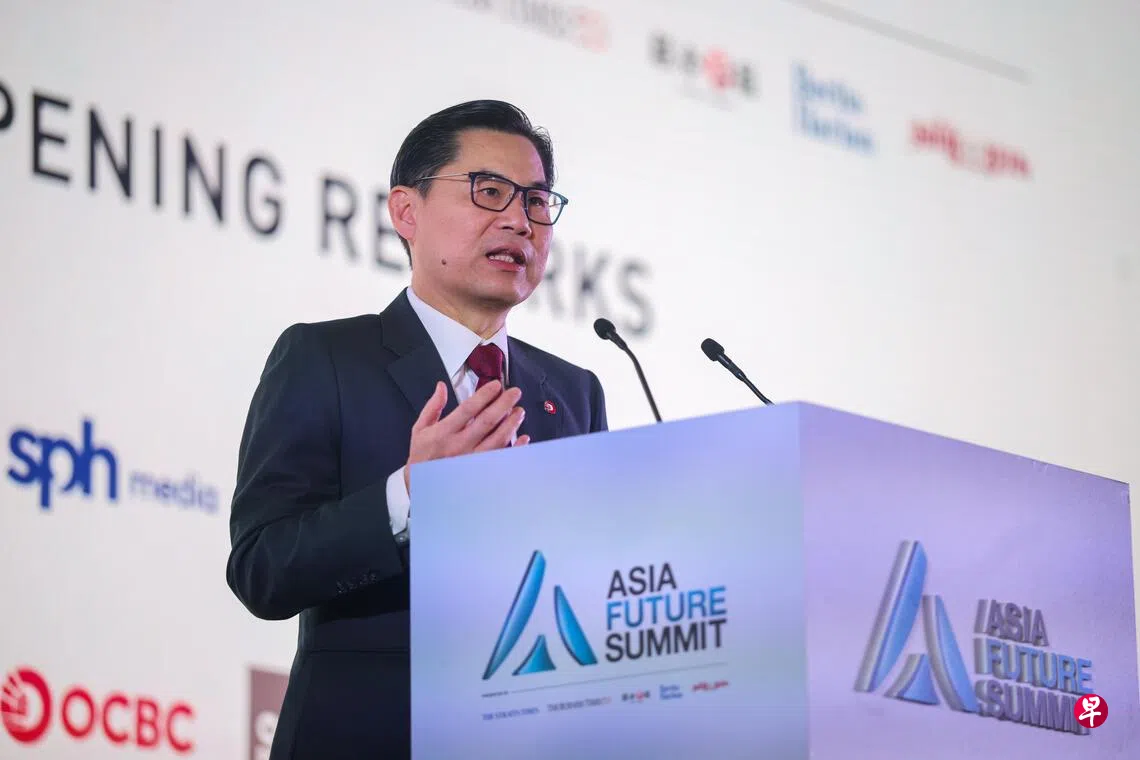
OCBC group CEO Tan Teck Long said in his opening address at the Asia Future Summit organised by SPH Media on Friday (27 November) that the current environment was marked by geopolitical tensions, trade barriers, technology bifurcation, and AI-enabled cyber threats and scams. However, supply chain restructuring and diversification, along with the use of AI to boost productivity, were also creating new opportunities.
He expects technical standards to diverge and access to technology to vary, but said this would not mean a complete separation of supply chains. For example, a set of advanced graphics processing units (GPUs) could be designed in the US and manufactured in Taiwan, paired with memory produced in South Korea, then packaged and tested in Singapore and Malaysia. It could then be sent back to Taiwan for further assembly before being deployed in data centres around the world, alongside cooling equipment made in mainland China.
“So even as technology controls tighten, the underlying supply chain remains deeply connected.”
Tan noted that despite constant changes in US tariff policy, intra-Asian trade and investment continued to grow, now accounting for more than half of the region’s total trade. Foreign direct investment into ASEAN also grew by 10% last year, driven mainly by supply chain diversification into ASEAN and AI investment.
He said regional trade agreements and cooperation would be key to sustaining this growth momentum.
Technology bifurcation could also extend to AI models. Tan said a combination of open-source and closed-source models offered a better way to balance cost and security. Despite current market concerns about AI-related stocks, AI would continue to develop as adoption increased, models became more capable and costs fell.
Meanwhile, AI-driven demand for electricity from data centres could also spur green energy development. Tan said OCBC’s work in financing data centres had shown that technology companies were increasingly seeking clean energy to meet their sustainability goals.
Drawing an analogy with BYO, or bringing your own drinks to a gathering with friends, he said the concept was also gaining traction among data centres. “In the data centre world, increasingly it is also BYO: bring your own power.”
This year’s Asia Future Summit is jointly organised by SPH Media’s five flagship publications — Lianhe Zaobao, The Straits Times, The Business Times, Berita Harian and Tamil Murasu — under the theme “Asia Rising: Reshaping the Region’s Role in a New Global Order”. OCBC is the presenting sponsor for Asia Future Summit 2026, with Marina Bay Sands as the official venue partner and Amazon Web Services as the official cloud partner.