

The US Democratic Party’s sweeping victory in the midterm elections triggered a global sell-off in technology stocks. The Nasdaq plunged 6.4%, wiping US$2.3 trillion (about S$2.95 trillion) off the market value of its constituent stocks, as several tech billionaires lost tens of billions of dollars overnight.
According to the Bloomberg Billionaires Index, the world’s 500 richest people lost a combined US$185 billion on Thursday (5 November), the 14th-largest single-day decline in wealth since the index began in 2012.
But not all billionaires suffered losses. Forbes’ real-time billionaires list showed that some fortunes in advertising, retail and consumer goods grew despite the downturn.
Who lost the most wealth in this global stock market rout? Which billionaires made big gains instead? And what lies ahead for their fortunes?
1) Who suffered the biggest overnight losses?
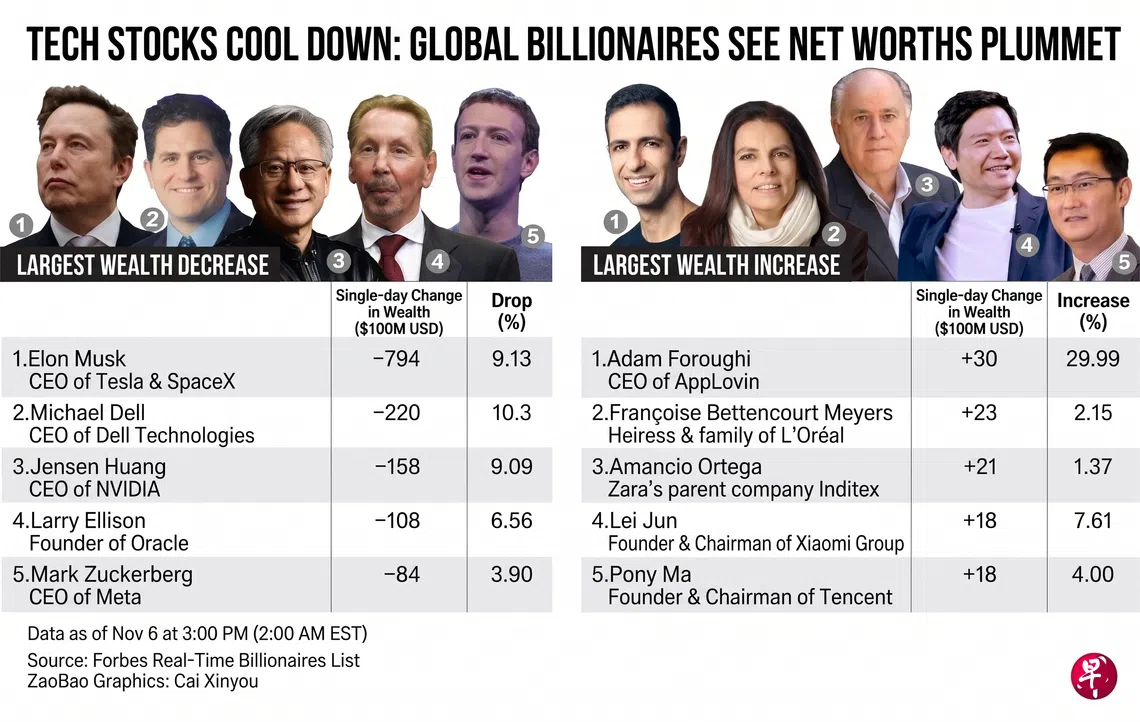
According to Forbes’ billionaires list, the five biggest losers were all technology industry leaders.
The world’s richest man, Elon Musk, was the biggest loser. The founder of Tesla and SpaceX saw his fortune shrink by US$79.7 billion in a single day, although he remained firmly at the top of the global rich list with US$785 billion.
Musk also suffered heavy losses on his political spending. He poured nearly US$500 million into supporting several Republican candidates, including backing the party’s ultimately unsuccessful bid to retain the governorship of Texas, where both companies he founded are headquartered.
Next after Musk was Dell Technologies founder Michael Dell, who lost US$22 billion in a single day.
Nvidia chief executive Jensen Huang dropped out of the world’s top 10 richest people, falling from ninth to 13th place. His wealth shrank by US$15.1 billion (about S$19.3 billion) in a single day to US$150.9 billion.
Oracle founder Larry Ellison and Meta chief executive Mark Zuckerberg also saw their fortunes fall by US$10.8 billion and US$8.4 billion respectively.
2) Asian billionaires also suffered heavy losses
The sell-off spread further into Asia on Friday.
According to Bloomberg data, 22 Asian billionaires among the world’s 500 richest people saw their combined wealth fall by more than US$21 billion at one point on Friday (6 November) morning, before losses narrowed to US$18 billion. They are from Japan, mainland China, Taiwan and South Korea.
Japan’s SoftBank Group founder Masayoshi Son suffered the biggest loss among them, with his fortune shrinking by US$3.9 billion to about US$29 billion.
Asian semiconductor billionaires were among the hardest hit. Takemitsu Takizaki, founder of Japan’s Keyence, and Jason Chang, the Singaporean chairman of Taiwan’s Advanced Semiconductor Engineering who entered Singapore’s rich list this year, each lost at least US$1 billion.
Samsung Electronics chairman Lee Jae-yong, his mother and his younger sister also lost a combined total of about US$2.5 billion.
3) Who made big gains despite the downturn?
US advertising technology company AppLovin bucked the trend with a sharp rally on strong earnings. This lifted co-founder and chief executive Adam Foroughi’s wealth by US$3 billion in a single day, a gain of nearly 30%, making him the biggest winner on the wealth rankings.
AppLovin’s third-quarter results showed revenue and net profit surging 55% and 72% year on year respectively, sending its shares up about 30%.
Meanwhile, a shift away from risk in the technology sector prompted a marked rotation of funds in Asian markets on Thursday. Investors reduced their holdings of semiconductor stocks closely linked to the construction of AI data centres, with some funds moving into Chinese internet and consumer technology stocks with relatively lower valuations.
Hong Kong technology stocks rebounded strongly on Thursday. Xiaomi shares jumped 8.8% and Tencent rose 7.2%, boosting the fortunes of their founders Lei Jun and Pony Ma by US$1.8 billion each. Both stocks had given back a small part of the previous day’s gains by Friday’s close.
European consumer goods and retail stocks also rose against the broader trend on Thursday, increasing the wealth of Françoise Bettencourt Meyers, heiress to the founding family of France’s L’Oréal, by US$2.3 billion.
Amancio Ortega, founder of Inditex, the parent company of Spanish clothing brand Zara, also gained US$2.1 billion.
4) Will tech billionaires’ fortunes keep shrinking?
The trigger for this broad decline in wealth was market concern that, after the US Democratic Party gained control of both the Senate and the House of Representatives, data centre expansion would face more regulatory restrictions, affecting the outlook for investment in artificial intelligence (AI) infrastructure.
On Thursday, Nvidia shares plunged 9.3%, their biggest single-day decline since January 2025. Tesla and SpaceX each tumbled about 10%, while Oracle fell 6.9%.
Before the sell-off, the AI boom had rapidly swelled tech billionaires’ fortunes, which at one point accounted for 36% of the total wealth of the world’s 500 richest people. They had been on course for their strongest year of wealth growth on record.
The prevailing market view is that Thursday’s sell-off reflected a concentrated reaction to concerns over AI spending and inflation risks, rather than a fundamental change in underlying conditions.
Saxo investor strategist Neil Wilson believes the market may be overly concerned about the impact of the Democrats slowing data centre construction. AI remains an important engine of US economic growth, and even a slowdown in construction would not mean the end of the investment cycle.
He noted that strong earnings growth at these companies, together with lower technology stock valuations and light investor positioning, could still support a rebound towards the end of the year. However, the Nasdaq would need to rise about 12% and the S&P 500 about 5% to return to their late-October highs.
As of Friday evening Singapore time, US technology stocks were showing signs of a rebound, with Nvidia, SpaceX and Tesla all recovering about 5% in pre-market trading. Asian technology stocks, however, continued to fall on Friday.
Market attention will next turn to major technology companies’ earnings and capital expenditure plans. Nvidia is expected to release its third-quarter results after the market closes on 17 November, potentially providing a test of whether demand for AI investment remains strong.
