

UOB cut its full-year net interest margin guidance after third-quarter net profit fell short of market expectations and the bank warned that funding costs could remain high. Analysts said this could weigh on the bank’s earnings for an extended period, while investors would continue to watch issues such as problem loans and asset quality.
UOB’s results, released before the market opened on Wednesday (4 November), showed that third-quarter net profit rose about 182% year on year, from S$443 million to S$1.25 billion, as provisions returned to normal levels. However, this fell short of the average forecast of S$1.38 billion in a Bloomberg analyst survey.
The bank’s third-quarter net interest income edged up 1% year on year to S$2.278 billion, mainly supported by loan growth. Stronger wealth management, card and loan-related businesses drove a 19% increase in net fee income to S$733 million. Other non-interest income fell 29% to S$370 million as trading and investment income declined.
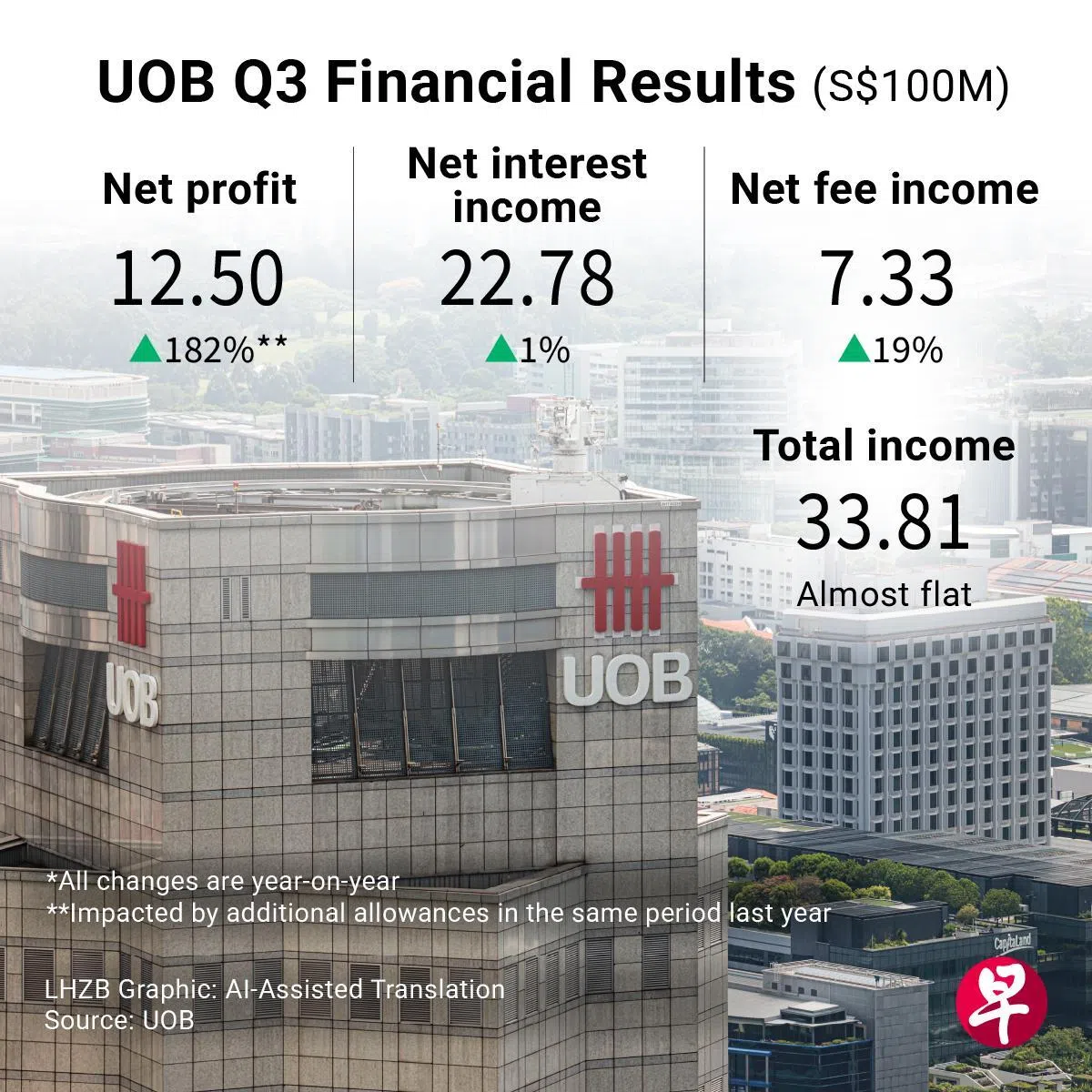
Compared with the previous quarter, third-quarter net profit fell 15%, mainly because gains from asset disposals in the preceding quarter did not recur. Net interest income was flat quarter on quarter, as loan growth of 3% offset the impact of higher funding costs, which narrowed the net interest margin by six basis points to 1.68%.
For the first nine months of the year, the group’s net profit rose 27% year on year to S$4.165 billion. Net interest income fell 2% to S$6.9 billion, mainly as lower interest rates reduced asset yields, narrowing the net interest margin by 16 basis points to 1.75%.
Full-year net interest margin could fall below 1.75%
UOB had previously forecast a full-year net interest margin of between 1.75% and 1.8%. However, Leong Yung Chee, UOB’s group chief financial officer, said at Wednesday’s results briefing that, with the margin remaining under pressure in the third quarter, the bank now expected its full-year margin to fall below that range.
Eric Xiao, CMC Markets’ Singapore sales director, said the continued narrowing of the net interest margin was a greater concern than the decline in trading income, as higher funding costs could have a more lasting impact on the bank’s earnings.
Looking ahead, UOB expects loan growth in 2027 to be in the mid-single-digit range, with mid to high-single-digit growth in fee income. Operating costs are expected to remain elevated as the bank continues to increase investment in wealth management and technology.
As of the end of September, the group’s non-performing loan ratio stood at 1.5%, down 0.1 percentage points both quarter on quarter and year on year. Third-quarter provisions returned to S$258 million from an elevated level a year earlier.
In the same period last year, UOB set aside as much as S$600 million in additional provisions to address problems in the Hong Kong and US property markets. The bank’s third-quarter results showed that its total non-performing assets in Greater China continued to rise, reaching S$2.456 billion. The region’s non-performing loan ratio had also increased as of the end of September.
Greater China loan recoveries take time as bank reshapes and reduces exposure
Responding to a question from Lianhe Zaobao, Leong said recoveries of non-performing loans in Greater China were progressing more slowly than in the US market. The bank’s property exposure is being reshaped and reduced, while the digital infrastructure and energy sector is among its faster-growing areas.
He said, “We do see recovery in Greater China asset quality issues, but they are recovering slower than what we have seen in the US portfolio. We intend to manage that very actively, and we will see that gradually decline in terms of non-performing loan numbers. But it will take a bit of time.”
Jefferies analysts Joanna Cheah and Ang Wei Han said that, with non-performing loans continuing to rise and provision coverage declining, asset quality could become a greater focus for the market if UOB’s new non-performing assets remained elevated in the fourth quarter while recoveries and disposals of problem loans progressed slowly.
Global equity index provider MSCI recently planned to downgrade Indonesia to a standalone market, triggering a sharp fall in the country’s stock index. But Wee Ee Cheong, UOB’s deputy chairman and CEO, said the bank remained positive about the Indonesian market over the long term.
Indonesia accounts for less than 3% of both UOB’s total loans and its profit.
ASEAN will remain a key growth market for UOB. Wee said, “We are long-term… so it’s a question of having the commitment, and we just move. If you don’t have a long-term commitment, every day you worry about volatility. You have to look beyond all this, and take a view.”
Following the results announcement, UOB shares closed down 4.99% at S$38.44.
The other two local banks, DBS Group and OCBC, will release their third-quarter results on Thursday (5 November) and Friday (6 November), respectively. Analysts said bank shares could continue to face downward pressure in the near term, as rising bond yields could weigh on banks’ earnings and capital levels.
James Ooi, Chief Market Strategist, Tiger Brokers, said that while the external environment was complex, with weakness in Wall Street technology stocks overnight, US-Iran tensions and uncertainty arising from the US midterm election results, the mixed performance of regional stock markets suggested that Singapore’s market weakness was not driven solely by global risk aversion. Concerns about banking sector earnings were also an important factor. “The continued selling may reflect growing anxiety that the banks' third-quarter results could fall short of investor expectations.”
