

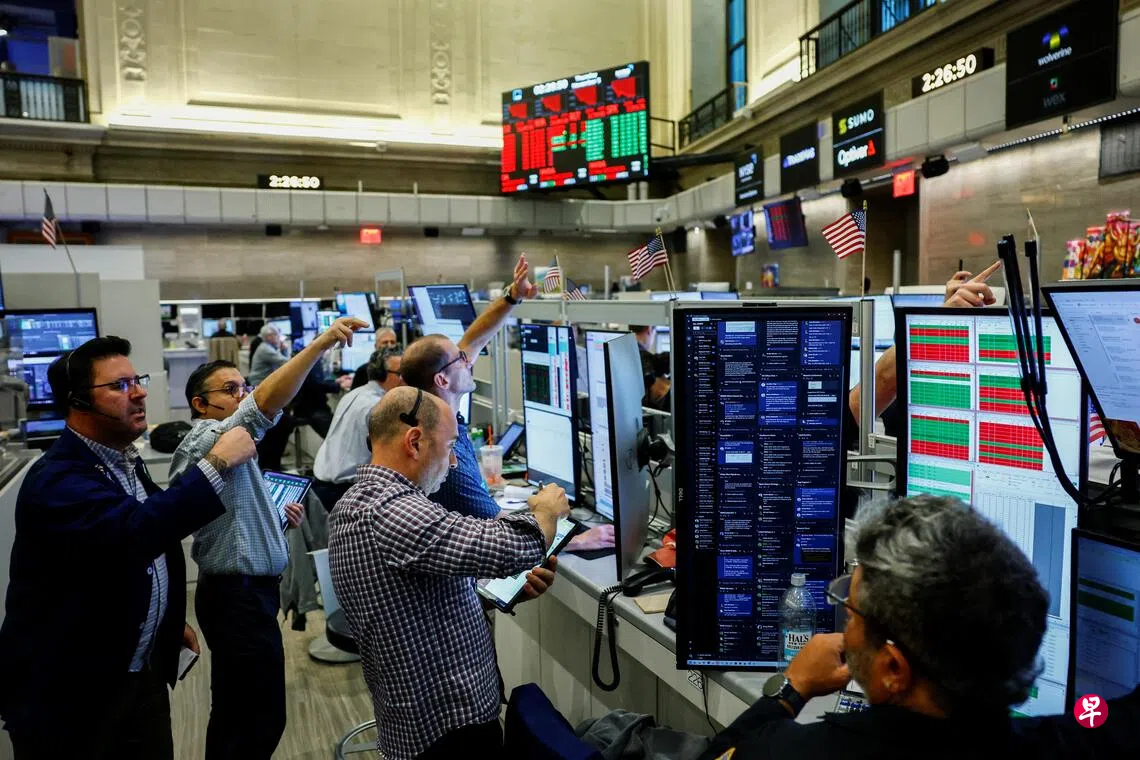
Wall Street technology stocks suffered their worst one-day sell-off in nearly two years on Thursday (5 November). Asian stock markets fell across the board on Friday (6 November), with Singapore shares dropping more than 2%.
What happened? Should investors join the exit or snap up bargains?
This rout was triggered by the US midterm elections. The Democrats won control of both the Senate and the House of Representatives in a “blue tsunami”, sparking concerns in capital markets that they would impose stricter regulation on the artificial intelligence (AI) industry.
Policy uncertainty arising from the shift in political power sent US stocks tumbling, dragging down semiconductor and technology shares across the Asia-Pacific.
Why are investors so worried about the Democrats regaining control of both chambers of Congress? Why have technology stocks fallen so sharply? And why has the reaction in Asian markets been so strong?
1. What sent US technology stocks tumbling?
It is not unprecedented for investors to be sensitive towards the AI sector. Well before the US midterm elections, they had begun questioning the sheer scale of AI-related capital expenditure and lofty projections for future demand, given the considerable uncertainty over the sustainability of that spending and its potential returns.
Market expectations for the AI sector have also been extremely high, pushing valuations to elevated levels largely on the assumption of sustained future growth.
Any sign of a slowdown in spending could therefore swiftly change how the market values these companies.
Charu Chanana, chief investment strategist at Saxo, said Democratic control of both chambers of Congress meant uncertainty over policy and scrutiny surrounding the expansion of AI infrastructure.
For example, the US could impose stricter scrutiny on data centres, electricity supply and costs and environmental impact, while giving greater weight to local opposition. This could delay AI data centre projects, increase costs and lengthen investment cycles.
Chanana said the sell-off reflected a market that was already highly vulnerable to multiple pressures, with the Democrats’ victory just one factor.
“This political shock came at a time when investors had already begun questioning the sustainability of AI capital expenditure. The risk is not necessarily that AI investment will disappear altogether, but that spending could be delayed or spread over a longer period,” she said.
The Democrats also won key posts including the Texas governorship. The New York Times reported that some analysts saw potentially significant obstacles to data centre construction, as these states are important hubs for such facilities.
Alan McKnight, chief investment officer at Regions Bank, said, “Some of these stocks were already overvalued, so what we are seeing is not entirely unexpected.”
2. Why have Asian technology stocks been hit so hard? Is it time to buy the dip?
During the rally across the AI value chain in recent years, Asian semiconductor and memory chip companies benefited significantly as suppliers of essential hardware for AI infrastructure.
Semiconductor giants such as TSMC, Samsung Electronics and SK Hynix, along with companies across the wider semiconductor supply chain, saw their share prices climb steadily during this AI supercycle, until doubts over the sustainability of AI capital expenditure began deepening recently.
Chanana said South Korea and Taiwan had particularly concentrated exposure to the global AI hardware cycle. Japanese companies also had a substantial presence through semiconductor equipment and industrial supplies.
Stocks in all three markets also fell sharply today. Chanana said this was partly due to a reassessment of future US demand for AI infrastructure. It also reflected the possibility that investors’ positions had become heavily concentrated in a handful of beneficiaries of the AI cycle.
She said several leading chipmakers’ underlying businesses remained robust. Investors were repricing their future valuations, rather than responding to a sudden collapse in current demand. This gap between expectations and reality could, in turn, create further investment opportunities.
Mark Fuchs, chief investment officer at Fuchs Capital Partners in Singapore, said, “Asian technology stocks face further valuation cuts as markets anticipate greater constraints on demand. Markets have also priced in a higher cost of capital since the Federal Reserve began raising interest rates in September.”
However, Chanana added, “If investors are still unwinding overcrowded positions, valuations could fall further even if fundamentals remain solid.”
Shane Oliver, chief economist and head of investment strategy at AMP, said the midterm elections were merely the trigger for this technology stock correction, but it was too early to declare that the market had bottomed out.
Chanana added that investors should watch for three signals before turning optimistic: stabilisation in credit markets, major technology companies reaffirming their capital expenditure commitments, and easing selling pressure in semiconductor and infrastructure stocks.
3. Should investors get out or seek safe havens?
Analysts said that, even as markets continued to fall, a complete withdrawal from the technology sector might not be wise.
Miro Mitev, chief executive of Smart Wealth Asset Management, said it was not yet time to abandon AI investments altogether. “AI will remain a structural investment theme and continue to attract substantial capital in the short, medium and long term… The current correction is an opportunity for investors to actively reassess their positions, rather than a signal to exit entirely.”
Saxo’s Chanana also advised investors to reduce concentration and maintain a diversified portfolio, rather than give up altogether.
For example, healthcare and consumer staples stocks in developed markets, selected financial and telecommunications stocks, and some high-quality companies paying high dividends are relatively resilient, as the factors driving demand for their businesses depend little on AI infrastructure expansion.
Some software and related services companies could also benefit as the AI cycle shifts from infrastructure construction towards practical applications and productivity gains.
Maybank analysts also said Singapore bank and non-bank stocks, along with small- and mid-cap stocks with long-term growth potential, remained worth watching.
Some high-quality government bonds are also returning to investors’ radar. Reuters reported that some Japanese investors had already begun buying long-term foreign bonds as a safe haven during the earlier technology stock sell-off.
Meanwhile, overseas investors put 2.36 trillion yen into Japanese bonds, the largest amount since 21 March.
Other analysts said that amid the sharp market swings, gold remained an effective hedge against geopolitical and policy uncertainty, while cash gave investors greater flexibility to adjust their allocations in response to volatility.
Chanana said maintaining US leadership in AI remained a strategic priority for both Democrats and Republicans, particularly in competition with China.
However, “there is a distinction between supporting AI leadership and pursuing infrastructure development at any cost”.
