

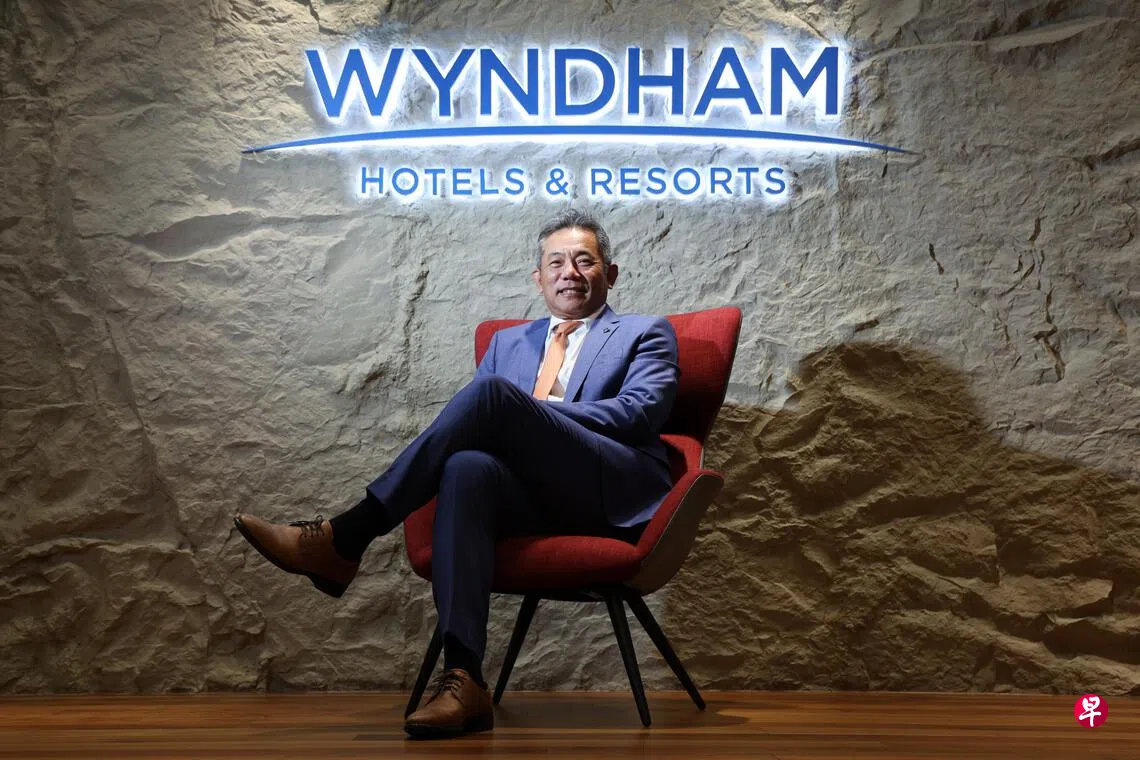
“Singapore’s market may be relatively small, but it is evolving very quickly and competition is quite intense. If we don’t adapt to changing trends, we risk being left behind.”
Joon Aun Ooi, Asia-Pacific president of Wyndham Hotels & Resorts, made the remarks in a recent interview with Lianhe Zaobao.
Headquartered in the US, Wyndham Hotels & Resorts is a hotel group whose core business is hotel brand franchising. It earns fees primarily by licensing its brands to hotel owners, providing reservations and marketing support, and offering hotel management services.
Wyndham has more than 20 hotel brands worldwide, spanning the luxury, midscale, upscale, boutique and mass-market segments.
Wyndham entered Singapore in 2010 and now has three hotels here, on Balestier Road, Beach Road and Coleman Street, targeting the upscale, midscale-to-upscale and mass-market segments respectively.
Ooi has more than 20 years of experience in the hotel industry. He previously served as vice-president of openings and operations for Greater China, and president and managing director for Southeast Asia and the Pacific. He now oversees Wyndham’s Asia-Pacific business.
Hotel giants’ expansion intensifies competition in Singapore
Asked for his views on Singapore’s hotel industry, Ooi’s immediate responses were “intense competition” and “rapid pace of change”.
Ooi said Singapore already has many hotels, making the market highly competitive overall. At times, two hotels very close to each other engage in price wars to attract local and overseas guests.
According to the Singapore Department of Statistics (DOS), Singapore had 285 licensed hotels last year, up 1.4% year on year and more than 15% higher than in 2022. An average of 23.77 million room nights were available over the year, with an average room rate of S$273.50 a night.
Several hotel giants are also expanding their presence in Singapore this year.
For example, Accor’s new hotel on Waterloo Street opened in January with more than 500 rooms. Next year, Accor will open another hotel on Hoe Chiang Road with more than 800 rooms.
Marriott International’s new hotel on Selegie Road opened in April with 128 rooms.
Despite the rising number of hotels and rooms, Ooi remains optimistic about Singapore’s market, since Singapore draws guests from a diverse range of markets.
According to Ooi, besides local guests, visitor numbers from Malaysia, China, India, Indonesia and Australia are also trending upwards. Demand remains robust, and the market has not yet reached oversupply or saturation.
He also noted that Singapore’s overall hotel occupancy rate is above 80%. “That’s a very high occupancy rate for any market. So hotels don’t need to slash their room rates to compete for customers.”
DOS figures show that the average occupancy rate for local hotels was 82% last year, higher than the 81.4% recorded in 2024 and 80.5% in 2023.
Accommodation preferences shift rapidly as co-living gains ground
Besides expansion by established hotel giants, Wyndham faces a new trend in the accommodation market: the rise of co-living. Under this model, tenants rent fully furnished bedrooms or suites while sharing communal spaces such as kitchens and living rooms with other residents.
Better-known operators include Singapore Exchange-listed Coliwoo Holdings and The Assembly Place.
Ooi said the rise of co-living has undoubtedly intensified competition to some extent. He has also observed that preferences in Singapore’s market are constantly shifting, and “over the past few years, the pace of change has accelerated even further.”
He said “experiential travel” has become a buzzword in the accommodation sector in recent years. Consumers increasingly want comprehensive, one-stop packages rather than simply paying for a hotel room. This has helped co-living gain ground.
“Therefore, every hotel must keep up with the latest trends, develop suitable packages to cater to changing consumer preferences.”
Ooi added that Wyndham’s hotels in Singapore span luxury and mass-market brands, reaching different consumer groups. This also gives the group insights into their current travel and spending preferences, allowing it to adjust its operations or marketing strategies quickly.
Not a zero-sum game: Sharing a growing market
Ooi also said the group has long adopted artificial intelligence (AI) technology. For example, it has developed interactive tools that allow hotels to contact guests proactively a few days before their stay to provide up-to-date information on transport, weather and other matters. Guests can also check themselves in within the 24 hours before their stay and ask the hotel to help book restaurants, among other services.
Even so, Ooi stressed that while AI can replace people in some tasks, it still cannot fully take on roles involving greater interaction, such as guest relations managers, concierges and room service staff. “Some customers will say, ‘Please don’t do that. I need to speak to a real person.’”
Although expansion by hotel giants and the rise of co-living have had some impact, Ooi does not see the competition as a zero-sum game.
He said these developments also reflect growing demand for accommodation in Singapore and an expanding market, which is undoubtedly good news for every hotel.
Beyond competition, Wyndham also has to consider costs.
Ooi said that under its current business model, most costs, including land and utilities, are borne by hotel owners — the owners of the hotel assets. But if costs rise too sharply and severely erode their margins, this will in turn affect demand from owners to license Wyndham’s brands.
Wyndham therefore has to work with owners to address these pressures, such as by jointly developing marketing strategies to attract more guests and using AI to improve operational efficiency.
As for whether Wyndham would expand further in Singapore, Ooi’s answer was “yes”. After all, demand in Singapore remains fairly robust. Its political stability, public safety, and numerous concerts and cultural events consistently draw substantial numbers of visitors.
However, specific expansion plans and their timing have yet to be finalised and will depend on shifts in market preferences and consumer trends.
Pandemic leaves deepest impression in a career spanning more than 20 years
When asked about the biggest challenge of his career, Ooi had a clear answer: the impact of the pandemic.
Ooi recalled taking charge of Wyndham’s Asia-Pacific business just as the pandemic broke out. Economic activity and consumer spending across the region weakened during that period.
Major economies also took markedly different approaches to the pandemic, including the severity of lockdowns, compounding the difficulties facing an already struggling hotel sector.
Fortunately, he said, domestic demand for accommodation and consumer spending in China remained strong, particularly during festive periods, supporting the group’s business.
The pandemic also deepened Ooi’s appreciation of the importance of staying prepared even in stable times. “Never take anything for granted,” he said. “Even when things are going well, we should always be prepared for the unexpected, think ahead about potential crises and have plans in place to deal with different situations.”