

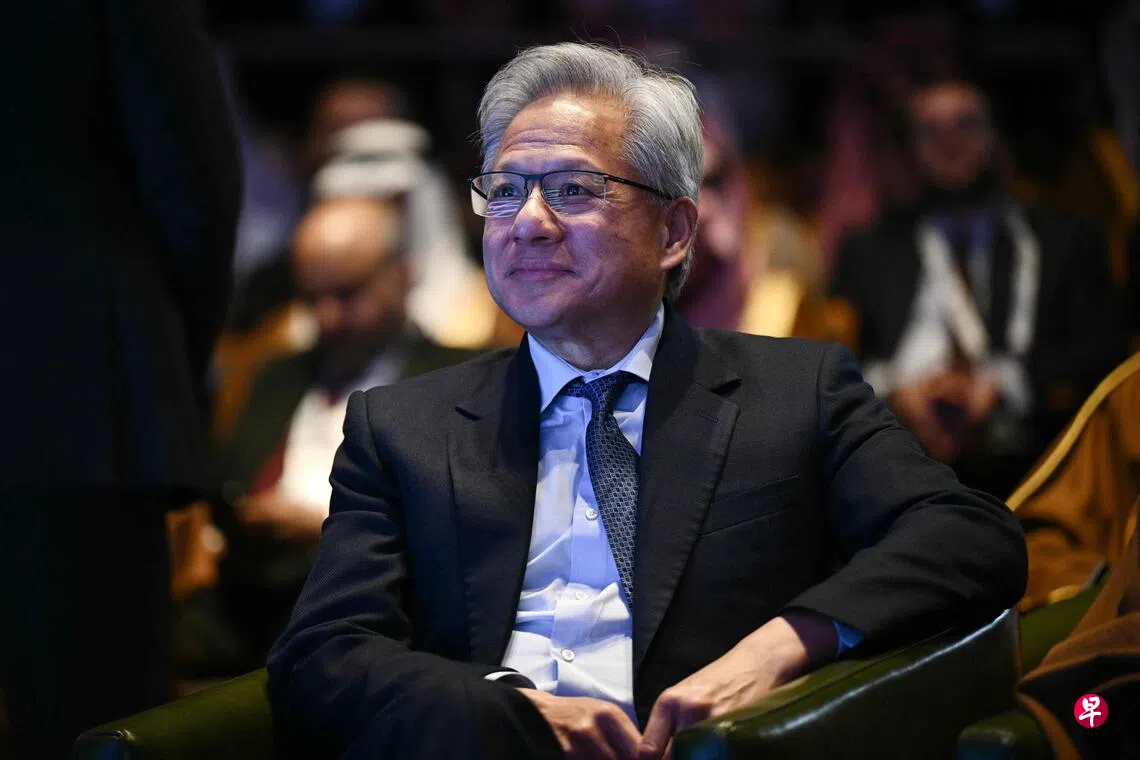
On 17 November, US chip giant Nvidia chairman Harvey Jones was still saying at its quarterly results briefing that the board had no intention of reinstating Jensen Huang.
Just five days later, the same board unanimously agreed to put Huang back in charge. When his return was announced on 23 November, Nvidia shares surged 31.5%, adding about US$1 trillion (S$1.29 trillion) to its market capitalisation in a single day.
While the stock has yet to recover all its losses since Huang’s resignation, the dramatic reversal set markets abuzz overnight. Who persuaded the board? And why was Wall Street willing to back Huang again?
Huang resigned as president, chief executive and director on 12 November, with chief financial officer Colette Kress taking over as interim chief executive. The board had begun a search for a successor, considering both internal and external candidates.
By 17 November, Huang had publicly expressed his willingness to return. But Jones said unequivocally that day that the board had unanimously accepted his resignation, noting that his personal conduct had breached the company’s code of conduct.
Filings with the US Securities and Exchange Commission show that the board decided on 22 November to reinstate him with immediate effect, announcing the decision the following day.
Why was the White House in a hurry to bring him back?
Behind the reversal in just five days, the strongest evidence so far points to the White House as a driving force. US President Donald J. Trump said in an overnight interview with CNBC that he had communicated directly and indirectly with Nvidia’s board, and had also spoken to Huang on Sunday (22 November) evening. He believed his intervention had been important to Huang’s reinstatement. The Wall Street Journal (《华尔街日报》) reported that the board had faced pressure from the White House, Silicon Valley and Wall Street investors simultaneously. Nvidia said that, after consulting senior US government officials, the board was satisfied that Huang’s reinstatement would pose no national security risk. Despite his return, an independent investigation into whether he had been targeted by foreign intelligence operations will continue.
Why did Trump step in?
There are many theories in the market. One is that he wanted to stabilise the stock market.
In the interview, Trump acknowledged that the market’s reaction to Huang’s resignation “may” have influenced his decision, but said he placed greater weight on the long-term benefits of Huang continuing to lead the company. Many market participants suggest that the White House may have had another consideration: Trump’s concern that the US could lose its edge in the artificial intelligence (AI) race if a Chinese company recruited Huang. So far, however, there have been no confirmed reports of any Chinese company making him an offer.
Within Nvidia, the most tangible concern was probably a potential talent exodus. After Huang resigned, reports emerged that Nader Khalil, Nvidia’s head of developer technology, had written to executives and directors warning that “irreplaceable” employees were considering leaving, and describing the global network Huang had built over many years as a strategic advantage for the company.
Nvidia employees also publicly called for Huang’s reinstatement. Their petition drew more than 200,000 supporters, including Tesla chief executive Elon Musk and some investors. Although it was not confirmed whether the core team intended to leave en masse, many investors were concerned about whether a new leader chosen by the board could retain the existing team. That concern was reflected in Nvidia’s share price. From the close of trading on the day the board accepted Huang’s resignation to the close last Friday (20 November), a staggering US$1.2 trillion was wiped off Nvidia’s market value.
Nvidia’s China business added another risk to the leadership turmoil. Market rumours suggested that, after Huang’s departure, some Chinese customers cancelled or delayed orders, unsure whether Nvidia’s RTX PRO 5500 graphics cards, used in computers and capable of running AI models, could still enter China. While the value of cancelled orders could not be established, and neither China nor the US had indicated whether shipments would be restricted, Huang’s return will certainly ease customers’ concerns and help restore continuity in communications with them. Investors are betting on his ability to navigate uncertainty, but whether those orders can be won back will depend on policy.
Anthropic listing fails to steady the market
Meanwhile, the timing of Huang’s reinstatement has also prompted speculation.
Some market participants see Anthropic and Nvidia as two giants championing entirely different AI ecosystems: the former advocates closed-source models, while the latter supports open-source systems. The tensions and interests involved are complex and intertwined. Anthropic, the new AI darling of the US market, launched its initial public offering (IPO) on 18 November and listed on Nasdaq on 19 November — just before Huang’s return.
Anthropic closed its trading debut 17% above its offer price, but even this heavyweight could not steady the market, with US stocks retreating in subsequent trading sessions. Last Friday (20 November), the broad-based S&P 500 recorded its seventh consecutive decline, its longest losing streak since February 2020. The Nasdaq 100 plunged 5.61% that Friday. Its weekly loss in market value was the largest since March 2020, and its gains for the year had been wiped out, leaving it in negative territory.
By contrast, after Nvidia announced Huang’s return overnight, the S&P 500 immediately jumped 326.78 points, or 4.74%, to close at 7,237.17. The Dow Jones Industrial Average also climbed 1,447.98 points to close at 49,595.31. The Nasdaq 100 surged 6.86%, or 1,717.11 points, to finish at 26,746.10.
But even taken together, a surface reading of these two events suggests only that sentiment in the US stock market may already have been nearing a bottom, that Anthropic’s large IPO absorbed considerable funds, and that Huang’s future at Nvidia affected investor sentiment towards the entire AI supply chain.
Analysis: The “new” Huang may return with different management autonomy
Wall Street is divided over how much further the rebound can go. Andrew Slimmon, senior portfolio manager at Morgan Stanley Investment Management, told the media that he believed the rally was not over and that investors could still gradually increase their exposure to technology stocks. Analysts at RBC Capital Markets also believe Huang’s return has eased investors’ concerns about a talent exodus. Independent technology analyst Luke Lango, however, views the surge as a relief rally. He believes the market still faces a possible slowdown in AI capital expenditure. After the turmoil Huang has just experienced, it remains to be seen whether he can continue to pursue investments and financing deals as aggressively as before.
Technology analyst Dan Ives’s price target offers a more concrete indication of how much the market is willing to pay for Huang’s return. Ives maintained his “buy” rating on Nvidia, but kept his price target at US$225. He explained that a US$300 share price would require not only Huang to remain at the helm, but also substantive progress on issues including the independent investigation, government inquiries and export controls.
Oanda senior analyst Kelvin Wong told Lianhe Zaobao that the “new” Huang now back at the helm may no longer have the same management autonomy as before. Steve Sosnick, chief strategist at Interactive Brokers, said it was difficult for outsiders to know how much influence the US government and shareholders had each exerted. But the reversal showed that parting ways with Huang would come at a high price for Nvidia.
