

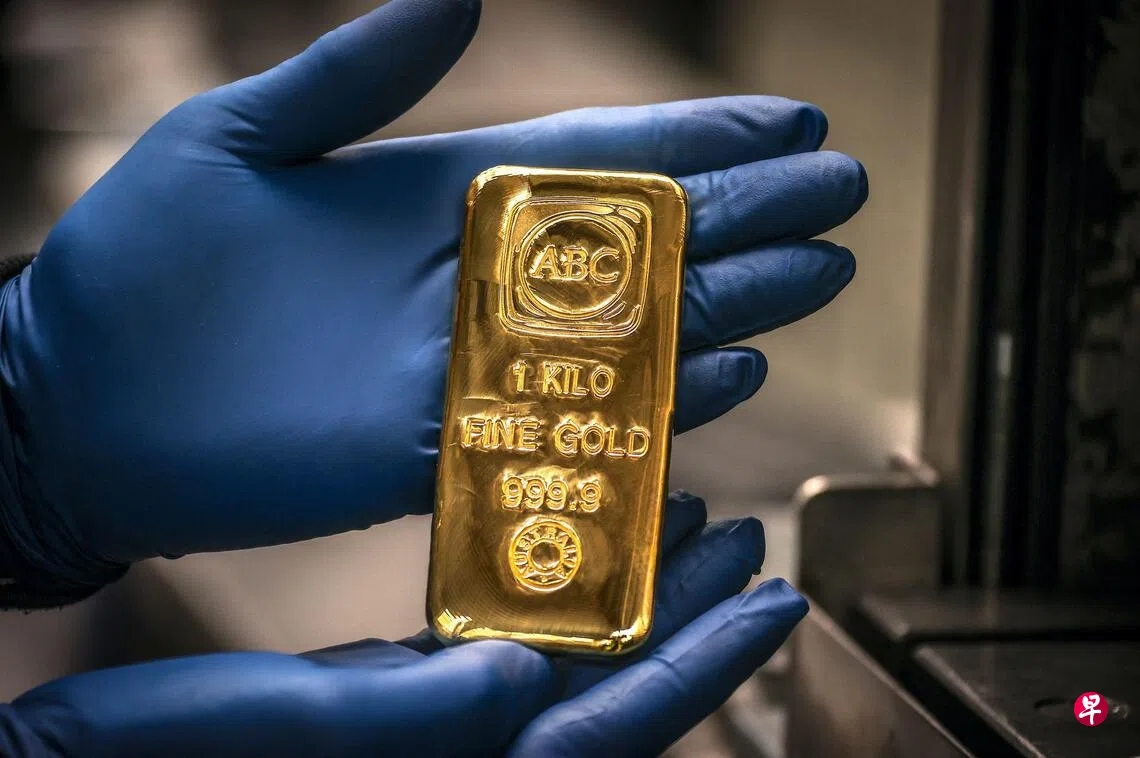
The latest US producer price index (PPI) data broadly met expectations, helping global gold prices hold steady on Friday (13 November). But gold still fell 4.6% over the week, its steepest weekly decline since June, closing below US$3,900 an ounce again.
With gold back below US$3,900 (about S$5,020), more analysts expect prices to fall in the coming week, while retail investors are divided.
Data released on Friday showed that US producer prices rose 0.3% month on month in October, following a sharp 1.4% increase in September. A Reuters poll had forecast a 0.4% rise.
Spot gold edged up 0.19% to US$3,884 an ounce on Friday, but still lost 4.6% over the week. Gold futures inched up 0.03% to US$3,886 an ounce, also ending the week 4.6% lower.
Gold had weakened earlier after the US consumer price index rose by a higher-than-expected 0.4% month on month in October. This prompted traders to increase bets on further interest rate rises next year and begin considering the possibility of a large, 50-basis-point increase this December. One US Federal Reserve official even said he would support a 50-basis-point rate rise if inflation continued to accelerate.
Heightened expectations of rate rises in turn pushed up US Treasury yields and strengthened the US dollar, both of which weigh on gold prices.
Reuters quoted independent metals trader Tai Wong as saying that the bond market remained under pressure from the Fed’s hawkish stance. Against this backdrop, gold struggled to hold on to its initial gains following the release of the PPI data.
Bloomberg quoted Ryan McKay, senior commodity strategist at TD Securities, as saying: “With bullish investors such as discretionary macro funds, exchange-traded funds and central banks unlikely to provide additional buying in the near term, the market is becoming increasingly vulnerable to shifts in expectations for Fed rate rises.”
McKay nevertheless believes gold prices still have strong support, as “there is currently little sign that those non-trend-following investors have capitulated”. He said: “These investors could return to buy at depressed prices, as they remain convinced of the trends towards long-term currency debasement and ‘de-dollarisation’.”
In information provider Kitco’s weekly gold survey, two of the 15 analysts polled, or 13%, expected gold prices to rise in the coming week, while 10, or 67%, expected a decline. The remaining three, or 20%, expected prices to remain flat. Among the 160 retail investors surveyed, 67, or 42%, were bullish, 60, or 38%, were bearish, and the remaining 33, or 21%, were neutral.
Kitco quoted James Stanley, senior market strategist at Forex.com, as saying: “I think spot gold will make another push higher, breaking above US$4,000, but I’m less certain whether that rally can hold.”
Adrian Day, president of Adrian Day Asset Management, said gold prices were caught between conflicting drivers. He expected prices to remain flat in the short term.
Daniel Pavilonis, senior commodities broker at financial services firm StoneX Group, believes gold’s direction has clearly turned downwards. Given the Fed’s aggressive rate rises, he believes gold could eventually fall to US$3,200 an ounce.
The coming week brings a busy economic calendar. Fed chair Kevin Warsh will speak at a conference in San Francisco on Monday (16 November), followed by the release of US October retail sales data on Tuesday (17 November). Minutes of the Fed’s October meeting will be released on Wednesday (18 November). Thursday’s (19 November) data releases include weekly jobless claims, while the University of Michigan’s US consumer sentiment index is due on Friday (20 November).
