

As the artificial intelligence (AI) wave sweeps across the world, companies have no shortage of reasons to invest. The real challenge is proving that the investment is worthwhile.
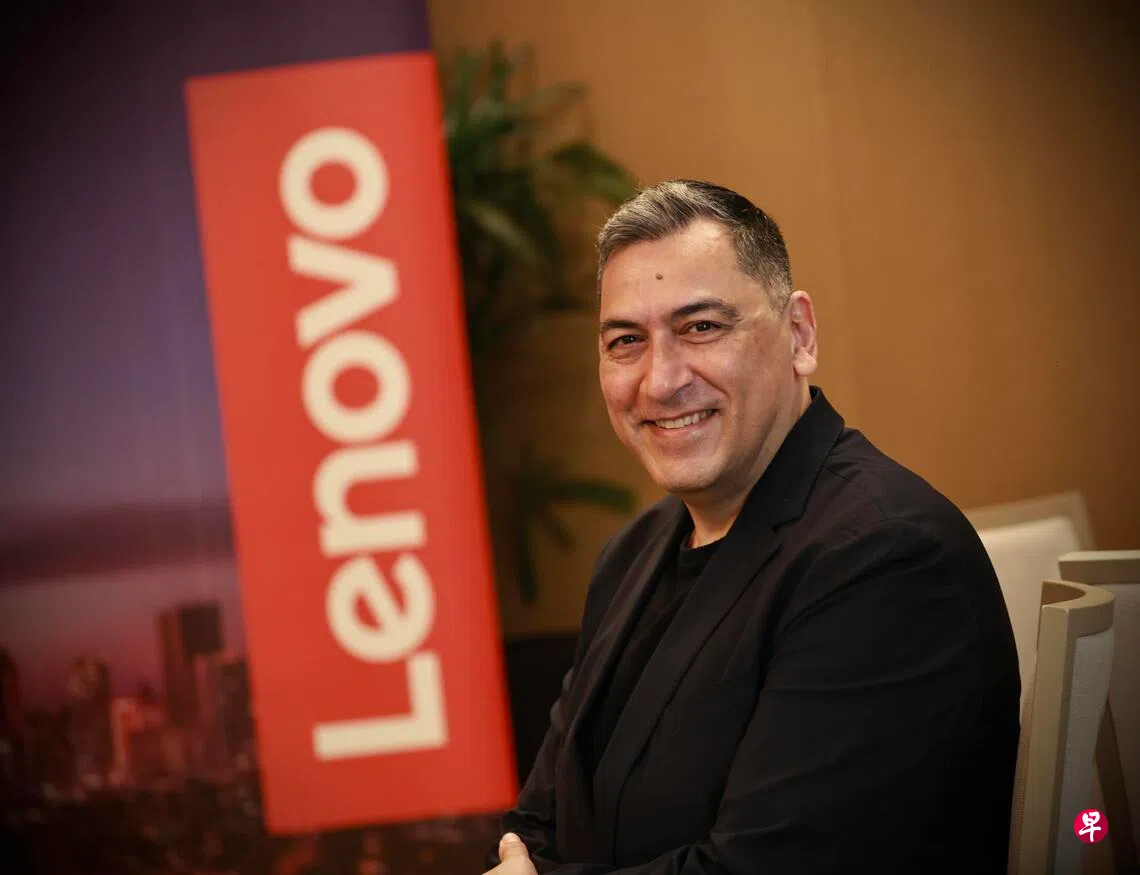
In an exclusive interview with Lianhe Zaobao, Lenovo’s Asia-Pacific chief commercial officer, Sumir Bhatia, said the executives he had spoken to recently were taking a more practical approach to AI: How should computing costs be calculated? How can data security be assured? And ultimately, what returns will the investment deliver?
These are not just questions for customers. They are also central issues Lenovo must address as it transforms its own business.
In Bhatia’s view, investing in AI is about more than buying equipment or building data centres. It requires companies to rethink their business processes, infrastructure strategy and returns on investment. “Everyone says AI is expensive. But if you can get results from it, it can become a profit centre,” he said.
That also captures the direction of Lenovo’s transformation: expanding beyond its traditional computer business into enterprise infrastructure and services to seize opportunities arising from the AI investment wave.
From hardware sales to enterprise AI solutions
Bhatia said the biggest opportunity Lenovo sees today is companies’ gradual shift from AI trials and proof-of-concept projects to deployment at scale. Demand is coming not only from more mature markets such as Japan, Australia and Singapore, but also from India, Indonesia and Thailand.
Lenovo’s global goal is to become a company with annual revenue of US$100 billion. Bhatia said that target remained unchanged, with the continued expansion of its AI business set to be an important driver of growth.
Growing demand for AI infrastructure, however, does not mean that buying more servers will automatically produce corresponding business returns. For Lenovo, helping customers turn technology spending into tangible results will be key to the next stage of its business development.

Helping customers turn AI investments into returns
Bhatia noted that customers no longer want to apply AI only in isolated areas. Instead, they want to connect different applications, data and infrastructure to improve overall business performance.
Lenovo has therefore adopted a hybrid AI strategy, providing integrated solutions spanning devices, infrastructure, software and services, tailored to customers’ data, business needs and stage of development.
“We need to go broader and deeper,” he said.
“Broader” means reaching more customers and use cases; “deeper” means moving from proof of concept to actual deployment, embedding AI in companies’ day-to-day operations rather than stopping once a trial is complete.
This means Lenovo is evolving from a traditional hardware supplier into a partner that helps companies plan, build and manage AI systems.

Lenovo’s CIO Playbook, released in 2026, cited a survey by market research firm IDC of 3,120 corporate IT and business decision-makers. It found that 93% of companies surveyed wanted their AI projects to deliver a positive return on investment, expecting to generate an average of US$2.79 in value for every US$1.00 invested. Companies nevertheless continue to face challenges in AI governance, data quality, talent and systems integration.
Bhatia believes companies should not blindly chase the AI wave or replace all their existing infrastructure. Instead, they should set clear investment objectives and measure success through tangible business outcomes.
Citing local logistics company ST Logistics, he said Lenovo had provided an integrated solution covering AI consultancy, software, hardware and ongoing support to help automate its warehousing operations. According to Lenovo, the deployment increased order throughput by up to 40% and productivity by 30%, while cutting energy consumption by 30%.
What makes these results noteworthy is not just the efficiency gains, but how AI can be integrated into existing workflows to deliver measurable business benefits. Bhatia said that for enterprise customers, improving productivity and reducing costs often matter more than how advanced the technology itself is.
Transformation efforts begin to show in results
Lenovo’s latest results show that AI has become a key growth driver for the group. In the first financial quarter ended June this year, revenue in Asia-Pacific, excluding China, reached a record US$4.8 billion (about S$6.144 billion), up 29% year on year. Global revenue rose 43% to US$26.94 billion. AI-related revenue surged 60% year on year to US$9.3 billion, accounting for 35% of the group’s total revenue.
Lenovo’s global AI server order book reached US$54 billion, more than double the level a year earlier, reflecting strong demand for AI infrastructure from enterprises and cloud service providers. To seize these opportunities, the group stepped up investment in its transformation. Capital expenditure for the financial year ended June this year reached US$1.859 billion, up 77.2% from US$1.151 billion in the previous financial year.
Bhatia noted that Lenovo’s hybrid AI strategy also aims to stabilise its revenue streams. Unlike hardware sales, which are affected by corporate investment cycles, ongoing services and project management help the group deepen customer relationships and generate more stable long-term revenue.
Lenovo’s Solutions and Services Group (SSG) recorded revenue of US$2.9 billion in the first financial quarter ended June this year, up 28% year on year.
He said SSG’s AI services revenue had achieved triple-digit growth, while managed services and its projects and solutions business together accounted for more than 62% of its revenue, providing a strong foundation for its financial performance.
Singapore is more than a sales market
On Singapore’s role in Lenovo’s global strategy, Bhatia said many multinational and local companies make important decisions here, with an impact extending across Asia-Pacific and even globally. Its concentration of enterprise customers, technology talent and specialist teams also makes Singapore an important base for Lenovo to test solutions before rolling them out across regional markets.
Lenovo is also working with the Singapore Manufacturing Federation to build AI capabilities and upgrade workers’ skills. It hopes to attract emerging AI companies and innovation resources to Singapore, supporting the country’s development as a regional technology and AI hub.
As part of its regional operations, Lenovo is developing AI infrastructure testing and validation capabilities at its Neptune laboratory in Japan. These are used to validate next-generation AI infrastructure and high-density graphics processing unit (GPU) environments, assessing their performance, energy efficiency, cooling and operational requirements in real-world use cases.
In India, Lenovo’s infrastructure research and development laboratory in Bengaluru designs, develops and tests next-generation server platforms, covering hardware, firmware and software, to support the group’s global innovation efforts. The company is also actively fostering collaboration across the ecosystem, including through its participation in Japan’s Kansai AI Hub. The initiative brings together businesses, academia, government and investors to accelerate AI innovation, commercialisation and practical applications, helping participants turn their AI ambitions into tangible value.
Turning major sporting events into repeatable business
Lenovo has actively pursued partnerships with major sporting events in recent years, becoming a technology partner of Formula 1 in 2022 and partnering with FIFA in 2024. These partnerships not only raise brand visibility but also give the group opportunities to validate its technology and build experience.
Citing the World Cup, Bhatia said Lenovo’s command centre supports 104 matches across 28 locations in three countries, leaving almost no room for error. He stressed that these are enterprise-grade solutions, simply being applied to the World Cup.
He believes the stringent demands that major sporting events place on data processing, system stability and real-time execution have much in common with the challenges faced by airports and industries such as manufacturing. Experience gained and validated at these events can readily be applied to other business settings.
From a commercial perspective, Lenovo hopes to turn its experience with large projects into replicable solutions, lowering development costs and broadening its customer base. This is consistent with the group’s strategy of validating AI solutions in Singapore before taking them to regional markets.
