

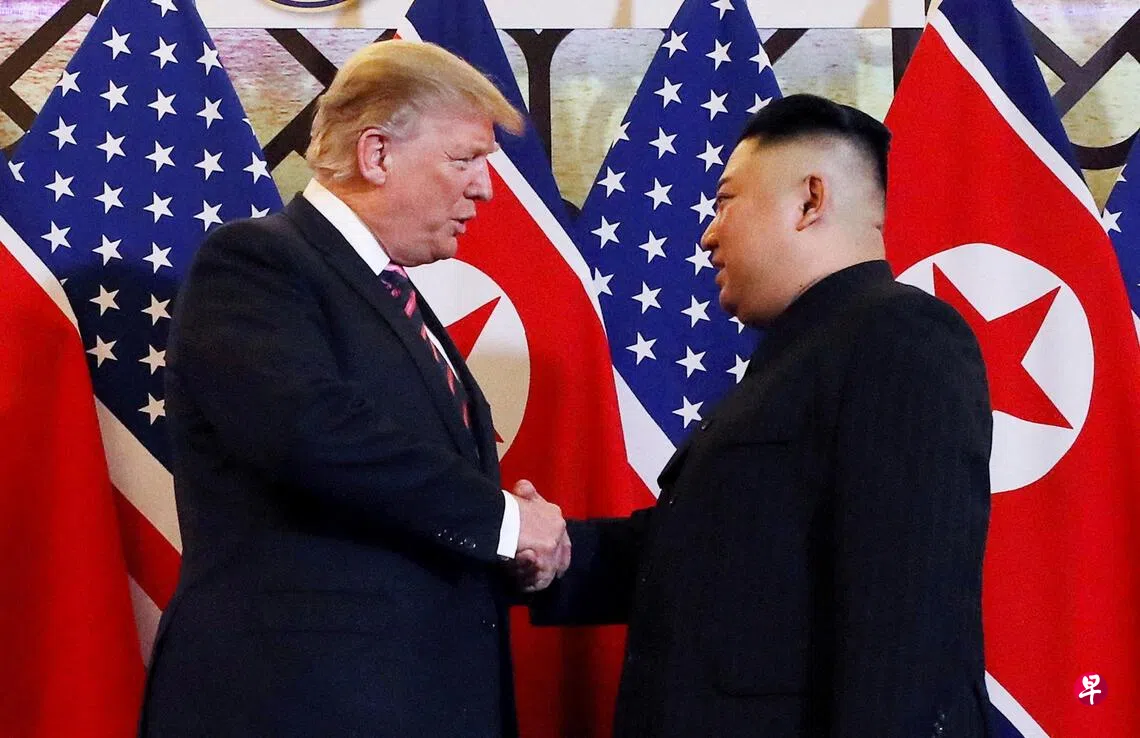
US President Donald J. Trump reportedly considered easing demands for North Korea to give up its nuclear weapons, declaring a formal end to the Korean War and setting up liaison offices between the two countries to secure another meeting with North Korean leader Kim Jong Un. South Korean foreign policy and security experts fear that if Washington sets aside denuclearisation to restart dialogue, it could bypass Seoul and effectively accept North Korea’s possession of nuclear weapons.
The Wall Street Journal reported on the 21st, citing people familiar with the matter, that after returning to office in January last year, Trump tried to contact Kim through existing channels but received no response. He then decided to write a personal letter.
White House officials went to the offices of North Korea’s permanent mission to the UN in New York and thrust Trump’s letter into the hands of a passing North Korean diplomat. The diplomat later returned the unopened letter to a US representative at a UN meeting.
The report said the Trump administration had sought to arrange a summit between the US and North Korean leaders during the Asia-Pacific Economic Cooperation (APEC) summit in Shenzhen, China, on the 18th and 19th of this month. A person familiar with the matter said US officials had discussed proposing to Pyongyang that the US declare a formal end to the Korean War and issue a statement that would neither formally recognise North Korea as a nuclear state nor demand that it give up its nuclear weapons.
In return, the US wanted North Korea to limit nuclear tests and missile test launches. Washington could also establish a liaison office, paving the way for more formal diplomatic relations.
Separately, the Korean Central News Agency reported that Kim Jong Un received credentials from the new ambassadors of 10 countries, including Russia, Sweden, India and Brazil, in Pyongyang on Sunday (22 November), and posed for photographs with each of them. It was the first time in more than 30 years, since the rule of Kim Il Sung, that North Korea’s top leader had personally accepted credentials from foreign ambassadors.
A spokesperson for South Korea’s Ministry of Unification said the move served, to some extent, to underscore Kim’s status as head of state to audiences at home and abroad.
In his speech, Kim stressed peace, development and international law without singling out the US for criticism. He also said the security situation in East Asia required North Korea to continue strengthening its military. Earlier, on the 13th, US Secretary of State Marco Rubio described Kim as “not an expansionist” and said the survival of his regime was his primary goal.
Lim Eul-chul, a professor at Kyungnam University’s Institute for Far Eastern Studies, said Kim’s reception of ambassadors from several countries was intended to broaden diplomatic channels, particularly by strengthening ties with emerging countries, to ease the pressure of US sanctions.
Park Won-gon, a professor at Ewha Womans University, said Rubio’s remarks echoed Pyongyang’s longstanding emphasis on its “right to self-defence”. Kim’s remarks could reflect North Korea’s perception that the US was willing to adjust the terms of negotiations.
Park warned that if Washington shifted the focus of talks from denuclearisation to managing the nuclear threat without fully consulting Seoul, it could make North Korea’s existing nuclear arsenal an accepted premise of negotiations and weaken South Korea’s voice in security affairs on the peninsula.
South Korean foreign policy and security experts also said that once an “end-of-war declaration” became an item on the agenda of US-North Korea talks, subsequent discussions about a peace treaty, the continued existence of the United Nations Command and the status of US forces in South Korea would all directly affect South Korea’s security interests.
