

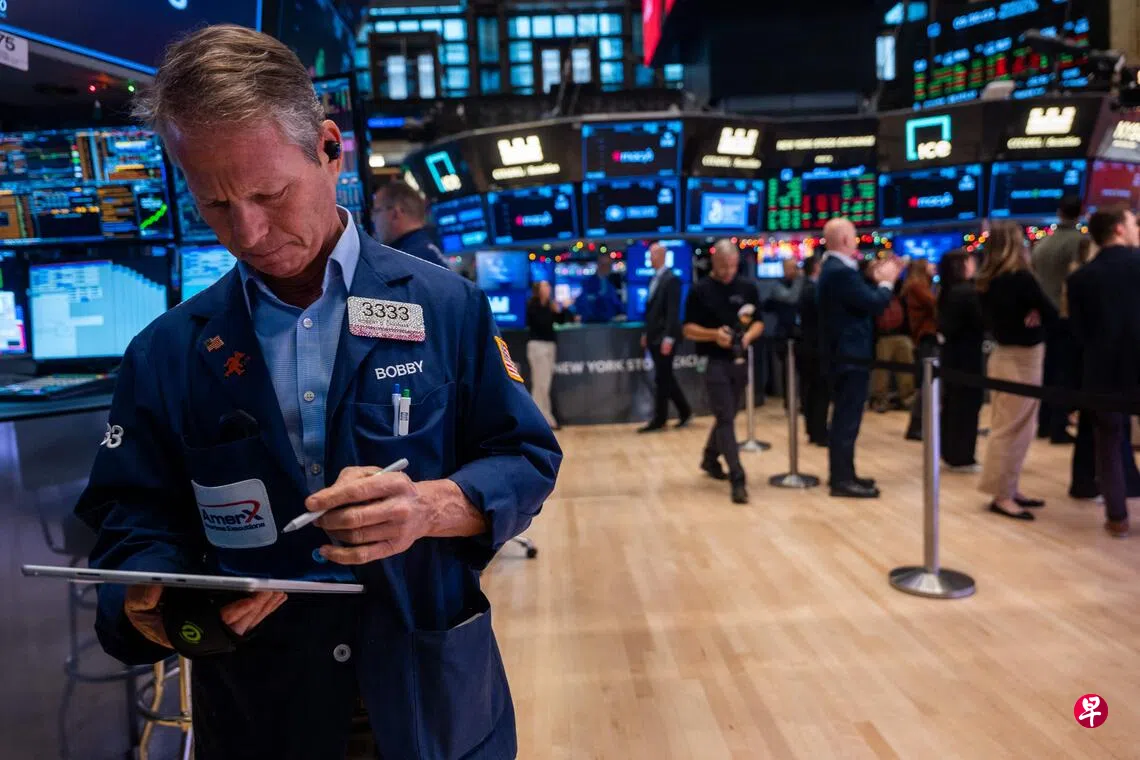
US stocks closed lower after a volatile session on Wednesday (25 November), with the Nasdaq 100 briefly entering a bear market before recovering most of its losses. The rebound was largely driven by dip-buyers willing to look past the biggest concerns clouding the outlook for artificial intelligence (AI).
The tech-heavy index ended just 0.6% lower after plunging as much as 4.7% during the session. The S&P 500 also fell as much as 3.2%, but pared its losses to close down just 0.3%.
Despite the fierce sell-off, not all sectors were affected, Bloomberg reported. Seven of the S&P 500’s 11 sectors advanced, led by materials. The Dow Jones Industrial Average, dominated by “old-economy” stocks, reversed its losses to close 0.3% higher.
After opening sharply lower on Wednesday, the Nasdaq 100 at one point fell 20% below its record high, meeting the definition of a bear market. An exchange-traded fund tracking chipmakers fell 0.5%, having tumbled more than 8% during the session. The Cboe Volatility Index (VIX), a key gauge of market turbulence, surged to nearly 35 before retreating to 28, a level that still signals mounting market stress.
With this week’s US trading schedule shortened by a holiday, liquidity is below normal levels. This could amplify market swings and leave investors reluctant to rebuild positions in the near term. US markets are closed on Thursday (26 November) for Thanksgiving and will close early at 1pm on Friday (27 November).
Enthusiasm over Jensen Huang’s return to the helm of Nvidia quickly faded as investors refocused on more consequential questions about AI risks, costs and profit prospects. After rallying on Monday (23 November), AI-related stocks dragged the broader market lower. Still, Wednesday’s buying suggested that, despite lingering doubts, investors were willing to believe the technology could be an engine of growth.
John Cunnison, chief investment officer at Baker Boyer Bank, said: “These reversals are extraordinary. I now wake up every morning not knowing what I’m going to see next.”
“The AI trade reaches so far. Our question remains: how long can this historic investment cycle last?”
The bank is adjusting its portfolios, marginally reducing its allocation to US large-cap growth stocks while adding to funds investing in dividend-paying value stocks.
An index of the “Magnificent Seven” US technology stocks fell 0.9%, after dropping as much as 5% during the session. Nvidia, which plunged more than 9% at one point, ended nearly 4% lower, leading losses in the group.
Amazon, Tesla and Microsoft also declined. Facebook parent Meta and Apple reversed their losses to close up 3.4% and 0.4% respectively.
Anthropic rose 1.1% but closed below its initial public offering price of US$83 for a second consecutive day. Buoyed by enthusiasm for AI, the stock had surged to as high as US$115 on its trading debut last week.
