

The US Democratic Party has won control of both houses of Congress in the midterm elections. Analysts say clarity over the election outcome could offer markets short-term relief, but tighter regulation may slow the expansion of artificial intelligence (AI) infrastructure and deepen the divergence in technology stocks. Returns on AI investment, fiscal policy and the situation in the Middle East will continue to drive market movements.
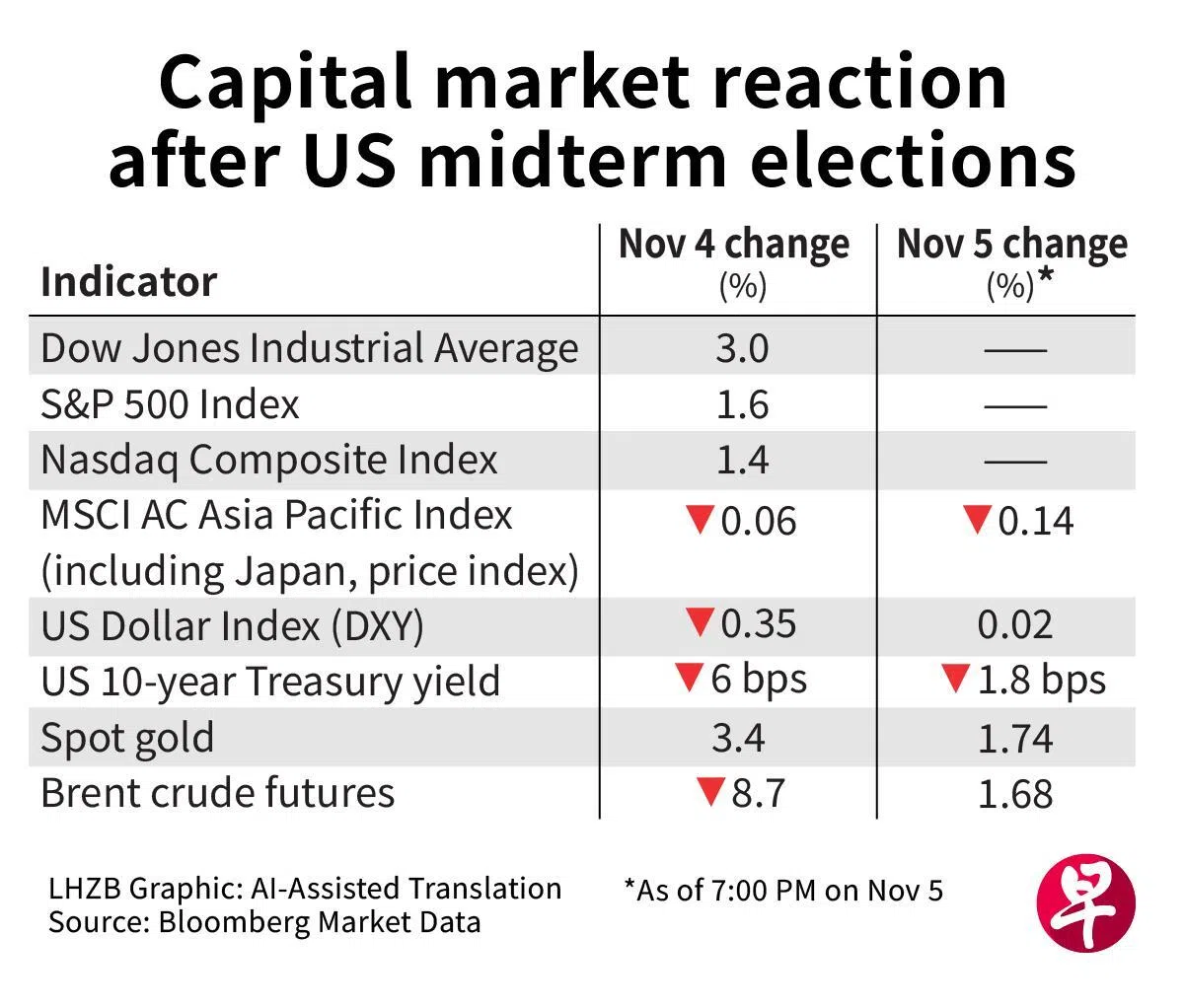
US stocks rose sharply on Wednesday (4 November) after the midterm elections concluded. However, concerns about tighter AI regulation sent shares in data centre operators lower against the broader market trend and contributed to sharply divergent performances across Asia-Pacific stock markets on Thursday (5 November). US stocks fell again at the open.
The MSCI Asia Pacific Index edged down 0.16% on Thursday. Seoul’s semiconductor-heavy stock market plunged 5.28% and Taiwan fell 3.2%, while Hong Kong rallied 3.67% and Sydney gained 2.61%.
Markets expect slower data centre construction could ease capital expenditure pressures on technology giants. Hospitals and some health insurers benefited from expectations that the Democrats would preserve measures supporting healthcare coverage, while renewable energy stocks rose on hopes of reduced policy risk.
However, the election of Democrat Gina Hinojosa as governor of Texas raised concerns about tighter regulation of data centres. Shares in data centre operators, chipmakers and power companies reliant on the expansion of AI infrastructure plunged, with the Philadelphia Semiconductor Index falling 3.1%.
Meanwhile, defence stocks fell after the Democratic victory, as markets anticipated a possible end to the war in Iran and greater resistance to Donald Trump’s plans to expand military spending.
Oil prices also tumbled as markets bet on a possible de-escalation of the US-Iran war. After plunging 8.7% on Wednesday, Brent crude futures recovered only modestly on Thursday, rising just over 1%.
US Treasuries and gold also attracted inflows. As of 7pm on Thursday, the 10-year US Treasury yield had fallen to about 4.88%, while spot gold had risen about 1.7% to above US$4,120 an ounce.
Investors expected checks and balances between the White House and Congress to constrain fiscal expansion, pushing Treasury prices higher and yields lower. A weaker US dollar and falling Treasury yields provided further support for gold prices.
Outlook: Doubts linger after elections, with AI investment returns still key
James Ooi, chief market strategist at Tiger Brokers, said the stock market rally reflected not only clarity over the election outcome but also investor expectations of a lower likelihood of sudden major policy shifts. “With the Democrats controlling Congress and the Republicans retaining the White House, sweeping policy changes may face greater resistance. Markets may welcome less government intervention in the economy.”
On the divergence in technology stocks, he said slower data centre expansion under Democratic regulation could allow major cloud service providers to reduce capital expenditure and improve free cash flow. Smaller data centre developers and cloud service providers, by contrast, could be more vulnerable to tighter regulation, given their relatively limited financial resources and reduced flexibility in handling project delays.
He added that tougher regulatory requirements for data centres under the Texas governor-elect would not necessarily mean an end to expansion. Projects that had yet to break ground could still delay construction or change sites.
Masahiko Loo, chief fixed income strategist at State Street Investment Management, said the Democratic victory had raised the political risk premium for the US AI industry, but would not necessarily disrupt the overall capital expenditure cycle.
He said, “That points more towards rotation than capitulation: capital can rotate away from crowded US tech exposure towards a broader range of sectors and markets. A softer dollar, lower US Treasury yields and reduced political uncertainty also create a more supportive backdrop for Asia and emerging markets.”
Alex Altmann, head of global equities tactical strategies at Barclays, said the midterm elections were unlikely to change the fundamental issues behind recent market volatility. The recent pullback in technology stocks stemmed more from investors’ concerns about AI financing and future revenue growth, with election uncertainty only a secondary factor.
Eugene Leow, rates strategist at DBS Group Research, said, “Beyond the near-term relief, investors will need to mull over a few issues that may be more durable. First, with fiscal spending likely to be more constrained, the growth / inflation outlook should ease somewhat. Second, US tech-exceptionalism may also be dented somewhat.”
Markets will next turn their attention to non-farm payrolls data due on Friday (6 November), and whether Trump will scale back US actions in the conflict with Iran.
