

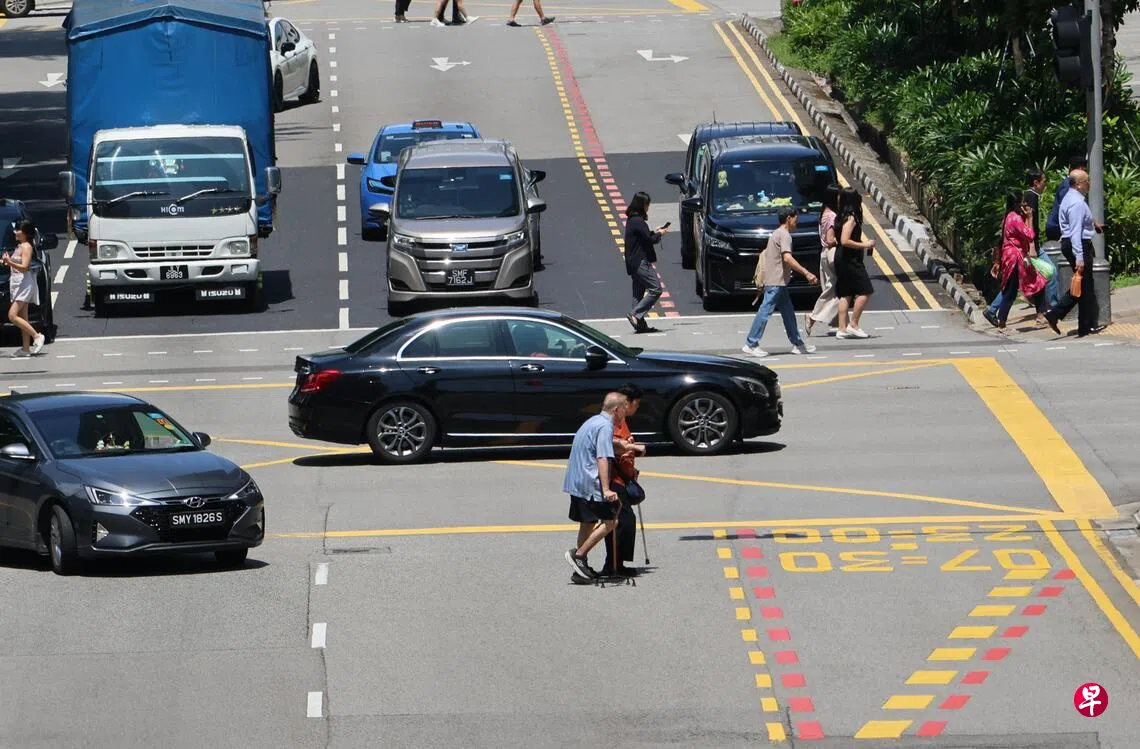
A 73-year-old woman recently died after being hit by a bus while crossing South Bridge Road in the direction of Tanjong Pagar. She was taken to hospital but did not survive. The accident drew widespread attention, not only because it was a fatal collision on a busy road, but also because it raised questions about transport infrastructure and how older people cross roads. It also brings into focus the details we should attend to as we strive to build a society that supports active ageing.
Singapore has already become a super-aged society. Our shared goal is to keep those aged 65 and above, who make up a fifth of the population, active rather than confined to their homes. In recent years, more centres offering activities for seniors have opened across our neighbourhoods, with an increasingly wide range of programmes. Public transport also offers substantial fare concessions to Singaporeans aged 60 and above, while cinema operators offer discounted tickets for daytime screenings from Monday to Friday. These measures all create opportunities for seniors to leave home and engage with society.
We are indeed seeing more seniors out and about, but this makes it all the more important to consider how safe their surroundings are. Getting around becomes more physically and mentally demanding with age. When walking or crossing a road, even a slight lack of speed or steadiness can pose a danger. A few extra steps may be trivial to a healthy young person, but for an older person they can be an ordeal best avoided.
The local traffic accident report for the first half of this year highlights a particular concern among accidents resulting in injury or death: there were 144 accidents involving pedestrians aged over 65, an increase of nearly 20% year-on-year. These left 132 people injured and nine dead. Nearly 40% of the cases involving older pedestrians arose from crossing outside designated areas or jaywalking.
Reports on the Chinatown accident and conditions at the scene indicate that traffic has always been heavy along this stretch. Yet pedestrians, including many seniors, frequently jaywalk between South Bridge Road and Upper Hokkien Street. The woman is believed to have been crossing from Upper Hokkien Street when she was hit. There is a signalised pedestrian crossing about 100 metres from the accident site, and a pedestrian overhead bridge a short distance away in the other direction. However, the bridge has a lift on only one side.
This draws attention to a reality: most seniors rely on public transport or walking to get around, while a small number need wheelchairs. Older people can tire easily when walking, or have other health conditions that leave them unable or unwilling to walk further, much less climb stairs. With no lift at one end of the nearby overhead bridge and the traffic lights some distance away, the facilities around the accident site are indeed less than convenient for seniors.
Singapore has, in fact, consistently put user safety at the heart of planning and designing public transport infrastructure. Under the Urban Redevelopment Authority's demarcation, the country has 55 planning areas. Outram, which comprises four subzones including Chinatown, has a far higher proportion of seniors than the national average. These areas have actively planned Friendly Streets that significantly reduce traffic speeds, as well as longer green-light timings to help seniors cross roads.
Recognising that older people's outings cannot be confined to their neighbourhoods, bus services have also been continually improved, including making boarding and alighting easier for wheelchair users. MRT stations have lifts that accommodate wheelchairs, and barrier-free routes extend to many parts of the island. Inevitably, however, gaps remain. Greater care is needed to identify and address them.
In practical terms, this means confronting the last-mile challenge from the perspective of older users. Do all traffic lights in areas frequented by seniors allow them extra crossing time? This is probably still far from universal. Are bus stops and MRT stations sufficiently accessible? Beyond HDB estates, other residential areas and parks, are there enough places to sit and rest along the way between destinations? Even everyday activities can present difficulties. Grandparents waiting for their grandchildren after school cannot enter the school to rest, and may find nowhere to sit outside the gate, leaving them to wait on their feet. Such shortcomings make it harder for seniors to walk longer distances or spend more time outside. These small provisions and facilities may seem peripheral or insignificant in national transport and urban planning blueprints. Yet they reflect the care and consideration essential to an age-friendly society.
To make drivers take greater responsibility for road safety, the Road Traffic Act was recently amended to tighten controls on mobile phone use while driving. Standards governing excessive alcohol levels have also been tightened, while legal penalties for deliberately using a vehicle to injure others have been increased. The aim is to send a clear message: dangerous driving must be curbed. From improvements to infrastructure to ongoing legislative amendments, the ultimate objective is to ensure that, even as Singapore strictly controls growth in vehicle numbers, those who rely on public transport and walking can enjoy a safe living environment and peace of mind.
Of course, some older people may jaywalk for convenience, unwilling to consider the consequences. Others may mistakenly assume that vehicles will always give way to them and see no need to obey traffic rules. Such a serious lack of road safety awareness endangers not only their own lives but potentially those of others who may also be harmed in an accident. These cases, however, are a minority. Overall, Singapore still has room to improve the detailed design of the last mile between destinations, so that no safety gaps remain. Making these journeys more accessible to older people, and bringing warmth and care to the last mile, would make inclusiveness and humanity visible throughout our city. In doing so, we would also instil respect and care for seniors in every Singaporean.
