

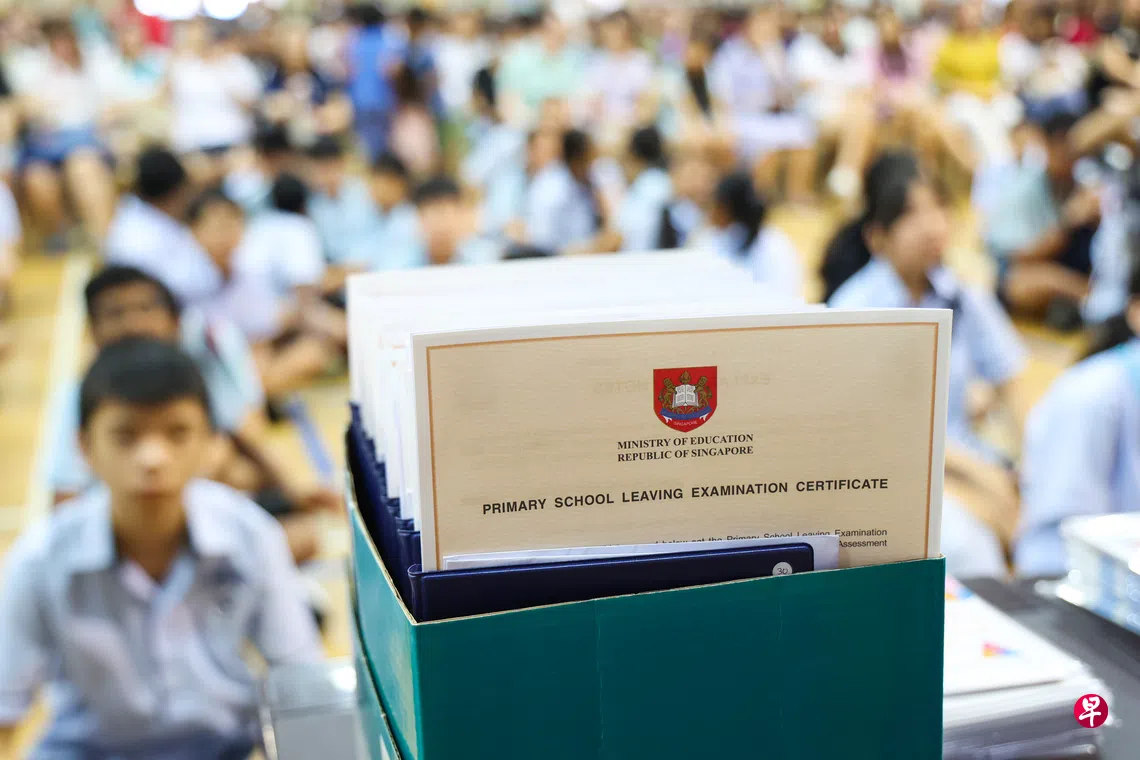
A friend said the “honeymoon period” he and his son had enjoyed after the Primary School Leaving Examination (PSLE) is nearly over. The thought of the impending results had made him more anxious.
His son had not applied through the Direct School Admission (DSA) scheme. They do not know how he will fare, and are even more worried that he may not get into his first-choice secondary school.
I told him that choosing a school was something he should work on with his son. Parents can gather information and offer advice, but it is more important to respect their children’s views and decide together on a choice that suits them.
PSLE results are undoubtedly important, but we need not see a single examination as a test that determines a child’s entire future. Falling short of expected grades or missing out on a conventional ‘brand-name’ school does not mean that doors are closed to the future.
Choosing a secondary school should not be just about its ranking or reputation. What matters more is whether it suits the child’s interests and abilities, offers a good learning environment and is convenient to travel to.
Then there is the classic dilemma when choosing schools: is it better to be a big fish in a small pond, or a small fish in a big pond? Some students are more motivated in a highly competitive environment, while others do better at a more gradual pace. Parents should therefore consider their child’s personality, study habits and ability to cope with pressure, rather than simply compare schools’ cut-off points.
When submitting school choices, parents and children should also look at previous years’ cut-off points, make full use of all six choices and rank them according to the child’s actual preferences. Past cut-off points are only a guide and do not guarantee admission in the current year. Besides their preferred schools, children should therefore include a few whose past cut-off points are more in line with their results.
Secondary school also brings a heavier workload than primary school, so commuting time must be considered. If two schools are otherwise similar, it may be worth giving priority to the one nearer to home. Saving a few dozen minutes each day gives children more time to study, exercise and rest.
Submitting Secondary 1 school choices is a practical opportunity to nurture independent thinking. Parents can research schools and weigh the pros and cons with their children, giving them room to express their preferences and learn to take responsibility for their choices.
Moving on to secondary school is more than simply choosing a school. It is part of growing up, as children learn to be independent and understand themselves better. May every child make a choice that suits them and enter a secondary school they hope to attend.
