

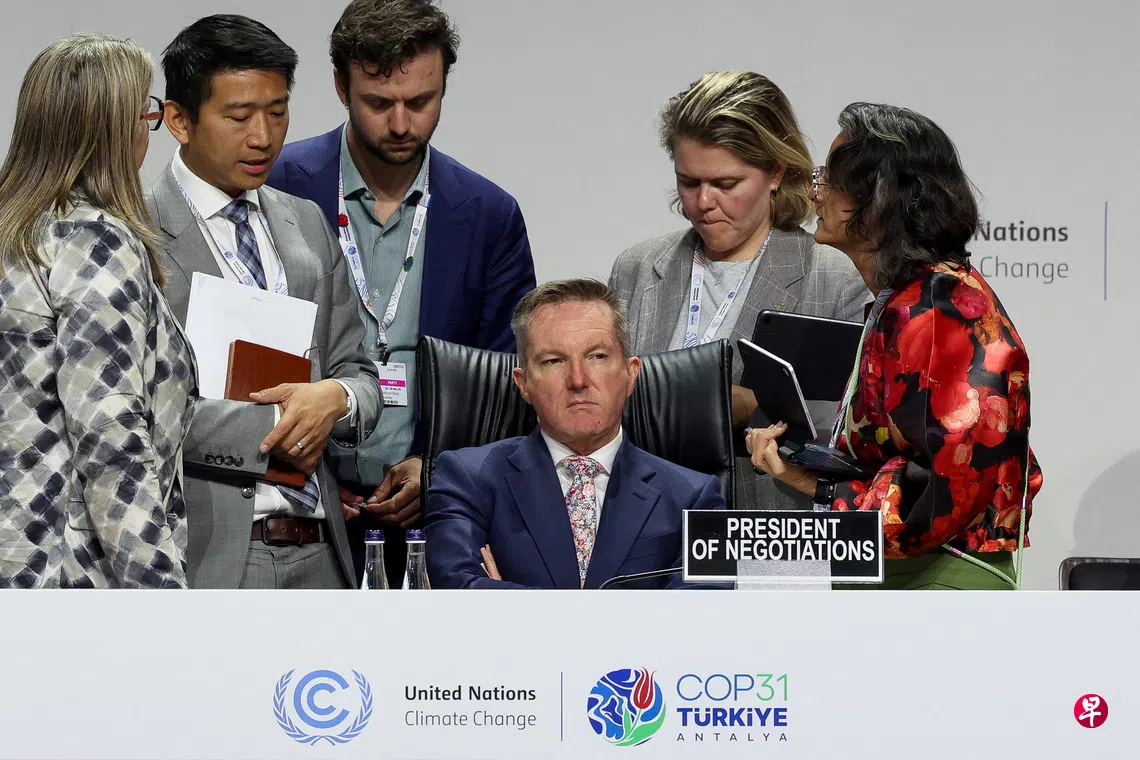
Talks at the UN Climate Change Conference (COP31) in Antalya, Türkiye, were declared a failure on 22 November after running about two days beyond their scheduled conclusion on 20 November. The conference’s proposed resolution, the Antalya Pact, fell through as two opposing camps remained deadlocked.
This is undoubtedly a setback for global efforts to tackle climate change. For small countries such as Singapore, which also faces climate risks, it presents both a challenge and a diplomatic test.
As the world becomes increasingly divided into blocs, the basic trust underpinning international cooperation is weakening. With major powers no longer willing to uphold the existing order, small and medium-sized countries have an even greater need to find common ground and protect their interests through cooperation. Tackling climate change is a test of their ability to work together.
The breakdown centred on wording in the agreement’s final text explicitly committing countries to “transitioning away from fossil fuels”. One camp, led by the EU and Pacific island states, insisted on retaining this wording. The other, led by Saudi Arabia, Russia and other economies dependent on fossil fuel exports, opposed any explicit reference to “fossil fuels”. As the agreement required unanimous consent, the impasse caused the talks to fail.
On the surface, the breakdown reflected a direct clash between environmental protection and economic development. Beneath it lay a lack of trust, evident in the stakeholders’ unwillingness to compromise. This may also reflect the prevailing mindset in global geopolitics, which bodes ill for future international cooperation.
The breakdown is a classic example of the tragedy of the commons: climate change affects every country, but addressing it requires a small number of countries to bear most of the costs, turning the issue into a geopolitical contest. The EU sought to use the climate issue to establish moral authority internationally, while energy-producing countries firmly resisted to protect their national interests.
The absence of the US also deprived the conference of a crucial source of leadership. The populist forces represented by US President Donald Trump reject any international rules that constrain US unilateralism. This led him to withdraw from the Paris Agreement and related climate processes during his first term.
China, which aspires to represent the Global South, also kept a relatively low profile at COP31, leaving the talks unable to achieve a breakthrough.
The current trend towards deglobalisation has led countries to place increasing emphasis on sovereignty and security, eroding the trust needed for international cooperation. The lack of basic mutual trust between countries has thus stalled both World Trade Organization negotiations on the rules governing global free trade and efforts to establish common guardrails for frontier artificial intelligence models that could threaten human safety.
The Russia-Ukraine war, the conflicts in Gaza and Lebanon and the US-Iran war that have erupted in recent years have heightened countries’ sense of crisis and weakened their incentive to cooperate.
Yet these are precisely the circumstances in which small and medium-sized countries should strengthen cooperation to safeguard their own and their collective interests in an increasingly uncertain international environment.
As with the challenge of responding to the erosion of the free trade system, Singapore has consistently advocated that like-minded countries begin by cooperating in specific areas of shared interest, rather than be paralysed by major powers’ inaction or an inability to reach consensus.
In the area of trade, the Comprehensive and Progressive Agreement for Trans-Pacific Partnership (CPTPP), signed by 11 countries in 2018, grew out of the Trans-Pacific Strategic Economic Partnership Agreement (TPSEP), also known as the P4 agreement, signed by Singapore, Brunei, Chile and New Zealand in 2005.
That same thinking underpins the cooperation mechanisms Singapore is now actively promoting, including the ASEAN Power Grid and carbon markets.
Singapore also actively promotes international trust and agreement on rules and standards for cooperation. Minister for Sustainability and the Environment Grace Fu, who represented Singapore at COP31, expressed regret over the breakdown in talks but urged the international community to maintain constructive cooperation.
Fu noted that although the agreement was ultimately not adopted, the draft contained a number of positive elements, including countries’ reaffirmation of their commitment to multilateralism. It also proposed a new global electrification target of 35% by 2035. She urged countries not to let this disagreement divide them, but to remain resolute in their commitment to cooperation and work towards an agreement at COP32.
In an interview with local media before the summit, Fu said it was vital for Singapore to “be at the table” to explain its position and emissions reduction pathway. She also told Parliament that, as next year’s ASEAN chair, Singapore advocated a pragmatic approach to future climate action that relied more on bilateral agreements and multilateral cooperation.
After taking over the ASEAN chairmanship next year, Singapore will have an opportunity to demonstrate that regional cooperation remains effective. It is expected to promote the establishment of a regional coordination centre for transboundary haze pollution control, advance cross-border electricity trading and the Green Economy Framework Agreement, guide cross-border cooperation in emerging green industries and support Southeast Asian smallholders in tackling climate change through an initiative to develop climate resilience projects and investments in Asia.
These concrete measures may not be as sweeping as a COP agreement, but their cumulative impact can still demonstrate the role small states can play and the responsibility they can shoulder in tackling climate change.
