

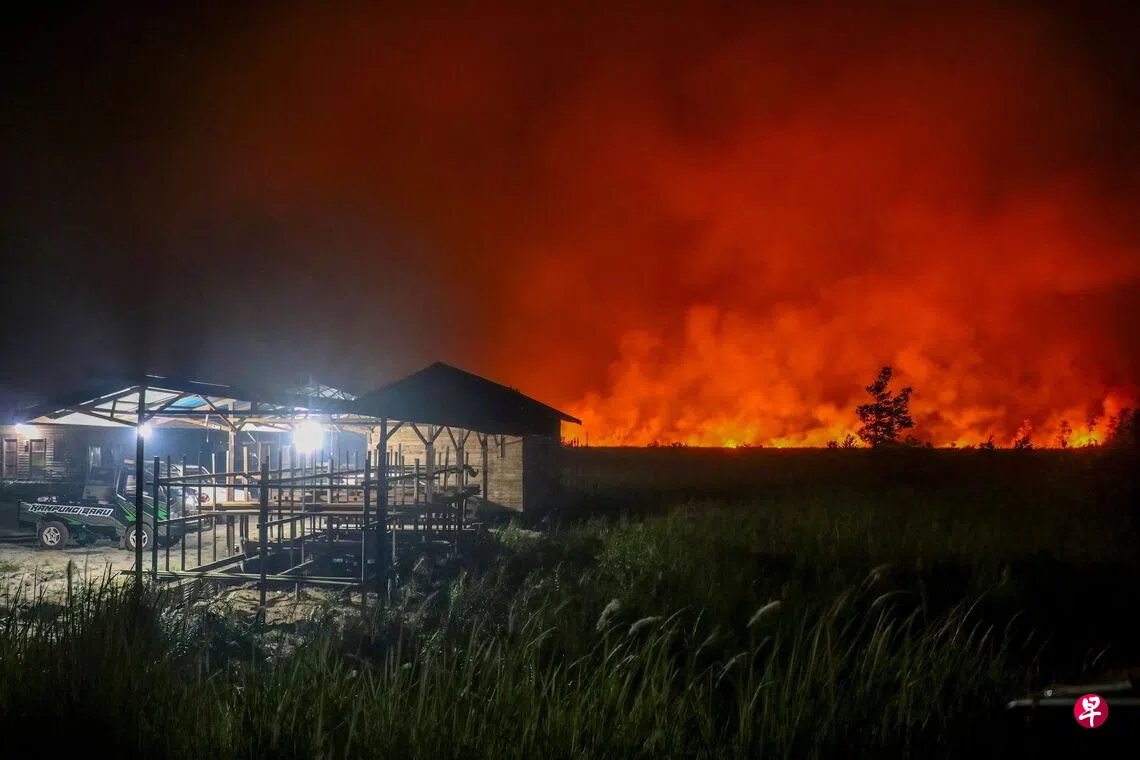
The regional haze caused by land-clearing fires in Indonesia has severely disrupted people’s health and daily lives across the region. It is time to take a firm stand.
Senior Minister K. Shanmugam warned on 19 October that the government was prepared to amend legislation urgently or introduce new laws if necessary. If companies refused to cooperate, it would use every available legal and regulatory means to affect their profits, access to financing and standing with investors.
This unequivocal stance on tackling the haze reflects the depth of public frustration. The harm caused by the regional haze has built up over many years, and lacks quick, easy solutions. However justified the discontent, dealing with practical constraints also requires sound judgement.
The haze problem has persisted for decades for the region and for Indonesians, and should have been resolved by now. Its persistence also underlines its complexity. It involves traditional land-clearing practices among local communities in Indonesia, weather patterns such as El Nino, and the business models and networks of commercial interests of the companies concerned. Moreover, although the harm crosses borders and affects the entire region, addressing any transboundary problem involves the sovereignty and priorities of the country in question. Other countries must respect national boundaries and cannot readily act in its place. Even as people express their dissatisfaction, they should recognise the many obstacles to a solution. Applying pressure or raising one’s voice in public diplomatic settings may attract attention, but effective governance should never be judged by how much of a show is put on, but on whether it delivers real improvements.
This certainly does not mean that Singapore can only sit back and suffer. On the contrary, this is precisely the moment to demonstrate our judgement and flexibility. This year’s haze has hit the region particularly hard, partly because El Nino has brought exceptionally dry weather that helps fires spread. But the commercial interests driving land-clearing by burning have also made the problem worse. Companies therefore bear an inescapable responsibility within this web of vested interests. Examining and dismantling these links could reveal a way to tackle the root of the problem.
To this end, the National Environment Agency has so far invoked the Transboundary Haze Pollution Act to question seven agricultural companies listed in Singapore. It has also issued notices to three other companies operating in Indonesia, requiring them to extinguish forest and peatland fires and prevent their spread. The Singapore Exchange has also queried the seven locally listed companies about possible links between their operations and the haze.
Shanmugam, who is also Coordinating Minister for National Security and Minister for Home Affairs, made clear on 19 October that the companies concerned cannot play “hide-and-seek” by exploiting complex corporate structures. Nor should they assume that, because the activities are carried out in Indonesia, they can evade their responsibilities in Singapore, and simply wait for this bout of haze to clear — Singapore will continue to call for accountability and not allow companies to play for time.
Shanmugam also spelt out the financial and economic penalties the government could bring to bear on the companies concerned. These include requiring banks to factor in environmental and legal risks when lending to companies with potential links to forest fires. As the banking regulator, the Monetary Authority of Singapore will ensure that banks properly manage these risks. The government will also investigate whether the companies concerned receive benefits such as government grants or incentives, and whether they remain eligible for them. These measures all fall within Singapore’s sovereign powers and could exert a considerable deterrent effect.
Over the years, some companies suspected of involvement have practised such moves as diversifying their operating structures and outsourcing to evade compliance obligations. The difficulty of gathering evidence has made it even harder to hold them accountable. Yet every action leaves a trace. If the authorities are determined to gather evidence and impose penalties — and go further by requiring companies to first prove that their supply chains are clear of land-clearing by burning — they can raise the cost of shirking public responsibility. This would force companies to address the burning at its source and remove a fundamental cause of the problem.
Investors and consumers, for their part, should become better informed and make a conscious effort to support companies that fulfil their public obligations. Together with the government’s legal, regulatory and economic measures, this would create pressure on several fronts to curb land-clearing by burning.
Southeast Asian countries have endured the haze for far too long. The Indonesian authorities are now showing a more proactive attitude and openness to international cooperation in fighting forest fires. Extinguishing the fires is the most urgent task, but much else can be done, including within Singapore’s own borders.
The government must act to restore clear skies over Singapore and keep them that way. The public must also understand that tackling the haze takes time. In addressing the problem involving an important regional neighbour, flexibility and wisdom are essential to achieving an outcome that will benefit both sides.
