

As someone who takes great pride in Singapore’s multilingualism and multiculturalism, I have long cherished a hope — one that goes back to my younger days.
I have always hoped that Singapore’s different communities would have more opportunities to read one another’s writings directly, understand how others see the world and approach issues, and know what matters to them. Our diversity is a precious asset. Like any asset, it needs to be nurtured, and the most fundamental way to do that is through connection, awareness and understanding between communities.
Lianhe Zaobao (《联合早报》) has made some modest efforts in this direction.
In the past, members of the older Chinese-educated generation were involved in translating Malay literature. Building on that tradition, we also introduced local Malay-language novels to readers through the literary pages of LHZB’s lifestyle section.
Last year, I visited some of our media counterparts in South Korea. During a meeting in their conference room, they told me they had begun using artificial intelligence to translate their newspaper content into English, Chinese and Japanese. From what I could see, they were translating only a limited selection of articles from their print editions. Nevertheless, it inspired me and opened my eyes to new possibilities.
When I returned, I shared some of our plans for the future with Yeng Kit, our then chief executive and now executive chairman. These included the possibility of using AI for translation, followed by human editing.
Yeng Kit was very supportive of the idea. In fact, he saw an even bigger opportunity. He believed that SPH Media’s major newspapers, published in Singapore’s four official languages, could all adopt this approach to reach more readers.
In fact, while we were still exploring how to proceed, The Business Times (《商业时报》) had already launched a beta version of its Chinese-language edition.
For a long time, with newspapers in different languages under SPH, our thinking tended to focus on avoiding competition that would erode one another’s markets. Hiring a dedicated translation team would also be expensive. In terms of cost-effectiveness, it did not make sense.
But times have changed.
In the international media industry, providing news in different languages is hardly a revolutionary idea. What has really changed is the technology, and its impact on the cost of translation and content production. Technological advances have made many previously impossible things possible. We should change the way we think, too.
For Lianhe Zaobao and The Straits Times (《海峡时报》), the overlap in content is only about 30%. This means each newspaper has a substantial body of reporting, analysis and commentary that readers of the other may not ordinarily have the opportunity to encounter.
From the perspective of SPH Media as a whole, translation is therefore not simply about presenting the same content in another language. It expands the information available to readers and gives more people access to different views and perspectives.
As a public service media organisation, this is an important part of our mission. That is why I was particularly excited by Yeng Kit’s decision to promote AI translation across our four major newspapers.
Of course, different language communities have their own concerns. Some support the initiative, while others worry that it could affect the readership of mother-tongue newspapers. We understand these concerns and take them seriously.
Lianhe Zaobao is expanding its video production while continuing to invest in student publications, so that younger generations remain engaged with Chinese-language media.
We also believe English translations can help more young people understand and appreciate our journalism, including those who are not yet comfortable reading in-depth reports in Chinese. This is not about replacing Chinese-language journalism, but about giving more people another way to discover its value. We believe it is worth trying.
At the group level, Yeng Kit decided to take an open and gradual approach, allowing each publication to experiment at its own pace.
We and our sister newspaper, The Straits Times, decided to take the lead, although we use different models and approaches.
The Straits Times uses SEA-LION, a language model developed in Singapore. Its Chinese-language edition went live on a trial basis at the end of last month.
The devil is in the details
LHZB has taken a somewhat different approach. We started with a very small team working on ThinkChina.sg. Over the past few months, the team tested various translation systems. This included using one AI model to evaluate another.
Every day, we select articles from the Lianhe Zaobao website, including exclusive news reports and commentaries. These are first translated by AI, then reviewed, edited and polished by our colleagues. Machine translation may sound straightforward, but in practice, the devil is in the details. For example, we want to ensure, as far as possible, that public figures’ Chinese and English names correspond accurately and are used consistently.
There is also the issue of quotations. Some statements may originally have been made in English and translated into Chinese for Zaobao’s reporting. When these reports are used in the English edition, we try, wherever possible, to restore the original English wording of important statements. Otherwise, the English version may end up being a translation of a translation, rather than what the person actually said.
Getting this right requires further work, and the technology still needs fine-tuning. Our AI translation system is being continually refined, and there is much room for improvement.
Our colleagues have worked with great dedication and care. They have put tremendous effort into bringing us this far, and I want to take this opportunity to thank them. I am confident that, with the team’s efforts and continued technological progress, we will keep getting better.
Of course, improvement is a process; it does not happen overnight. If mistakes occur along the way, or AI produces hallucinations, I hope our readers will be patient and understanding. Please also be assured that we take accuracy very seriously. We will address mistakes conscientiously, learn from them and keep improving.
So please give us a little time. Once our English edition is firmly established, we hope to take the next step and introduce Malay and Tamil editions. Our sister newspapers in other languages are also exploring how to proceed.
There is, however, one point I must stress. What we are doing is using translation to make our journalism accessible to more people. This does not change the essence of Lianhe Zaobao. At its core, it remains a Chinese-language media organisation. Our editorial policy, journalistic traditions and commitment to Chinese-language journalism will not change. The journalists we recruit must still be able to report and write in Chinese.
We simply hope to open another window through which more people can discover and understand our work.
As a public service media organisation, we already attract considerable attention and scrutiny from all sections of society. Translating our content into other languages under such intense scrutiny may seem like inviting trouble. I have told my colleagues that we may face even more criticism in the days ahead.
More interpretations and criticism may follow
But I believe we should look at this from another perspective. It is precisely because we are a public service media organisation that we should take this step. When technology has reached a stage where multilingual access is increasingly practical, we have a responsibility to make good use of it.
To me, this is not simply an application of technology. It is also part of SPH Media’s responsibility to society.
We know that reaching more readers from different backgrounds also means we may face a wider range of questions and interpretations, as well as inevitable criticism.
We will respond to criticism with humility and sincerity. But we sincerely hope this process will not add to hostility in society. Instead, we hope it will encourage something increasingly important, yet increasingly difficult: a willingness to engage with views different from our own and try to understand the experiences and reasoning behind them.
We do not have to agree with every opinion we read. But we can at least make the effort to understand why others think differently. To me, that is the true value of this initiative.
We hope Zaobao’s English edition will provide a platform for more people to understand how a Chinese-language media organisation sees itself, the community it serves, Singapore, our region and the world.
As newspapers in other languages gradually embark on similar initiatives, we hope readers will have more opportunities to see how different language communities understand our shared society from different perspectives. These differences should not divide us. Instead, they should enrich our society.
Technology can help us cross language barriers. But only human curiosity and empathy can truly bring different communities closer together.
A truly multicultural society should be more than different communities simply living in the same place. More importantly, people must be willing to listen to one another, learn from one another and continually deepen their mutual understanding.
By giving more people access to different information and perspectives, we hope to contribute, in our own modest way, to making Singapore a society that understands itself better.
Today, we are taking a new step. There will certainly be challenges ahead, and much to learn. But we believe this is a step worth taking. As we embark on this new journey, we need your encouragement to sustain our courage.
Finally, I would like to express my sincere thanks to President Tharman Shanmugaratnam for taking the time to join us on this meaningful occasion.
The writer is editor-in-chief of SPH Media's Chinese Media Group.
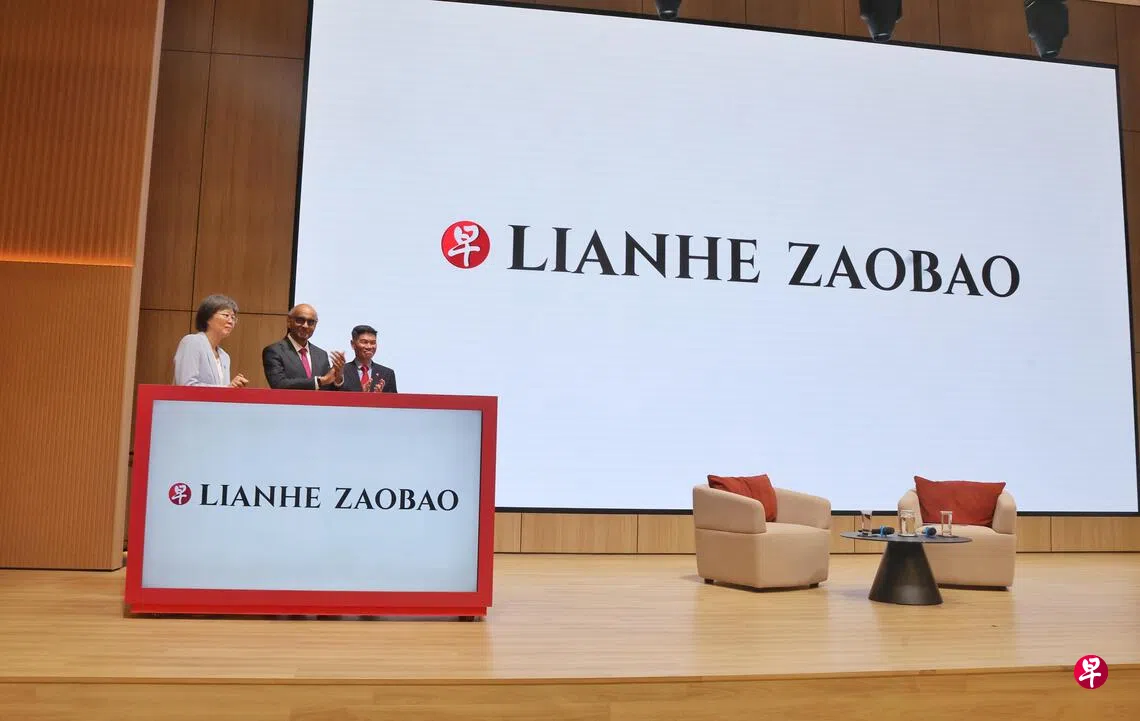
This is the speech she delivered at the launch of the Lianhe Zaobao English Edition website on 5 November.
