

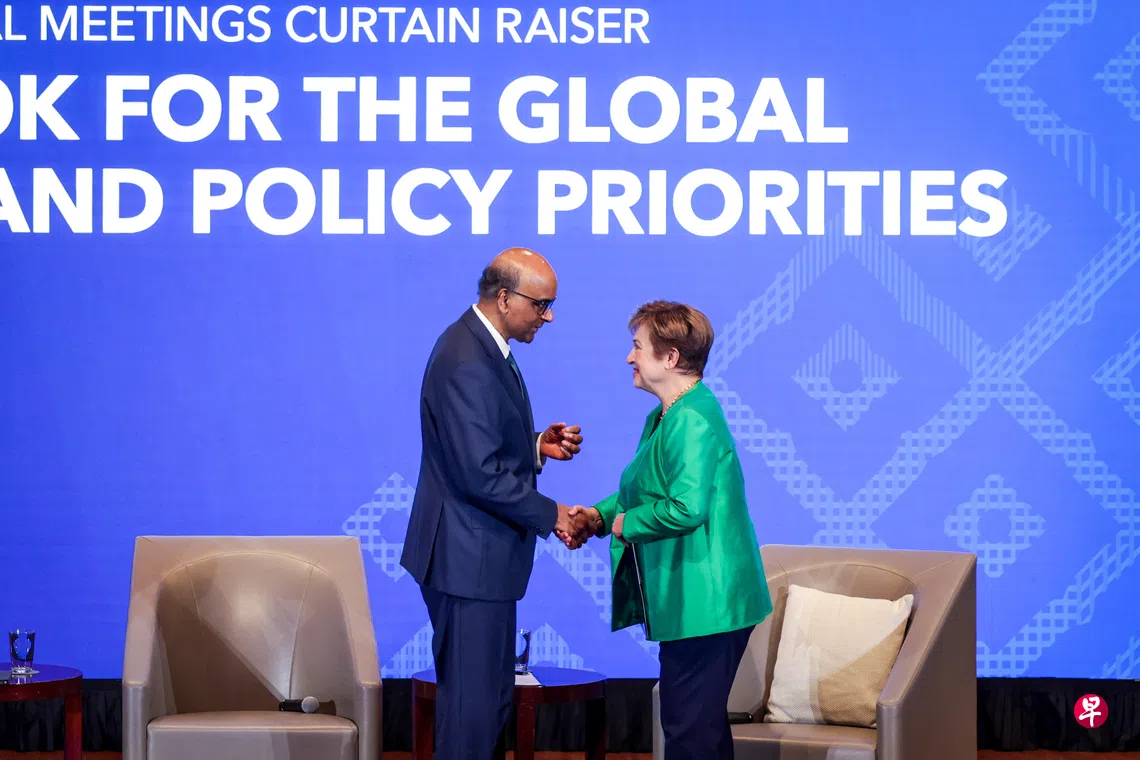
On 7 October, President Tharman Shanmugaratnam held a dialogue with International Monetary Fund (IMF) Managing Director Kristalina Georgieva ahead of the IMF’s annual meetings. Georgieva said the IMF had the important task of explaining to all parties why they needed to work together to address global challenges: everyone was in the same boat, navigating the same turbulent seas.
President Tharman responded with the Chinese idiom “weathering the storm in the same boat”, stressing the urgent need for mutual trust in today’s global order.
This natural use of a Mandarin idiom by a non-Chinese head of state at a high-level international financial forum reflects not only his personal ability to communicate across cultures, but also the deep understanding of, respect for and emphasis on multiculturalism that Singapore’s political leaders possess.
However, as rivalry between major powers intensifies, the use of language and cultural symbols can easily become excessively politicised.
This brings to mind remarks by Coordinating Minister for Public Services and Minister for Defence Chan Chun Sing at the Beijing Xiangshan Forum last month. Quoting Mencius in Mandarin, he said: “Those who subdue others by force do not win their hearts; those who win others over through virtue earn their heartfelt and sincere submission.” He called on major powers to build mutual trust rather than resort to military intimidation.
His remarks drew widespread attention on Chinese social media. Some saw Chan’s use of Mandarin and references to Confucian thought on an international stage as a diplomatic gesture of goodwill. Others cautioned that this cultural affinity did not mean Singapore was taking political sides.
The Sohu account “Hongbing Zhuojian”, for instance, argued that though Chan’s remarks were steeped in Eastern culture, behind them lay the careful diplomatic choices Singapore was making in a turbulent international environment as a small Southeast Asian state. The article argued that for Singapore, getting too close to China could arouse US suspicions, while aligning fully with the US could cost Singapore opportunities in the Chinese market. Singapore can therefore only continue seeking a balance between the major powers.
This exercise in “language diplomacy” also attracted regional media attention. Hong Kong’s South China Morning Post cited academics who noted that some members of the Chinese public might equate linguistic and cultural affinity with political alignment. The academics were concerned that attaching excessive political expectations to such cultural affinity could lead to unnecessary misunderstandings if Singapore subsequently adopted a foreign policy position that did not meet those expectations.
Indeed, Singapore’s political leaders often insist on speaking English when visiting China precisely to avoid such misunderstandings.
Founding Prime Minister Lee Kuan Yew was a case in point. He understood that although Singapore had a majority ethnic Chinese population, it was fundamentally a multiracial, multicultural country. When visiting China, he often insisted on speaking English in meetings with its political leaders or when addressing audiences there. This was more than a choice of language. It sent a political signal: Singapore was an independent, sovereign state whose neutral political stance was not determined by cultural or linguistic affinity. It also guarded against Singapore being labelled a “Chinese country”.
Similarly, Senior Minister Lee Hsien Loong has publicly stressed on more than one occasion that “we are not a Chinese country”, and that all Singaporeans must put the nation’s interests first.
Chan’s remarks at the Xiangshan Forum should therefore be understood as a show of respect for his hosts and Chinese culture, rather than an attempt to signal political alignment through cultural affinity. Drawing on language and philosophical ideas familiar to his audience, he urged major powers to shoulder their responsibilities and avoid using their strength to force other countries into submission.
Chan has, in fact, explained many times before why Singapore must never take sides. He even said once, “If you want to take sides, that is fine. Take Singapore’s side.”
At this year’s Shangri-La Dialogue, Chan deftly used four rhyming lines in Mandarin to stress the importance of defence communication: “Discussion without action makes everything hard to achieve; action without discussion makes mutual trust even harder to achieve; the lack of both discussion and action compounds the difficulty; the combination of action and discussion together makes everything achievable.” He also provided an English translation on the spot so that international participants could understand the meaning of his words. This highlighted Singaporeans’ ability to switch flexibly between languages in a multilingual setting.
It is therefore evident that, be it insisting on English during visits to China and maintaining Singapore’s identity as “not a Chinese country”, or skilfully using Mandarin, Confucian thought, idioms and rhymes on the international stage, Singapore’s political leaders are utilising the same diplomatic principles: demonstrating cultural affinity while preserving strategic autonomy and refusing to take sides in rivalries between major powers.
Cultural affinity can certainly bridge gaps in communication, but it should not be interpreted as political alignment. Singapore’s strength lies precisely in its ability to understand different cultures and communicate in different languages while maintaining its national position and independent judgement.
(The writer is political editor of Lianhe Zaobao.)
