

I was once an entrepreneur and early investor in companies such as the haptic technology firm Immersion.
Looking back, what stays with me is never success or failure, but the resolve to take that imperfect first step when the answers were still unclear. School taught me precisely the opposite: seek the right answer, avoid mistakes wherever possible and, when mistakes happen, correct them rather than learn from them.
Stanford University changed my thinking. In 1995, a group of students there ran into a problem: web browsers could not display Chinese characters. Rather than write a paper about it, they cobbled together a solution on a small Linux server.
That makeshift fix later grew into Sinanet, which became Sina, Weibo’s parent company. The lesson lay not in the sophistication of the technology, but in an instinct: do not wait until everything is in place before acting. Test the waters first, then work towards perfection.
Singapore has no shortage of talent, capital or ambition, but our system prizes precision. The entrepreneurial spirit, however, is forged in uncertainty: meeting users before you feel ready and launching a prototype before it is perfect. Constantly playing safe does not eliminate risk; it merely delays learning. In a race where the fast keep getting faster, such delays are costly.
Risk is the foundation of innovation, both for entrepreneurs and for investors willing to back potential before it has been proven.
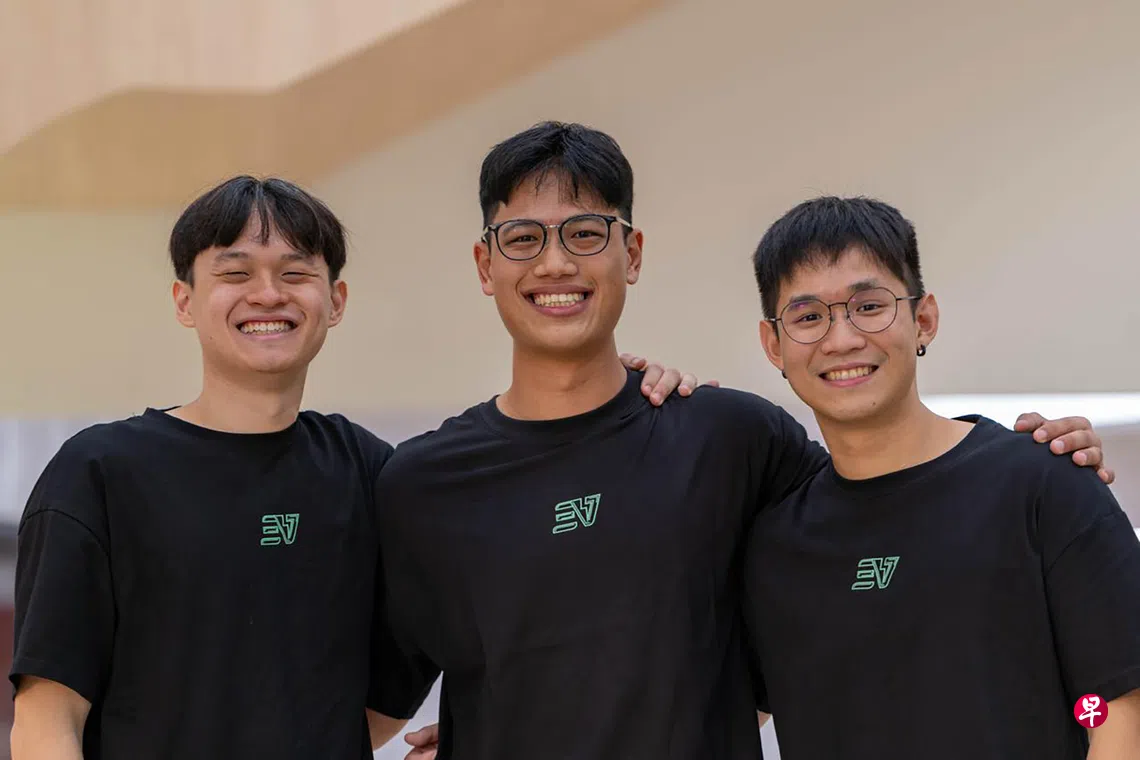
Ecovolt is one example. Through NUSX programmes, including National University of Singapore (NUS) Overseas Colleges (NUS Overseas Colleges, or NOC) and B71 (formerly BLOCK71), Raphael Chew, Eugene Chia and Glenn Quah founded Ecovolt.
All three had interned at well-known companies, but none had ever developed a physical product. Experts discouraged them, saying others had already tried this path and failed. What sustained them was not a moment of revelation, but their commitment to keep working week after week, even when there were no results in sight.
Today, their systems are used in more than 75 buildings across Singapore. One of those buildings belongs to a developer who initially turned them down.
Fear of losing face has made us accustomed to concealing failure rather than seeing it as an inevitable part of the journey. It has also led many young people to quietly abandon the idea of forging a different path. Yet failure and rejection are constant companions in entrepreneurship — and among its best teachers.
My own journey began with a rejection. In the 1990s, my application for a master’s programme at Stanford was turned down.
Two weeks later, I was admitted after a senior professor who had seen my work argued strongly for me. He was backing a person, not impersonal credentials on a piece of paper. That inspired me to back myself as an entrepreneur and, later, to back others as an investor.
Setbacks do not define us. Rather than see them as a loss of face, we can turn them into motivation and find the courage to take the first step, even when we feel unprepared. A journey of a thousand miles begins with a single step.
Entrepreneurship is often seen as a solitary struggle, and it can certainly feel that way at times. But behind every successful entrepreneur is a supportive community of mentors, investors, teammates, family members and institutions.
Young people today have far more support than I did 30 years ago. At NUS, students can experience entrepreneurship first-hand through NOC, tackle industry challenges through the NUS-Stanford Global Engineering Design Innovation Programme, and turn research findings into commercial products through the National Graduate Research Innovation Programme.
The question now is whether they will take the initiative to make the most of these resources.
No education system or programme can replace courage, resilience and adaptability. Every generation inherits opportunities created by those who came before it. What defines a generation is how it uses them.
I hope more young Singaporeans will find the courage to try, create and discover their potential — not because success is guaranteed, but because this is how meaningful ideas, ventures and lives are built.
The writer is senior vice president (Innovation and Enterprise) at the National University of Singapore.