

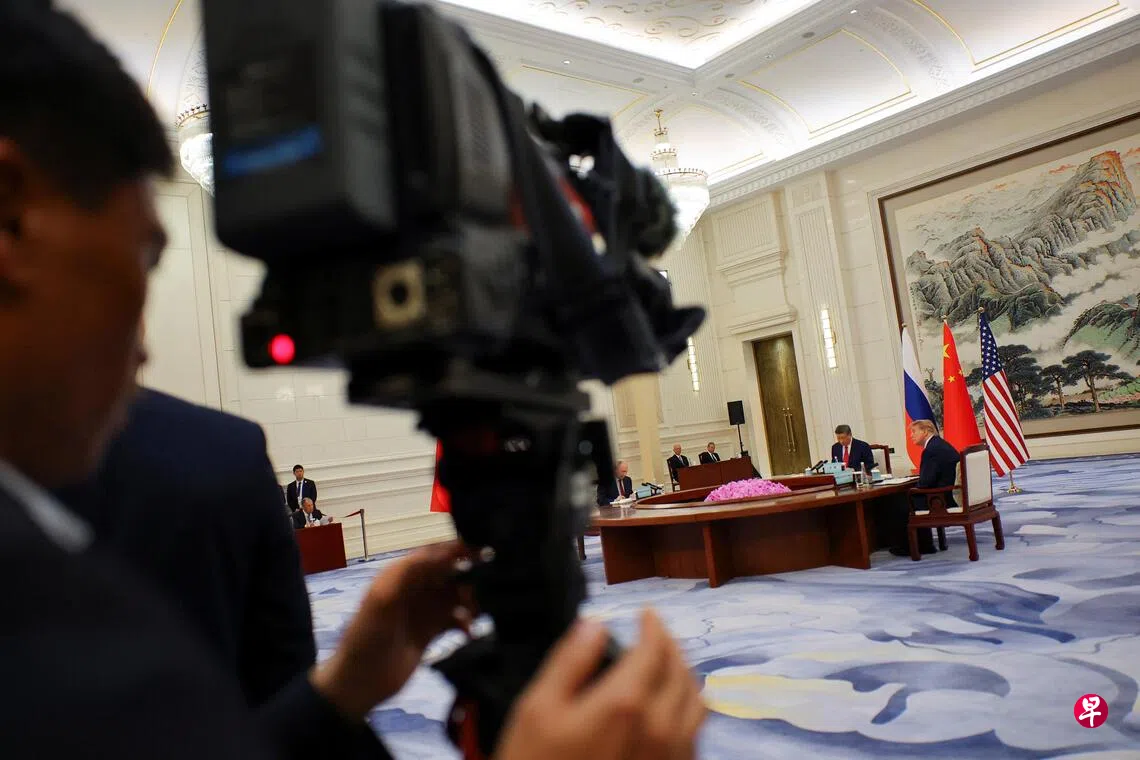
On 19 November, the leaders of China, the US and Russia held their first-ever summit in Shenzhen. The meeting undoubtedly carries major geopolitical significance. The leaders of three countries with enormous influence over international affairs, but also deep strategic differences, finally sat down at the same negotiating table.
After the summit, Chinese President Xi Jinping, US President Donald Trump and Russian President Vladimir Putin issued a joint peace declaration, pledging to uphold world peace and promote strategic stability among major powers. All three leaders agreed that “a nuclear war cannot be won and must never be fought”.
The Shenzhen summit naturally invites comparisons with the Yalta Conference of 1945, when the leaders of the US, the UK and the Soviet Union gathered in Yalta to discuss arrangements for the post-war international order. Yet the geopolitical circumstances of the two meetings are entirely different, as is their historical significance.
At the time of the Yalta Conference, the three countries were wartime allies fighting fascism together. Their discussions centred on constructing the post-war international order and dividing spheres of influence. Those arrangements reflected the reality of that time: major powers dominated international affairs and determined the fate of smaller countries.
China, the US and Russia today have no comparable alliance underpinning their relationship. Instead, they have deep strategic differences. China has consistently stressed the interests and representation of the Global South, maintaining that international affairs should not be decided by a handful of major powers. It is therefore clearly inappropriate to view the Shenzhen summit as a new Yalta Conference, let alone suggest that the three countries are preparing to carve up the world.
Is a new pattern of major-power relations emerging?
The real significance of the Shenzhen summit lies in establishing channels of communication among major powers and providing an important platform for managing differences. This allows the parties to explore new ways of handling their relationships in a highly interdependent world.
The summit’s greatest achievement may not be the number of disputes it resolved immediately, but the important signal the three countries have jointly sent: strategic competition among major powers must not spiral out of control, much less descend into an unmanageable conflict.
Competition between China and the US in technology, trade and industry will continue, while tensions between Russia and the West will not easily disappear. At the same time, however, the three countries share certain interests, including preventing military conflict, reducing nuclear risks and maintaining stable global energy supplies.
We may therefore be witnessing the emergence of a new pattern in major-power relations: competition will be long-term, cooperation will be selective, and strategic stability will become an international public good that all sides must safeguard.
For the global economy, the Shenzhen summit’s tangible short-term results may be somewhat limited. Its main value lies in reducing the likelihood of extreme risks materialising. It is more akin to installing a “shock absorber” in the global economy, as compared to fitting it with a new engine of growth.
For Asia, this “shock absorber” is especially important. When making investment decisions today, Asian businesses must increasingly consider geopolitical risks alongside costs, markets and technology. Tariffs, export controls and tensions among major powers can all drive up financing costs, delay investment and even disrupt supply chains.
If the Shenzhen summit can bring about a sustained, stable mechanism for communication among major powers, it will help improve the long-term investment environment, particularly benefiting sectors such as infrastructure, energy, advanced manufacturing and cross-border logistics.
Stable energy supplies are particularly important for Asian economies that rely heavily on energy imports. An ideal outcome would be for the major powers to strengthen coordination and create a more predictable external environment for global energy markets.
More importantly, the summit could create greater room for ASEAN to exercise strategic autonomy. More stable major-power relations would help ASEAN maintain openness and flexibility in its external economic ties. Amid intensifying competition between China and the US, ASEAN countries neither want to be forced to choose sides, nor wish to lose opportunities to cooperate with either side on markets, capital and technology.
ASEAN should not assume, however, that better communication among major powers means geopolitical risks will automatically disappear. Its strategic autonomy ultimately still depends on continually strengthening its own economic power, industrial capabilities and institutional competitiveness.
This is particularly important as economic and trade relations between China and ASEAN undergo a transformation. Their cooperation is moving beyond traditional trade in consumer goods towards deeper integration of industrial chains and production capacity.
Chinese investment, machinery, technology and industrial intermediate goods are increasingly supporting the development of ASEAN’s manufacturing sector. This creates new opportunities for ASEAN countries to upgrade their industrial capabilities and move into higher value-added segments of global production networks.
But deeper industrial integration between China and ASEAN also brings new challenges. If ASEAN manufacturers rely heavily on the US market while making extensive use of Chinese industrial inputs, their exports could face heightened risks of US tariffs, along with rules-of-origin scrutiny and other trade restrictions.
ASEAN countries should therefore continue diversifying their export markets. Beyond the US, they should actively expand into China, the 15 signatories to the Regional Comprehensive Economic Partnership (RCEP), and other countries in the Global South.
Technological competition is another challenge that warrants attention, particularly as artificial intelligence (AI) has become a focal point of China-US strategic competition. US export restrictions on advanced semiconductors and computing power could affect Chinese companies’ investments in data centres and AI infrastructure in Southeast Asia.
ASEAN should work towards building a diverse, open and rules-based AI ecosystem. Its development priorities should extend beyond computing infrastructure to expanding practical applications of AI and advancing regional digital cooperation.
From a broader perspective, Asia as a whole has an opportunity to become a key driver and organiser of a new form of globalisation, exploring a new balance between security, efficiency and resilience. It can play a greater role in connecting production capacity, technological resources and markets across borders.
Of course, Xi, Trump and Putin cannot determine the future of the world economy through a single summit. What really matters is whether the three countries can sustain high-level communication and translate political declarations into concrete cooperation.
For Asia and ASEAN, the summit’s greatest value may lie in the major powers’ willingness to prevent their differences from escalating further into confrontation. In an uncertain world, sometimes averting a crisis is in itself an economic achievement.
The author is an associate professor with the Lee Kuan Yew School of Public Policy at the National University of Singapore.
