

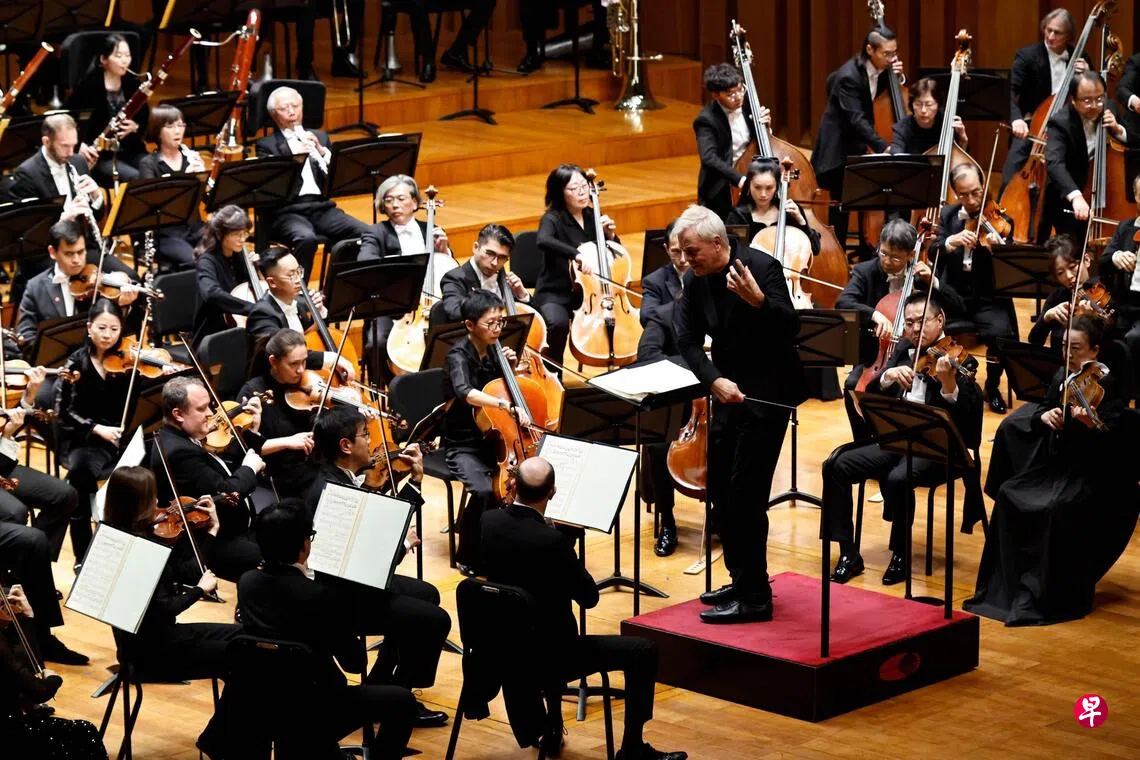
On 25 October this year, the Singapore Symphony Orchestra (SSO) concluded its seven-city China tour at the Banlam Grand Theatre in Xiamen. Its new music director, Finnish conductor Hannu Lintu, led the orchestra, with violinist Chloe Chua as soloist. The programme spanned markedly different styles, from Wang Chenwei’s The Sisters’ Islands to Mendelssohn’s Violin Concerto in E minor and Mahler’s Symphony No. 1 in D major. Yet the orchestra rose splendidly to the challenge with a cohesive sound, precise playing and seamless shifts in tonal colour. The musical dialogue between Chua and the principal cellist was particularly sensitive and finely attuned.
How does a country of just six million people sustain a world-class symphony orchestra and nurture young musicians of international standing such as Chloe Chua?
The SSO’s development as a professional ensemble began with the institutional framework established at its founding. Following the national decision to create a truly professional orchestra, founding conductor Choo Hoey did not rush for results. Instead, he set professional standards and made them part of the orchestra’s organisational culture. More importantly, Singapore gradually built a system for nurturing musicians, from childhood music education through to professional performance. Chua exemplifies the success of this long-term investment in musical talent: she entered the Nanyang Academy of Fine Arts’ School of Young Talents at four, took to the international stage at 11, and gained the backing of a professional orchestra at 15 when she became the SSO’s artist-in-residence, opening up further international career opportunities.
The SSO does not exist in isolation. When I lived in Singapore in the late 1990s, I experienced a rich and diverse musical ecosystem. Alongside the symphony and Chinese orchestras were a youth symphony orchestra, various choirs, amateur ensembles, community orchestras and school music groups. Many concert programmes carried the names of supporting organisations such as the Lee Foundation. Even then, music in Singapore was no longer the preserve of professional musicians; it had become part of schools, communities and ordinary people’s lives. In 2002, Esplanade-Theatres on the Bay officially opened, and its 1,800-seat concert hall became one of the SSO’s key performance venues. The Yong Siew Toh Conservatory of Music was established the following year.
Despite the country’s limited land area and market size, the SSO has charted a clear international course.
As the orchestra’s fourth music director, Finnish conductor Hannu Lintu aims not only to raise performance standards but also to develop a distinctive sound and help make Singapore an important platform for contemporary music in Asia. The Sisters’ Islands, which featured on this tour, draws on Singapore’s geography and cultural memory. Incorporating elements of Malay zapin and Indonesian gamelan music, it evokes a distinctively Nanyang cultural character. Listening to it, I felt that Singapore’s composers could both draw nourishment from the world’s music and find inspiration in their own history, geography and diverse cultures to create a distinctive voice.
Through its international tours, the SSO offers a window into Singapore’s cultural identity. It shows the world that Singapore has not only an advanced economy and a modern urban landscape, but also an open cultural environment, mature arts institutions and creative capabilities. The orchestra’s international line-up also reflects Singapore’s ability to attract talent from around the world and foster exchange and interaction between cultures. More importantly, when international classics share the concert hall with works by Singapore composers, and home-grown music reaches other countries through an international orchestra, Singapore becomes more than an admirer and recipient of the world’s music. It becomes an active participant, contributing its own voice to global musical culture.
Economic strength provides the material foundations for a country’s development, while soft power gives it international recognition and cultural influence that transcend material conditions. Soft power allows a country not merely to be seen by the world, but to be understood and appreciated, giving it lasting appeal. Through music, the SSO brings together international talent, fosters exchanges between cultures and takes Singapore’s own creative work to the world.
The SSO’s success shows how a small country can build a world-class arts institution through a long-term cultural strategy, a systematic approach to developing professional talent, an international outlook and sustained public investment. Thirty years ago, I experienced the rich and diverse musical life of Singapore society. Thirty years later, listening to this orchestra again in Xiamen, I saw how that accumulated cultural strength had become a source of international influence for the country — soft power born of music.
(The author is honorary president of the China Conservatory of Music’s Xiamen alumni association and holds a doctorate in music.)
