

In recent years, as Singapore has placed greater emphasis on building an inclusive society, the government has progressively introduced more systematic and comprehensive resources and policies to support people with special needs.
Yet for many young people with special needs and their families, the “post-18 cliff” remains a profound concern. The term describes the abrupt loss of daily routines and structured support — including teachers, therapists and vocational training — when these young people graduate from special education schools at 18. They can suddenly feel lost, as though left on a cliff edge. Parents, too, worry: after leaving school, will their children find workplaces that accept them, and be able to keep their jobs? Will they eventually be able to live independently and truly become part of society?
The issue has received greater attention since the Enabling Masterplan 2030 framework was unveiled in 2022. In its report released last month, the Taskforce on Assurance for Families with Persons with Disabilities, led by Senior Minister of State for Home Affairs and Social and Family Development Goh Pei Ming, specifically called for stronger employment support to ease the “cliff” that people with special needs face after graduation. Its proposals included providing more work experience opportunities in special education schools.
Beyond government policy, many non-profit organisations and social service groups have also been working quietly on this front. Through education, skills training and employment support, they help people with special needs who are able to work, develop their skills and secure job opportunities — an important step towards becoming part of society. I recently had the opportunity to learn about Presbyterian Community Social Services’ (PCS) efforts to connect training with employment for young people with special needs aged over 18. I was deeply moved, and would like to share a little about its work.
People with special needs have long been among those PCS serves. In 2017, it introduced a childcare assistant training programme, followed in 2022 by an eldercare assistant training programme. These programmes equip young people with special needs with workplace skills while helping to ease manpower shortages in the respective sectors.
The CareAbilities Programme, launched this year, further broadens employment opportunities in the care sector for trainees with special needs. Funded by the Enabling Lives Initiative Grant administered by SG Enable, the three-year pilot is expected to offer about 48 training places for people with mild intellectual disabilities or autism, equipping them with vocational skills.
A distinctive feature of the programme is its systematic approach. Trainees undergo 12 months of full-time training and work placements in small cohorts, with trainers providing individual guidance and comprehensive support. Alongside technical skills, the curriculum emphasises communication and decision-making, helping trainees participate in society and the workplace with greater confidence. Those interested can first apply for a suitability assessment to determine whether they qualify for the course.
I understand that the first cohort of six trainees joined the course in March this year. The first three months focused on classroom learning, with trainees also spending two days a week at PCS’ senior care centres observing staff and taking part in simulated work placements. This hands-on experience helped deepen their understanding of the basic knowledge and theory taught in class. The remaining nine months focus on work placements. Job coaches work closely with placement providers, refining the training based on feedback from both the organisations and trainees to better meet practical needs.
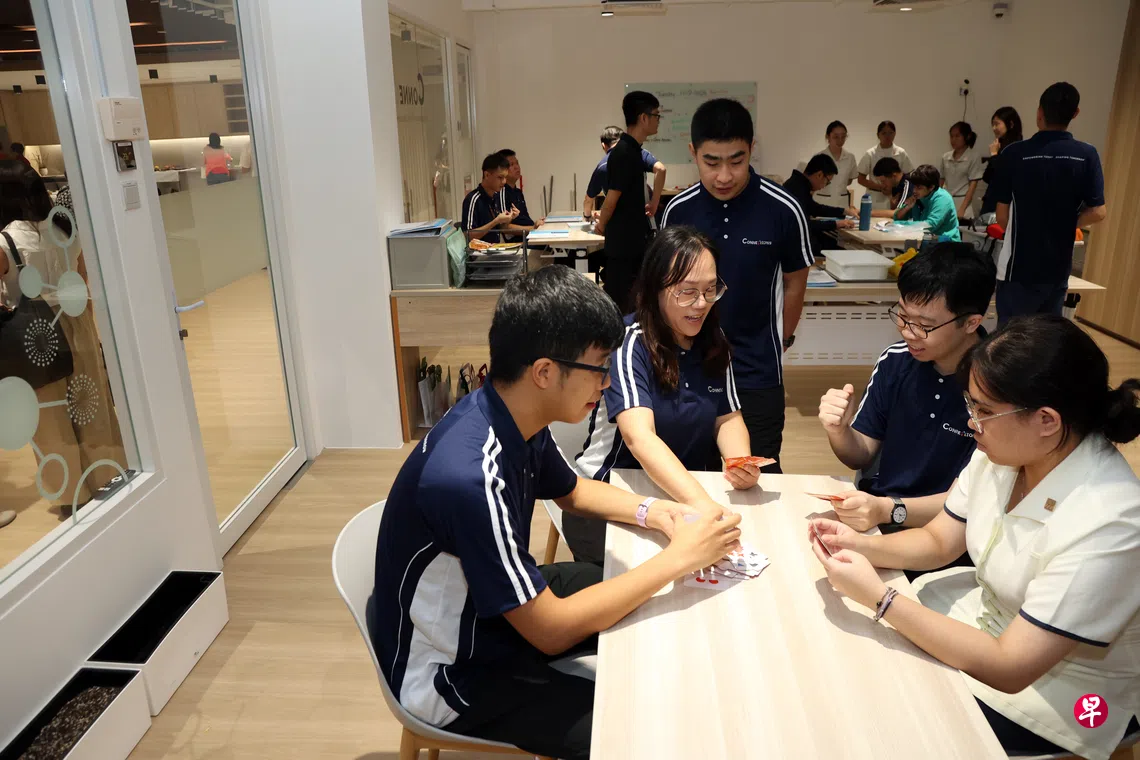
Last week, I had the opportunity to observe the programme at MWS Senior Care Centre – Eunos, run by Methodist Welfare Services. Three trainees had been on placement there for nearly three months. Wearing the same uniforms as the centre’s staff, they fitted naturally into the team. What moved me most was their warm interaction with the older people, bridging not only the age gap but also stereotypes about special needs. At work, they were not recipients of help, but caregivers whose contributions were needed.
The second cohort began training in September this year. Recruitment is under way for the third cohort, which is expected to start next February. PCS also plans to introduce a sports facility management course next year, further widening career options for people with special needs.
However, advancing training and employment for people with special needs also presents challenges. One is employers’ understanding. Some still hold misconceptions, failing to recognise that many people with special needs can do their jobs well if given suitable tasks and sufficient training. Colleagues, too, need to learn to be accepting and to communicate patiently with co-workers with special needs.
I once asked Esther Chong, head of PCS’ special needs services, who has worked in this field for many years, what she hoped to see from society. She said, “We must firmly believe that every person with special needs has potential, and deserves to have it recognised and nurtured.”
Expanding job opportunities is crucial to addressing the “post-18 cliff”. But making people with special needs visible in the workplace is an even more important step towards an inclusive society. When people encounter colleagues with special needs day after day in supermarkets, care centres, preschools and offices, prejudice will naturally fade through everyday interaction, and inclusion will become a daily reality rather than a slogan.
(The author is an associate professor in the Department of Japanese Studies at the National University of Singapore.)
