

In the 1980s and 1990s, some people in a neighbouring country would periodically raise the issue of water supplies. Whenever Singapore displeased them, they would threaten to turn off the taps.
Water supplies are a matter of survival for Singapore. Yet, faced with such provocations, Singapore chose neither to respond with threats of force nor to engage in pointless verbal sparring. Instead, we calmly defended our rights under the agreements signed by the two countries, while quietly but actively researching reverse osmosis technology.
And so we developed NEWater.
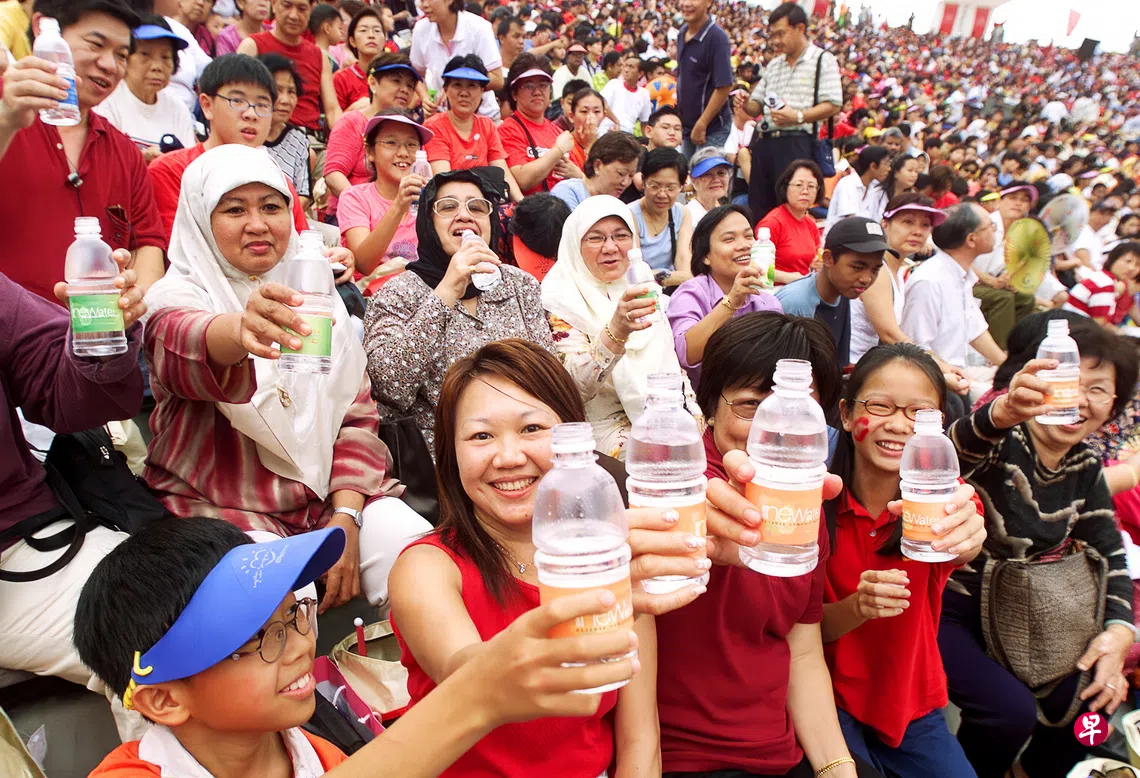
On 9 August 2002, at the National Day Parade celebrating Singapore's 37th birthday, the then Prime Minister Goh Chok Tong joined 60,000 Singaporeans in the National Stadium in raising bottles of NEWater for a toast, at the emcee's prompting. As we called out “Cheers!”, we toasted not only Singapore's birthday, but also our water independence.
Anyone who still thinks they can use water supplies to hold us hostage would now be wasting their breath.
Recently, as haze shrouded Singapore and there was talk of cutting natural gas supplies to our country, I could not help feeling a sense of déjà vu.
But just as it did when threats were made to cut off our water supplies, Singapore has responded calmly this time.
That is why I was somewhat puzzled to see some Singaporeans asking online why Singapore was seeking to hold companies involved in Indonesia's forest fires accountable. In their view, doing so would be difficult and unlikely to achieve much. Instead, it would antagonise our neighbour, prompting it to retaliate by cutting natural gas supplies.
Yet such a response plays right into the hands of those making the threats. They hope to use the reactions of Singaporeans themselves to put pressure on the government and influence policy.
Fortunately, when others try to hold us hostage, Singapore has, as always, first stood firm on its legal rights, then continued doing what needs to be done. Efforts to hold the companies accountable have not stopped, but rather advanced step by step.
What gives us this confidence?
In reality, ever since Singapore began importing piped natural gas (PNG) for power generation in 1992, we have understood that a complete shift from oil-fired to gas-fired power generation could not rely solely on PNG imports. That would leave our sources of supply too narrowly concentrated.
We all know the consequences of relying on too few sources for essential supplies. The same principle applies to water, natural gas, eggs and food.
So, even as we signed natural gas supply agreements with our neighbours, we actively explored importing liquefied natural gas (LNG). Singapore's LNG terminal began operations in 2013, further opening the door to gas purchases from around the world.
LNG imports have risen steadily since then. In 2015, PNG imports exceeded 7.13 million tonnes of oil equivalent, while LNG imports were below 2.32 million tonnes of oil equivalent. In other words, LNG accounted for less than a quarter of total natural gas imports. But in 2023, LNG imports surpassed PNG imports for the first time.
Looking ahead, can we achieve energy independence, just as we have achieved water independence?
First, we must be realistic: energy independence cannot mean complete self-sufficiency in the way that water independence does. That is impossible. What we can do, however, is diversify our sources as widely as possible so that we do not become overly dependent on any one supplier.
On Monday (26 October), Minister for Energy, Trade and Industry (Energy and Industry) Dr Tan See Leng announced a series of energy infrastructure plans at Singapore International Energy Week (SIEW). They cover six areas: the electricity grid, power generation, natural gas, solar deployment, energy storage and low-carbon electricity imports.
Because of the coincidental timing, some linked the announcement to the talk of gas supply cuts, seeing it as our response. But to do that would be to read too much into it. SIEW had been planned long beforehand, and the minister's keynote speech could not have been completely rewritten in just a few days.
These are Singapore's long-term plans for energy security. This is how we have always worked, rather than acting hastily in response to someone else's manoeuvre.
Still, coming after the news about gas supply cuts, the report on these energy plans drew considerable attention from readers.
Besides diversifying our energy sources, we can also develop renewable energy. Singapore has long been actively developing and deploying solar energy. Progress has been faster than expected, prompting the government to raise its solar deployment targets several times.
Solar panels have now been installed on the rooftops of many of our buildings. The government will next explore how technology can make it possible to install them on conserved historic buildings as well.
The government will also actively explore geothermal energy in the years ahead.
But there is another option we cannot avoid considering: nuclear power. At this stage, the government has not decided to adopt or deploy it. What it is doing is strengthening and building capabilities in nuclear science, safety and regulation, while actively developing talent in these fields.
Although public education on nuclear power has begun, public concerns remain and cannot be ignored. This work must therefore continue.
The energy crisis triggered by the outbreak of the US-Iran war has exposed the harsh reality of rising resource nationalism. When supply chain disruptions cause energy shortages, many countries prioritise their own domestic needs.
So, if you asked me to choose between being at someone else's mercy and accepting the known risks of nuclear power, my choice, as a layman on nuclear energy, would be clear: I would rather accept the risks.
(The author is a senior editorial adviser at Lianhe Zaobao.)
