

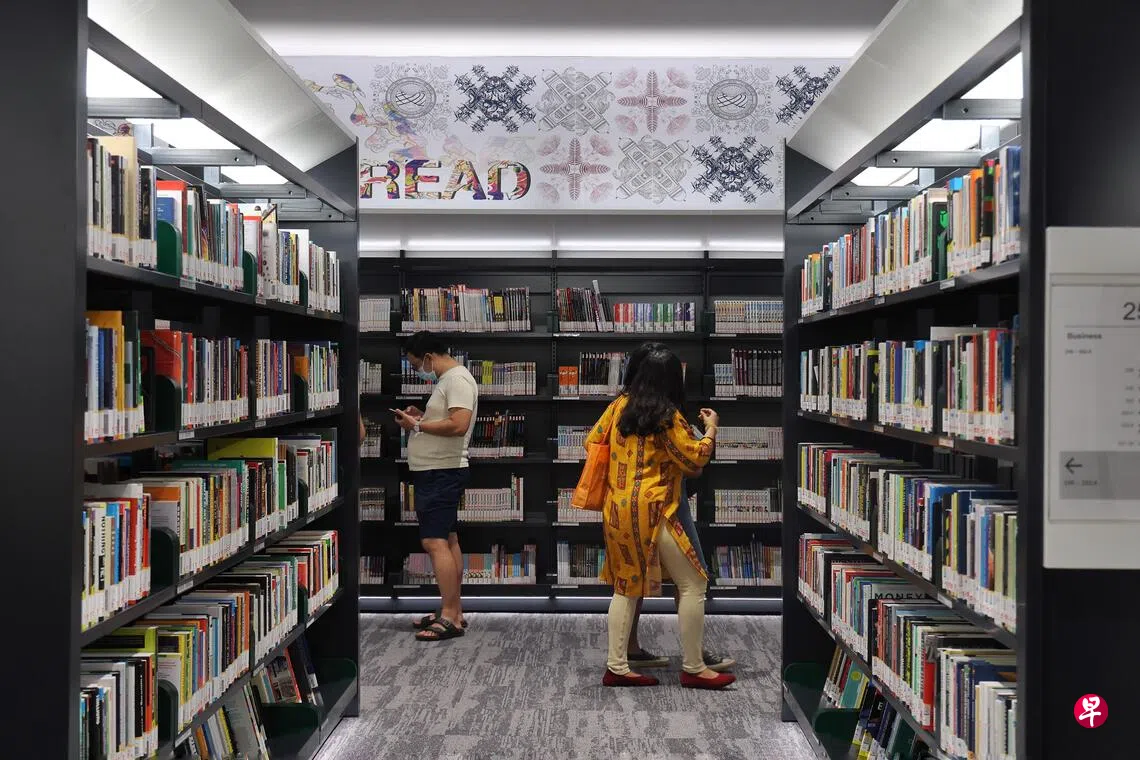
Some time ago, foreign media reported that the Singaporean government was offering cash rewards to encourage everyone to read.
Though the headlines sounded sensational, the National Library Board did, in fact, launch a five-year reading programme in September this year, using a system of redeemable tokens and points that could be exchanged for cash.
The hope is that Singaporeans will read every day and, over time, make reading books part of their daily habits and lives.
Singapore has relatively ample reserves and fiscal resources. Therefore, whenever the government wants to encourage Singaporeans to make an effort, in matters big or small — from buying a home and raising children to lifelong learning, exercise and healthy living — it offers subsidies and grants with various strings attached.
Singaporeans, too, have grown accustomed to the satisfaction of being rewarded financially for making positive choices.
Yet putting reading and cash handouts together inevitably raises an awkward concern: that money might taint reading, reducing it to just another material pursuit.
As a matter of fact, even before this, the SG Culture Pass credits issued by the Ministry of Culture, Community and Youth to all citizens could already be used to purchase literary works written by local authors.
Rather than channelling subsidies through authors, publishers, booksellers or bookshops, this approach uses them to directly influence the purchasing decisions and behaviour of readers at the very end of the publishing chain.
Nor have bookshops become a sunset industry. Young readers were a prominent presence at the Singapore Indie Bookshop Day, jointly organised by several booksellers last month.
This was followed this month by the Singapore Book Street, where more than 40 publishers showcased their publications and many visitors came as whole families.
Founding Prime Minister Lee Kuan Yew once said, “Poetry is a luxury we cannot afford”, illustrating how, in the nation-building years, the urgent task of securing livelihoods and putting food on the table necessarily took precedence over literature and the arts.
Today, however, Singapore ranks among the world’s three richest countries, according to the International Monetary Fund’s measure of per capita purchasing power.
In an increasingly fast-changing world that constantly tests our ability to distinguish right from wrong and truth from falsehood, reading helps to steady the mind and nurture reason.
And when reading ceases to be merely a utilitarian or functional task and becomes a valued tradition and everyday practice for everyone, we will also begin to recognise the distinctiveness and worth of Singapore’s literary works.
Before his death, archaeologist John N. Miksic, who had lived in Singapore for many years, translated the 17th-century Malay vernacular chronicle Hikayat Tanah Hitu into English. A carefully edited bilingual edition was published last month by the National University of Singapore Libraries.
The translation fills a longstanding gap in our understanding of the medieval history of the Nusantara archipelago we inhabit, for which we have had to rely on the Malay Annals and a handful of other incomplete records.
Local independent food culture historian Khir Johari spent 11 years conducting field research across Southeast Asia. Drawing on 1,400 years of cultural history, he wrote the monumental The Food of Singapore Malays: Gastronomic Travels Through the Archipelago.
Last year, the Gourmand World Cookbook Awards, the world’s most authoritative awards for food and wine books, bestowed on it the “Best of the Best” accolade — the only such top honour awarded in its 30-year history.
We are hardly short of good works that tell the stories of Singapore and Singaporeans well. The blind spot that exists is often that people know the price of books but not their value.
My hope is that, through writing and studying these works, readers and authors will continue to serve as custodians of our cultural heritage.
(The writer is a senior multimedia editor at Lianhe Zaobao.)
